
HISTORY · Legends & Folklore
The Dragon of Terca: The Legend Behind Buzău’s Eternal Flame
How a Multi-Headed Beast’s Final Breath Became a Fire That Has Never Gone Out
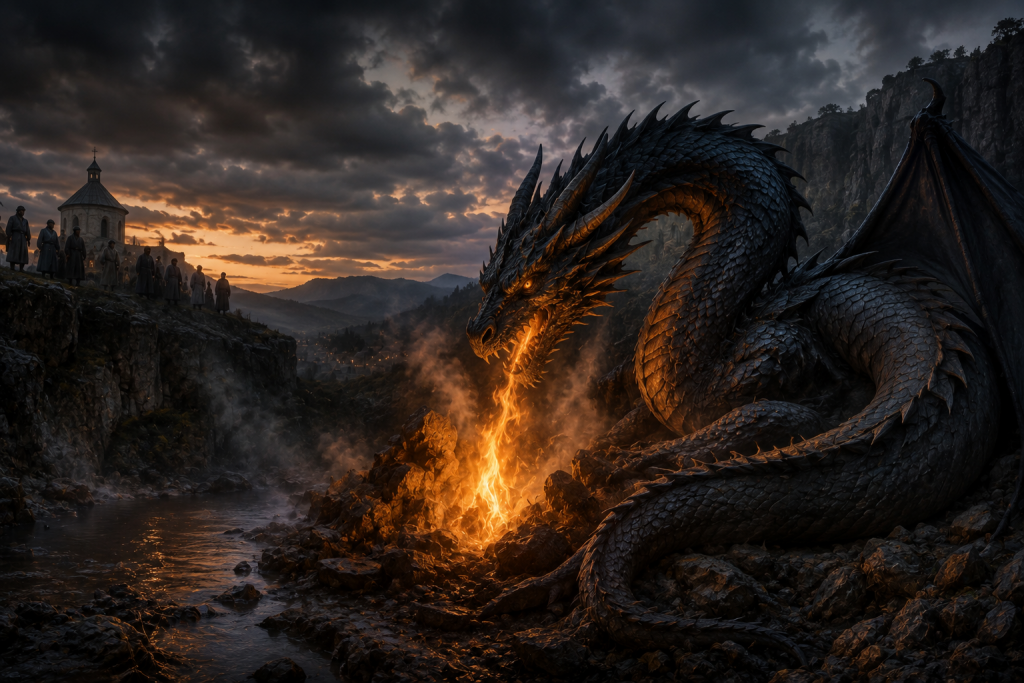
An artistic interpretation of the Dragon of Terca, inspired by the Romanian legend associated with the mysterious eternal flames of Buzău.
8 min read

“Cut off a dragon’s many heads, and by most story logic the danger should end there. In the village of Terca, local legend insists it did not — the heads fell scattered across the hillside, and from their scattered nostrils, the fire kept breathing long after the beast itself was dead.”
Among the many natural wonders that Wallachian and Romanian folklore has worked to explain across the centuries, few are quite so literal, or quite so genuinely still burning, as Focul Viu. This is the actual natural phenomenon still visible today in Lopătari commune, in the village of Terca, in Buzău county, where genuine flames rise continuously from cracks in the earth, fed by natural gas escaping from underground deposits. For generations, local tradition has explained this genuinely striking natural occurrence through the story of a fire-breathing, many-headed dragon and the mountain hero who finally brought it down.
A Real Fire, Burning in a Real Place
Unlike a great many folkloric traditions, where the underlying phenomenon being explained is itself supernatural or unverifiable, the Focul Viu of Terca describes something genuinely, physically real and still visible today. Small but persistent flames rise from the ground along a hillside near the Slănic river, close to its confluence with the Smoleanu stream, within what is now protected as a geological reserve covering a modest but carefully preserved plot of land. The flames, which local accounts describe as reaching anywhere from a few tens of centimetres up to occasionally a full metre in height, burn continuously regardless of season or weather, a genuinely rare phenomenon that has made the site a significant point of local pride and, in recent years, a growing draw for curious visitors willing to make the genuinely difficult final approach on foot.
The scientific explanation for the flames, well understood by modern geologists, involves natural gas deposits held underground gradually finding their way to the surface through cracks in the earth, where the escaping gas ignites, according to local and popular accounts, on contact with quartz crystals present in the surrounding rock. The site now forms part of the Buzău Land UNESCO Global Geopark, formally recognised in April 2022, a designation reflecting the area’s genuinely significant geological, ecological, and cultural value considerably beyond the flames themselves alone.
A phenomenon this visually striking, burning apparently without fuel and without end, hardly needed embellishment to capture local imagination — and yet local imagination supplied a considerably more dramatic explanation anyway.
The Dragon That Terrorised Terca
The most widely told version of the legend explaining the flames’ origin centres on a multi-headed dragon, a balaur in the Romanian folkloric tradition, who made life genuinely miserable for the people of Terca, breathing burning flames from its nostrils and generally wreaking havoc across the village and surrounding countryside. According to this tradition, no one in the village possessed the courage or the strength to confront the beast directly, until a figure remembered simply as Munteanul cel Viteaz, “the Brave Mountain Man,” finally stepped forward to face the threat the rest of the community had been unable to overcome.
The resulting battle, according to the legend as commonly told and repeated across local and regional accounts, stretched across two full days and two full nights of continuous combat, a duration itself carrying genuine symbolic weight within the broader tradition of Romanian folk heroism, where prolonged, exhausting struggle against overwhelming odds frequently marks the difference between an ordinary combatant and a genuine folk hero. Munteanul cel Viteaz eventually succeeded in severing the dragon’s many heads, which fell scattered across the surrounding hillside in different directions. It is from the scattered nostrils of these fallen heads, according to the legend, that flames still rise today, moving occasionally from one spot to another across the site precisely because the heads themselves were never gathered back together in a single place.
A dragon’s death, in most versions of this kind of story, draws a clean line under the danger it once represented. Here, the ending is considerably stranger and more enduring — defeat scattered the threat rather than extinguishing it, leaving behind not a single grave but an entire hillside still quietly, endlessly burning.
A Second Telling: The Guarded Well and the Falling Treasure
A somewhat different version of the legend, recorded and published by the writer Dumitru Șerbescu, who collected a number of local stories from the Vrancea and Buzău mountain region, offers a related but distinct account. In this telling, the village once possessed a well of famously cold, delicious water, said to cure any illness in whoever drank from it, but the well was guarded by a dragon so formidable that no one dared approach. Munteanul cel Viteaz, through his own considerable bravery, eventually managed to force the dragon back nearly two hundred metres up the mountainside, where he finally struck it down with a single decisive blow. As the dragon died, flames burst forth from its nostrils reaching toward the sky, the surrounding trees caught alight, and the sky itself is said to have darkened with smoke, an origin point from which, according to this version, flames have continued appearing ever since, shifting periodically from one of the dragon’s many nostril-openings to another across the landscape.
A further, related strand of local storytelling frames the site in more explicitly supernatural or religious terms entirely, describing the flames as a kind of permanent opening onto the underworld itself, associated in some retellings with a wealthy local figure named Giurgiu Mocanu, whose shepherds are said to have fought off attacking thieves during a struggle that tore open a chasm leading directly down to hell, swallowing Giurgiu’s own considerable treasures in the process. Though the chasm itself is said to have eventually closed, the flames rising from the earth, in this version of the tradition, could never be fully extinguished afterwards.
Three separate tellings, a slain dragon, a guarded healing well, and a chasm torn open toward hell itself, all converging on the same underlying explanatory task: making sense of a fire that, by any ordinary understanding of how fire works, simply should not still be burning.
Fire as Warning, Fire as Protector
Beyond its specific dragon-slaying origin story, the Focul Viu of Terca carries genuine additional symbolic weight within local tradition, understood by some as carrying a protective religious significance connected to the wellbeing of livestock and animals. This role would situate it within the same broader pattern of practical, livestock-focused folk belief found across Wallachian and Romanian tradition more generally. At the same time, the flames carry a rather less comforting secondary meaning within local belief: unusually tall flames are said by some local accounts to signal the approach of an earthquake, transforming what is otherwise regarded as a source of local pride and natural spectacle into, at moments, a source of genuine unease and careful watching.
This dual symbolic character, simultaneously protective and ominous, reflects a pattern common across a great deal of Wallachian and Romanian folk tradition: natural phenomena rarely receive a single, tidy symbolic interpretation within these traditions, instead accumulating multiple, sometimes contradictory layers of meaning as successive generations continue retelling and reinterpreting the same underlying, genuinely striking natural occurrence.
A Site Still Growing, Still Being Discovered
Interestingly, the Focul Viu tradition at Terca has not remained a purely historical or static site. Local accounts describe the more recent discovery of a second, similar flame point closer to the main road, and further natural gas seepage sites have, according to local reporting, continued to be identified and in some cases actively encouraged to ignite by local residents, gas that had previously simply dispersed harmlessly into the atmosphere rather than catching alight on its own. This ongoing, still-developing relationship between the local community and the underlying natural phenomenon suggests that Focul Viu remains, even now, a genuinely living tradition rather than a fixed historical curiosity, with new chapters still quietly being added to a story that has already, by local reckoning, been burning for as long as anyone can remember.
A dragon slain long enough ago to have passed entirely into legend, and a natural gas seep still active enough to be discovered afresh within living memory — Focul Viu manages, remarkably, to be both an ancient story and an ongoing one at the very same time.
A Landscape That Still Remembers the Fight
Considered as a whole, the Focul Viu of Terca offers a genuinely striking example of a folkloric process central to Wallachian and Romanian storytelling tradition more broadly: a real, physically observable natural phenomenon, striking and genuinely difficult to explain through ordinary pre-scientific understanding, given coherent narrative shape through a story of heroism, danger, and ultimate, if strangely incomplete, victory. Whether told through the dragon of Terca, the guarded healing well, or the chasm opening onto hell itself, each version of the legend performs the same essential cultural work: turning an unsettling, inexplicable fire into a story a community could tell its children, explaining not only how the flames came to be, but why, against every ordinary expectation, they have never actually gone out.
Key Facts and Attested Details
- Location: Lopătari commune, Terca village, Buzău county, Romania, along the Slănic river near its confluence with the Smoleanu stream.
- Nature of the phenomenon: A geological reserve covering roughly 0.03 hectares, where natural gas escaping through surface cracks ignites and burns continuously.
- Primary legend: A multi-headed, fire-breathing dragon terrorising the village of Terca is defeated after a two-day, two-night battle by a hero known as Munteanul cel Viteaz; the flames are said to rise from the dragon’s scattered, severed heads.
- Alternative legend: Recorded by writer Dumitru Șerbescu, describing a guarded healing well and a dragon driven up the mountainside before being killed, with flames bursting from its dying breath.
- Further tradition: A separate strand of local storytelling connects the flames to a chasm opening onto the underworld, associated with a local figure named Giurgiu Mocanu.
- Local symbolism: The flames are regarded by some as protective of livestock, while unusually tall flames are locally associated with the approach of an earthquake.
- Modern recognition: The site now forms part of the Buzău Land UNESCO Global Geopark, formally recognised in April 2022.
author's note
This legend is not simply background research for me; it is the very first piece of Wallachian folklore my character Sebastian encounters in Related to Dracula: At Tudor Court, and it is a legend I have known since I was a child myself, long before I ever thought to write it into a novel. On the day his great-grandmother Ana first tells him the truth of his heritage, a bewildered, grieving Sebastian wanders without thinking until he reaches Focul Viu, the real, still-burning flames near his own village.
sources and further reading
- Consiliul Județean Buzău, “Focul Viu” — official county council page describing the site, its geology, and the local legend: cjbuzau.ro/focul-viu/
- Visit Buzău, “Focul Viu” — regional tourism board account of the legend and site details: visitbuzau.ro
- AGERPRES, “Buzău: Focul viu înconjurat de gheață și zăpadă în zona Lopătari” — national news agency coverage including legend summary and scientific explanation.
- Mistere România, “Focul Viu de la Buzău, simbolistică și legendă” — includes the alternative guarded-well version of the legend and local symbolic beliefs regarding livestock protection and earthquake warning.
- Secretele lui Lovendal, “Focul viu de la Lopătari (Buzău)” — includes the Dumitru Șerbescu-recorded version involving Giurgiu Mocanu and the chasm to the underworld.
- Terra Voyage, “Focul Viu” — practical and descriptive account of the site’s geography and recent discovery of additional flame points.
A note on sources: this legend is documented primarily through regional tourism boards, local news reporting, and popular folklore collections rather than formal academic ethnographic scholarship, and different local sources record genuinely different, sometimes contradictory versions of the story. This article has presented the most consistently repeated version alongside its most significant documented variants, rather than treating any single telling as more authoritative than the others.
related articles
- Ielele: The Beautiful Spirits Romanians Dared Not Name
- Strigoi: The Restless Dead Who Haunted Wallachia Long Before Dracula
- Wallachian Legends & Folklore: When History Becomes Myth
- The Real Castles of Vlad the Impaler
- Vlad the Impaler: The Man Behind the Dracula Legend
- Wallachia: The Kingdom Between Two Empires
continue your journey through history
Discover the novels inspired by the people, rivalries and legends of medieval Europe.

Historical Fiction Author
History has always fascinated me—not simply for the great battles or famous rulers, but for the people behind the legends. Through years of research into medieval Europe, the Ottoman Empire, Tudor England, and the lives of extraordinary historical figures, I’ve sought to uncover the stories that lie beneath popular myths. My novels blend documented history with compelling fiction, inviting readers to step into the past and experience it as those who lived it might have done.
Join the Related to Dracula Circle