
HISTORY · MEDIEVAL WARFARE
Knights, Ransom, and the Business of Medieval War
Why Capturing a Nobleman Alive Was Worth Considerably More Than Killing Him
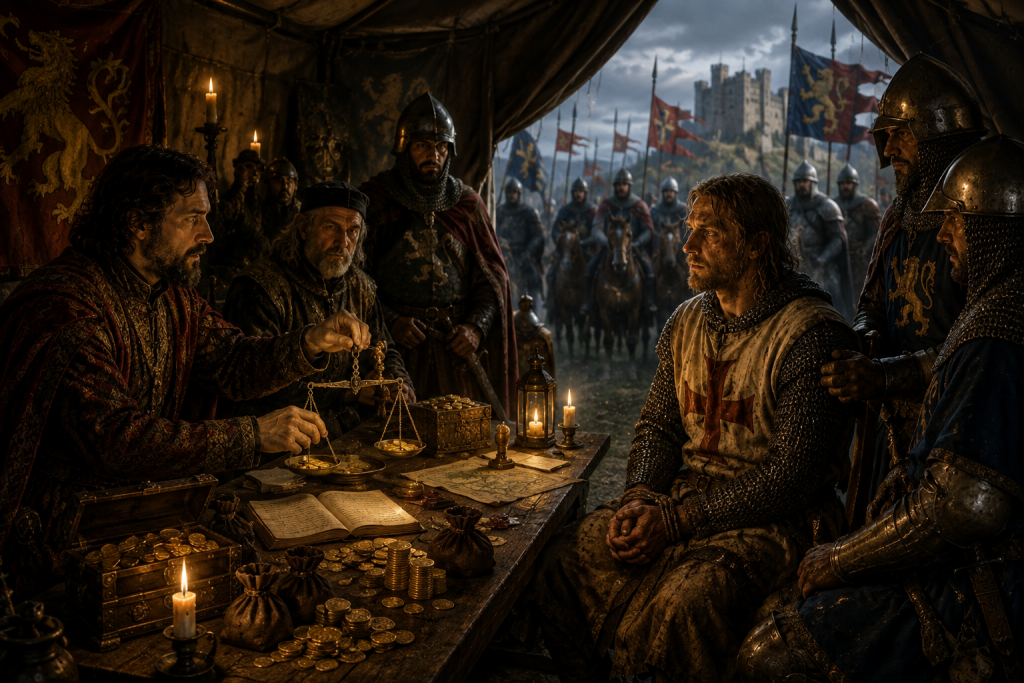
An artistic interpretation of the negotiations, payments, and exchanges that made ransom an important part of medieval warfare.
9 min read

“A dead knight was a battlefield statistic. A living one, properly identified and properly held, was a small fortune waiting to be collected.”
Medieval warfare is remembered in the popular imagination as a business of killing. For the knightly class specifically, across much of the medieval period, it was frequently something closer to the opposite: a business in which killing a fellow nobleman represented a genuine missed opportunity, and taking him alive, cataloguing his armour, his lineage, and his family’s likely capacity to pay, represented the far more sensible course of action. Ransom, rather than slaughter, sat at the very centre of how the knightly class actually understood and conducted war against social equals, and understanding this economic logic explains a great deal about medieval battlefield behaviour that would otherwise look, to modern eyes, genuinely strange.
A Chivalric Convention With a Very Practical Foundation
The medieval practice of ransoming captured knights and noblemen rested on a convention widely, if unevenly, observed across Western Europe: a combatant of sufficiently high social rank, once clearly beaten and willing to yield, could reasonably expect to be taken prisoner rather than killed outright, held under conditions befitting his status, and eventually released upon payment of a sum negotiated according to his wealth, his family’s standing, and his usefulness as a diplomatic or political asset. This convention is frequently described, in popular retelling, as a product of chivalric idealism, knightly mercy extended to a fellow member of the same elite military caste. The genuine historical picture is rather more transactional. Chivalric literature certainly celebrated mercy toward a defeated equal as a virtue, but the practice persisted and spread primarily because it made overwhelming financial sense to nearly everyone involved.
A captured knight represented, to his captor, a directly convertible financial asset, potentially worth several years of ordinary income from a single successful battlefield encounter. To the captured knight’s own family, paying a ransom, however painful, remained considerably preferable to permanently losing a son, a husband, or an heir. And to the wider political order governing medieval Western Europe, a system in which the aristocracy did not routinely exterminate itself in battle helped preserve exactly the kind of dynastic continuity and diplomatic flexibility that this same aristocracy depended upon for its own long-term survival.
Mercy that happens to be extremely profitable is not necessarily insincere — but it is worth noticing how consistently medieval battlefield mercy flowed toward exactly the individuals who could actually pay for it.
What a Ransom Actually Cost
The sums involved could be genuinely staggering, particularly at the very top of medieval society. King John II of France, captured by English forces at the Battle of Poitiers in 1356, was eventually ransomed for three million gold écus, a sum historians have estimated at roughly twice France’s entire annual royal revenue at the time. It was so enormous that it took years to negotiate and was never, in fact, fully paid before John’s death in 1364, having voluntarily returned to English captivity after his son and designated hostage escaped custody in his place. David II of Scotland, captured at the Battle of Neville’s Cross in 1346, was held for eleven years before a ransom of 100,000 marks was finally agreed, a sum so large it required instalment payments stretched across a full decade and placed genuine strain on Scotland’s royal finances for a generation afterwards.
Further down the social scale, ransoms scaled roughly, if imperfectly, with rank and evident wealth. A minor knight might be ransomed for a sum equivalent to a year or two of ordinary income; a great magnate or a prince of royal blood might represent a sum capable of reshaping an entire kingdom’s finances for a decade. This scaling created a powerful financial incentive for common soldiers and lesser knights alike to identify, during the chaos of battle, exactly which enemy combatants were worth the trouble of capturing alive; heraldic devices, quality of armour, and the specific banners a man fought beneath all served as practical, readable signals of a captive’s likely market value.
The System of Thirds
English military practice during the Hundred Years’ War developed a particularly well-documented formal structure for managing the considerable wealth that flowed through successful ransom-taking, generally known as the system of thirds. Under this arrangement, a soldier who personally captured a valuable prisoner did not simply keep the entire resulting ransom for himself. Instead, he customarily owed a third of the proceeds to the captain of the retinue under whom he served, who in turn owed a further third of his own accumulated take to whichever higher-ranking noble commanded that captain’s retinue, who might himself owe a further share upward to the Crown.
This cascading structure meant that a single valuable capture on a medieval battlefield could, in practice, enrich an entire chain of command simultaneously, from the individual man-at-arms who made the actual capture through to the king himself. It gave senior commanders genuine, direct financial incentive to encourage exactly the kind of disciplined, capture-oriented battlefield conduct that maximised ransom revenue rather than indiscriminate slaughter. Indenture contracts, the formal agreements under which English soldiers were increasingly recruited and organised across the fourteenth and fifteenth centuries, frequently specified these ransom-sharing arrangements in explicit written detail, transforming what might otherwise have sounded like a matter of battlefield custom into a genuine, binding contractual obligation.
A soldier fighting under a properly structured indenture contract was not simply hoping for plunder. He was operating under something closer to a formal profit-sharing arrangement, with clearly defined obligations that ran all the way up his own chain of command.
The Knights Who Made a Career of It
For a certain class of skilled, sufficiently well-connected medieval soldier, ransom-taking developed into something considerably more than occasional battlefield fortune; it became a sustained career strategy. Bertrand du Guesclin, the celebrated French military commander of the fourteenth century, was himself captured and ransomed on more than one occasion across his own long career, sums eventually paid, in at least one notable instance, directly by the French Crown itself, recognising his value as a military asset worth recovering regardless of cost. English commanders including Sir John Chandos and Sir Robert Knolles built substantial personal fortunes across the Hundred Years’ War substantially through ransom income, wealth that in several documented cases considerably exceeded what these men might otherwise have accumulated through inherited land or royal favour alone.
This career dimension helps explain a pattern that otherwise looks puzzling: extended periods of nominal truce during the Hundred Years’ War frequently saw considerable continued violence anyway, conducted by so-called free companies, bands of soldiers left unemployed by the temporary absence of official war who nonetheless continued raiding and ransom-taking largely on their own account. For men who had built their entire livelihood around capturing and ransoming opponents, a formal peace treaty represented, from a certain uncomfortable angle, a direct threat to their own income, and many simply declined to observe it particularly closely.
Where the Convention Broke Down
The ransom economy, for all its careful financial logic, was never applied evenly, and its limits reveal a great deal about medieval society’s underlying hierarchies. Common soldiers and ordinary archers, captured in the same battles that saw noblemen carefully preserved for ransom, possessed no comparable financial value and were, as a direct consequence, considerably more likely to be killed outright rather than held prisoner, a stark, largely unspoken class division running directly through medieval battlefield violence. The convention of ransom protected wealth and rank considerably more reliably than it protected human life in any more general sense.
Even among the nobility, the convention could be suspended entirely when a commander judged the tactical risk of maintaining prisoners too severe to accept. The most famous documented instance occurred at the Battle of Agincourt in 1415, when Henry V, fearing that his own substantial body of French prisoners might rearm themselves and attack his rear during a renewed French assault, ordered a significant portion of them killed outright. Contemporary chroniclers, drawn overwhelmingly from the same noble class as the men being killed, recorded the episode with unease, precisely because it was noblemen and gentlemen being killed in this manner rather than the low-born soldiers, battlefield convention generally expected to die in far greater numbers. Tellingly, though, most contemporary accounts stopped short of laying the blame directly on Henry himself, placing responsibility instead on the alarming French rearguard movement that had prompted his order. The episode is remembered today as a striking departure from ordinary practice precisely because the convention it broke was so widely assumed to hold among men of equivalent rank.
A rule this widely observed reveals itself most clearly in the rare moments it gets broken. Agincourt’s mass killing of prisoners was recorded with unease specifically because ransoming captured noblemen had become close to an assumed baseline of civilised medieval warfare — even if contemporaries were more inclined to blame the circumstances than the king who gave the order.
An Economy That Shaped How Battles Were Actually Fought
The financial logic underlying ransom-taking did more than determine what happened after a battle ended; it shaped how battles were fought even as they were underway. Knights and men-at-arms facing an opposing force of equivalent social rank had direct personal incentive to disable and capture rather than kill outright wherever the immediate tactical situation reasonably allowed it, since a dead opponent yielded nothing. In contrast, a captured one yielded a potentially substantial payday. This incentive helps account for the comparatively high survival rates documented among captured nobility relative to common soldiers across numerous medieval engagements, and for the specific tactical preference, visible in period accounts, for disarming and restraining a wealthy opponent rather than simply cutting him down where he stood.
The ransom economy also shaped the broader strategic character of medieval warfare in ways that extended well beyond any single battlefield. Commanders weighing whether to risk open engagement had to consider not only the military consequences of defeat but the very real personal financial catastrophe that capture might represent. A nobleman’s own capture could burden his family and estate with debt for a generation, providing yet another rational reason, alongside the tactical caution already common among medieval commanders, to avoid unnecessary battlefield risk wherever a safer alternative presented itself.
Timeline: The Medieval Ransom Economy
- 12th century onward — The convention of ransoming captured knights and noblemen, rather than killing them, becomes increasingly well established across Western European warfare.
- 1346 — David II of Scotland is captured at the Battle of Neville’s Cross, beginning eleven years of captivity before a ransom of 100,000 marks is finally agreed.
- 1356 — King John II of France is captured at the Battle of Poitiers, resulting in one of the largest ransom negotiations of the medieval period.
- 14th century — English indenture contracts increasingly formalise the system of thirds, governing how ransom proceeds are shared up a chain of command.
- 1360 — The Treaty of Brétigny concludes major terms surrounding John II’s ransom and temporarily ends the first phase of the Hundred Years’ War.
- 1364 — King John II dies in England, having voluntarily returned to captivity after his son and hostage escaped in his place.
- Mid-to-late 14th century — Commanders including Bertrand du Guesclin, Sir John Chandos, and Sir Robert Knolles build substantial personal fortunes substantially through ransom income.
- 1415 — Henry V orders the killing of French prisoners at the Battle of Agincourt, a controversial departure from the ordinary ransom convention.
- 15th century onward — The ransom economy gradually declines in prominence alongside broader changes in military organisation, recruitment, and the changing composition of European armies.
author's note
Researching the ransom economy properly changed how I think about medieval battlefield violence considerably more than I expected. It is tempting, writing about any medieval battle, to imagine the fighting itself as the whole story. So much of what actually happened — who lived, who died, who profited, and who was quietly bankrupted for a decade afterwards — was decided by a financial logic operating alongside the fighting rather than separate from it. Knowing this changes how I read the aftermath of any medieval engagement now: not simply victory or defeat, but a considerably messier, more human accounting of who was worth keeping alive, and to whom.
sources and further reading
- Ambühl, Rémy. Prisoners of War in the Hundred Years War: Ransom Culture in the Late Middle Ages. Cambridge University Press, 2013 — the standard modern scholarly study of medieval ransom practice.
- Bell, Adrian R., Anne Curry, Andy King, and David Simpkin. The Soldier in Later Medieval England. Oxford University Press, 2013 — includes detailed treatment of indenture contracts and the system of thirds.
- Green, David. The Hundred Years War: A People’s History. Yale University Press, 2014.
- Curry, Anne. Agincourt: A New History. Tempus, 2005 — includes detailed discussion of the killing of French prisoners and its contemporary reception.
- Barber, Richard, and Juliet Barker. Tournaments: Jousts, Chivalry and Pageants in the Middle Ages. Boydell Press, 1989 — useful context on the broader chivalric culture surrounding knightly capture and ransom.
A note on sources: much of what survives regarding individual ransom sums comes down to us through royal financial records, chronicles, and surviving indenture contracts, meaning high-profile royal and noble ransoms are considerably better documented than the far more numerous, smaller transactions involving lesser knights and men-at-arms. This article has focused on the best-documented cases while noting that the broader pattern they illustrate operated, on a smaller financial scale, throughout the medieval military class as a whole.
related articles
continue your journey through history
Discover the novels inspired by the people, rivalries and legends of medieval Europe.

Historical Fiction Author
History has always fascinated me—not simply for the great battles or famous rulers, but for the people behind the legends. Through years of research into medieval Europe, the Ottoman Empire, Tudor England, and the lives of extraordinary historical figures, I’ve sought to uncover the stories that lie beneath popular myths. My novels blend documented history with compelling fiction, inviting readers to step into the past and experience it as those who lived it might have done.
Join the Related to Dracula Circle