
HISTORY · Legends & Folklore
Strigoi: The Restless Dead Who Haunted Wallachia Long Before Dracula
The Genuine Folk Tradition Behind Europe’s Most Famous Vampire Legend
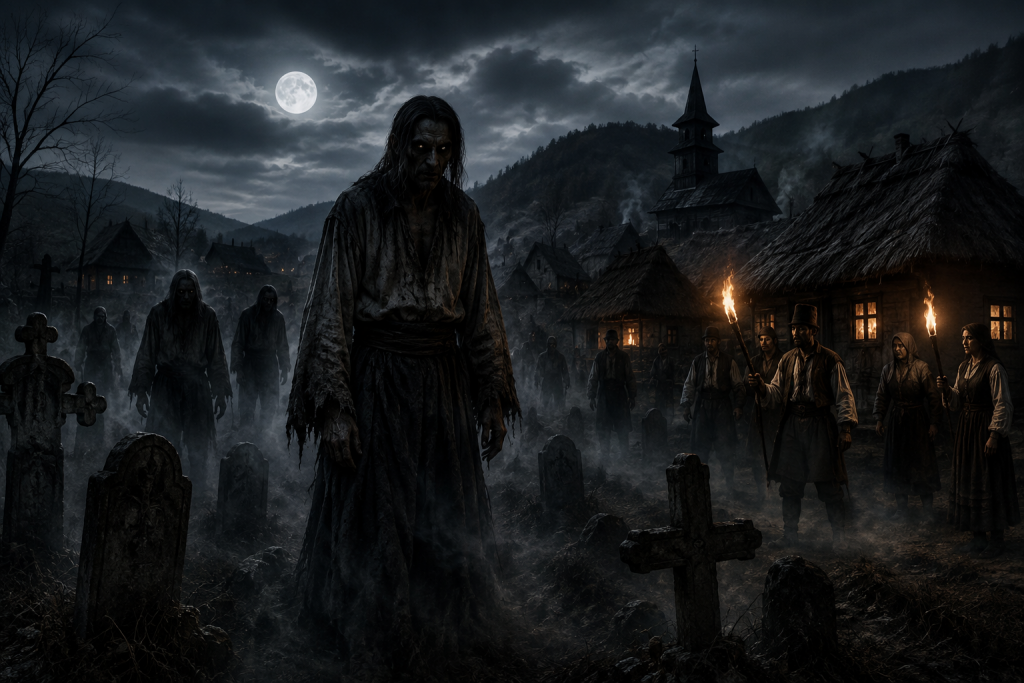
An artistic interpretation of the Strigoi, the restless dead of Romanian folklore believed to wander the night long before the legend of Dracula emerged.
9 min read

“Long before any novelist ever dressed a vampire in evening wear and gave him a castle, Wallachian villagers were already burying their dead with garlic, with iron, and with a genuinely careful eye toward exactly which corpses might not be willing to stay buried.”
The strigoi belong to a considerably broader tapestry of Wallachian and Romanian supernatural belief. The tradition deserves, on its own genuine historical and cultural merits, considerably fuller dedicated treatment, both because it represents one of the most sophisticated and internally coherent supernatural belief systems in the region, and because it stands among the most direct and historically significant regional folkloric antecedents to the entirely separate, considerably later Western vampire mythology that would eventually, largely by historical accident, become associated with Vlad the Impaler’s own borrowed name. Understanding the strigoi tradition on its own terms, considered as the genuine, practically functioning belief system it actually was for the ordinary Wallachian and broader Romanian communities who maintained it, reveals something considerably more sophisticated than a simple folkloric ancestor to a later, more famous literary creation.
Two Kinds of Strigoi
The strigoi tradition’s genuine internal sophistication becomes immediately apparent through its own careful, deliberate distinction between two quite different categories of supernatural threat. The strigoi vii, or living strigoi, referred to individuals believed to possess certain malevolent supernatural capabilities during their own actual lifetime, frequently associated with specific physical or circumstantial markers that regional folk tradition held to indicate a genuine, inherent supernatural danger, including, depending on the specific local variant of the broader tradition, being born with a caul, possessing red hair, or being the seventh child of the same sex within a single family.
The strigoi morți, or dead strigoi, referred instead to the considerably more familiar tradition of the restless dead, deceased individuals believed capable of returning from the grave to trouble the living, typically as a consequence of specific circumstances surrounding their own death or burial rather than any inherent characteristic present during their lifetime. This second category proved, by most surviving folkloric evidence, considerably more central to the tradition’s genuine practical significance within Wallachian and Romanian communities, given its own direct, immediate connection to the specific, universal human experience of death and burial that every community, regardless of its own particular circumstances, needed some coherent framework for managing.
The tradition’s careful distinction between living and dead strigoi reflects a genuinely sophisticated underlying logic: some supernatural danger, in this particular belief system, was understood to be present from birth, while other danger was understood to emerge only through specific failures or irregularities in how a community handled its own dead.
What Made a Corpse Become a Strigoi
Regional folk tradition identified several specific circumstances believed capable of transforming an ordinary deceased individual into a genuine strigoi morți, and examining these specific believed causes reveals a great deal about the underlying anxieties and practical concerns these communities were genuinely working to address through the broader tradition. Improper or incomplete burial ritual stood among the most significant identified causes, reflecting the genuine, practical importance Orthodox Christian communities of the period placed on proper religious burial procedure, with any significant deviation from expected ritual practice believed capable of leaving the deceased in a genuinely dangerous, unresolved spiritual state.
Death occurring under particularly violent, sudden, or otherwise irregular circumstances similarly featured prominently among identified causes, along with, in certain regional variants of the broader tradition, death occurring before proper baptism, excommunication or other significant unresolved conflict with the Orthodox Church during the individual’s lifetime, or the deceased having died with significant unresolved personal grievance or unfinished business believed capable of preventing their own spirit from achieving proper rest. This pattern of identified causes reveals a coherent underlying logic: strigoi manifestation, within this belief system, resulted overwhelmingly from disruption or irregularity, whether in the specific circumstances of death itself or in the community’s own subsequent handling of proper burial ritual, rather than from any more arbitrary or unpredictable supernatural cause.
A community anxious about maintaining proper burial ritual, and about resolving conflict and grievance before death rather than after it, had genuinely practical, this-worldly reasons for maintaining these specific beliefs, considerably beyond any purely supernatural concern alone.
Protective Practice: Garlic, Iron, and Careful Burial
The strigoi tradition’s genuine practical significance for the communities who maintained it becomes considerably clearer through examining the specific, concrete protective practices these communities employed, practices worth briefly noting here, and which deserve fuller documentation given their own genuine historical significance as the direct ancestor of protective measures later Western vampire fiction would eventually popularise on a considerably wider international scale. Garlic featured prominently within this protective tradition, employed both during burial itself and as an ongoing protective measure within households believed to face potential strigoi threat, a practice whose later, considerably more famous appearance within Western vampire fiction traces directly back to precisely this genuine regional folk tradition rather than to any later literary invention.
Iron similarly featured prominently within protective practice, believed to possess apotropaic, or evil-averting, properties against strigoi and related supernatural threats, employed through various specific practices including the placement of iron objects within or near graves believed to pose potential risk. In cases of suspected active strigoi manifestation, considerably more drastic ritual intervention became necessary, including, in the most serious documented cases, the exhumation of a suspected strigoi’s remains and the application of specific ritual practices, including, in certain documented instances, the driving of a stake through the corpse, intended to definitively neutralise the supernatural threat believed to be troubling a given community.
Every one of the now internationally famous vampire-repelling measures, garlic, the driving stake, careful attention to proper burial, originated not as literary invention but as genuine, practically employed protective folk custom, developed by real communities working to address what they experienced as a genuine, immediate threat to their own safety and wellbeing.
A Belief System That Persisted Remarkably Long
What deserves particular historical emphasis regarding the strigoi tradition is the sheer, genuine duration of its practical, believed significance within Romanian rural communities, extending considerably beyond the specific fourteenth- to sixteenth-century period as history records. Documented instances of communities undertaking genuine, practical protective or corrective action against suspected strigoi activity, including exhumation and related ritual practice, continued occurring within certain Romanian rural communities well into the nineteenth and even early twentieth centuries, a striking testament to just how deeply embedded and practically functional this folk tradition remained for considerably longer than many observers might reasonably assume for what popular modern perception frequently treats as purely medieval or early modern superstition.
This remarkable persistence reflects, in historical terms, considerably more than mere superstitious stubbornness alone; it reflects the tradition’s continued, practical utility for rural communities navigating exactly the kind of otherwise inexplicable illness, misfortune, and mortality that considerably more limited pre-modern medical understanding left largely unexplained through any alternative, more conventionally scientific framework.
From Regional Folk Belief to Global Literary Phenomenon
The strigoi tradition’s eventual, largely indirect connection to the internationally famous Western vampire mythology as history records deserves careful, precise restatement here, given how frequently popular discussion conflates the two traditions considerably more directly than genuine historical evidence actually supports. Bram Stoker’s 1897 novel drew on broader Eastern European vampire folklore considerably more generally than on the specifically Romanian strigoi tradition alone, with Stoker’sresearch materials reflecting a somewhat generalised, composite understanding of regional Eastern European supernatural belief rather than any precise, specifically sourced engagement with the particular Wallachian and Romanian strigoi tradition.
Nonetheless, the broader genuine historical and folkloric relationship remains real and significant: the specific protective practices, including garlic and the driving stake, that Stoker’s novel and the resulting century of subsequent vampire fiction popularised on a global scale, trace their own ultimate origin directly to authentic regional folk practices of precisely the kind this article has documented, even if the specific literary channel through which these practices reached Stoker’s own novel involved more generalised regional folklore compilation than any direct, precise strigoi-specific source material alone.
The strigoi tradition did not simply inspire a single famous novel directly. It contributed, alongside broader regional Eastern European folklore, genuine practical and symbolic material that a considerably later literary tradition would eventually absorb, generalise, and ultimately transform into something the original Wallachian villagers who first developed these protective practices would likely find genuinely unrecognisable.
A Tradition That Deserves Its Own Recognition
Considered on its own genuine historical and cultural terms, separate from its later, largely coincidental association with internationally famous vampire fiction, the strigoi tradition represents a sophisticated, internally coherent folk belief system through which real Wallachian and Romanian communities across many centuries made practical, actionable sense of death, misfortune, and the uncertainty surrounding proper burial ritual within a period offering considerably fewer alternative explanatory frameworks than later centuries would eventually provide. The tradition deserves recognition as a genuine, historically significant cultural achievement in its own right, considerably more than merely a folkloric footnote to a later literary phenomenon that ultimately drew on it only indirectly and, in historical terms, only partially.
Timeline: The Strigoi Tradition
- Pre-Christian era — The deeper cultural roots underlying the later strigoi tradition draw on considerably older regional supernatural belief.
- 14th–16th centuries — The strigoi tradition, in the form this article has documented, becomes well established within Wallachian and broader Romanian oral folklore and practical burial custom.
- Ongoing across the medieval and early modern periods — Communities maintain specific protective practices, including garlic, iron, and careful burial ritual, against suspected strigoi threat.
- 19th–early 20th centuries — Documented instances of exhumation and related ritual practice against suspected strigoi activity continue occurring within certain Romanian rural communities.
- Late 19th century — Western researchers and folklorists, including sources drawn upon by Bram Stoker, begin compiling broader Eastern European vampire folklore for Western audiences.
- 1897 — Stoker’s Dracula draws on this broader, generalised regional folklore tradition, popularising protective practices with genuine roots in traditions including the strigoi.
- 20th–21st centuries — Scholars increasingly work to document and distinguish the genuine historical strigoi tradition from its later, considerably more generalised Western literary vampire descendant.
author's note
The strigoi tradition sits close to the heart of Related to Dracula, closer than I can say without spoiling the novels themselves, and it is a piece of folklore I have known since childhood, long before I understood its own genuine historical depth. Knowing the real distinction between strigoi vii and strigoi morți, the real protective customs long predating any vampire novel, is something I absorbed over a lifetime of reading and listening, and it shaped how I wanted the supernatural elements of Sebastian’s own story to feel: rooted in something a real Wallachian village might actually have believed, rather than borrowed wholesale from later Western vampire fiction. Readers of the novels will recognise, I hope, how much of this genuine folklore is quietly woven through Sebastian’s own inherited world.
sources and further reading
- Senn, Harry A. Were-Wolf and Vampire in Romania. East European Monographs, 1982 — the standard dedicated scholarly study of the strigoi tradition.
- Kligman, Gail. The Wedding of the Dead: Ritual, Poetics, and Popular Culture in Transylvania. University of California Press, 1988.
- Barber, Paul. Vampires, Burial, and Death: Folklore and Reality. Yale University Press, 1988 — a detailed comparative study of European vampire burial folklore, including Romanian traditions.
- McNally, Raymond T. and Radu Florescu. In Search of Dracula: The History of Dracula and Vampires. Houghton Mifflin, 1994.
- Miller, Elizabeth. Dracula: Sense and Nonsense. Desert Island Books, 2000 — useful for understanding precisely how Stoker’s own research related to genuine regional folklore traditions.
- Vulcănescu, Romulus. Mitologie Română (Romanian Mythology). Editura Academiei, 1985.
A note on sources: Paul Barber’s comparative folklore scholarship remains particularly valuable for distinguishing genuine documented regional burial practice from later literary embellishment, while Senn’s dedicated study offers the fullest available English-language treatment of the strigoi tradition specifically. This article has drawn on both in reconstructing the tradition’s genuine historical character.
related articles
continue your journey through history
Discover the novels inspired by the people, rivalries and legends of medieval Europe.

Historical Fiction Author
History has always fascinated me—not simply for the great battles or famous rulers, but for the people behind the legends. Through years of research into medieval Europe, the Ottoman Empire, Tudor England, and the lives of extraordinary historical figures, I’ve sought to uncover the stories that lie beneath popular myths. My novels blend documented history with compelling fiction, inviting readers to step into the past and experience it as those who lived it might have done.
Join the Related to Dracula Circle