
HISTORY · Castles & Fortresses
The Tower of London: A Thousand Years of Power, Terror, and Survival
One Fortress, Nearly a Millennium of English History, and Almost Every Role a Building Can Play
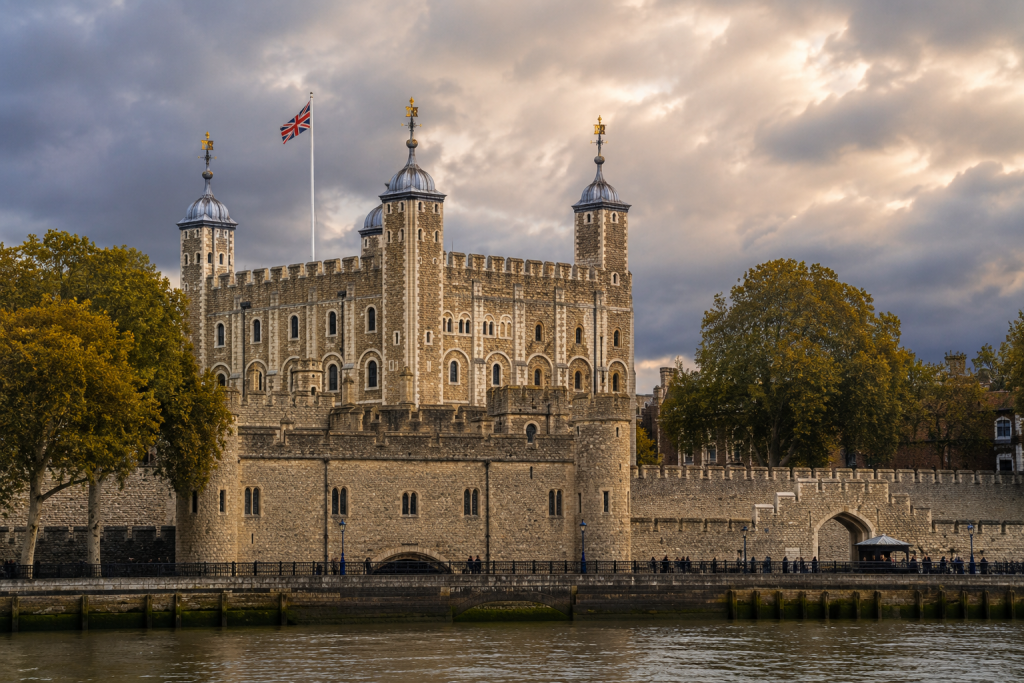
The Tower of London, originally founded by William the Conqueror and expanded over centuries into one of England’s most famous royal fortresses.
10 min read

“Ask what the Tower of London actually is, and the honest answer keeps changing depending on which century you happen to be asking about. Fortress, palace, prison, mint, menagerie, armoury, treasury, tourist attraction — few buildings anywhere have been asked to be quite so many different things to quite so many different centuries.”
Few structures anywhere in the world carry a documented history as long, as continuous, and as genuinely varied as the Tower of London, a fortress complex standing on the north bank of the River Thames that has, across nearly a thousand years of continuous use, served at various points as royal residence, military stronghold, state prison, execution site, royal mint, menagerie, and, in its current incarnation, one of the world’s most visited historical attractions. Some of the Tower’s own most historically significant episodes are the disappearance of the Princes in the Tower and Anne Boleyn’s execution within its walls. It is without a doubt a building whose genuine institutional flexibility across nearly a millennium of English history offers a uniquely comprehensive window into how English royal power itself has been exercised, displayed, and occasionally weaponised across almost the entire span of the nation’s post-Conquest history.
A Conqueror’s Statement in Stone
The Tower’s own origins trace directly to the Norman Conquest of 1066, when William the Conqueror, having successfully claimed the English throne through his decisive victory at the Battle of Hastings, moved swiftly to consolidate his own still-precarious new rule through a deliberate, sustained programme of castle construction across his newly conquered kingdom. This strategy intended to provide secure, defensible strongholds from which the new Norman ruling class could maintain effective control over a still genuinely restive and potentially rebellious English population. The White Tower, the imposing central keep that remains the Tower complex’s most immediately recognisable structure today, was begun around 1078, constructed under William’s own direct authority using Caen stone imported specifically from Normandy, a deliberate architectural choice underscoring the Tower’s genuine function as a visible, unmistakable statement of Norman authority imposed directly upon the newly conquered English capital.
This original defensive and symbolic function shaped the Tower’s subsequent architectural development considerably more directly than any of its later, more varied institutional roles would eventually require, with the fortress complex expanding steadily across the following centuries under successive medieval monarchs. It included significant thirteenth-century expansion under Henry III and Edward I, who together transformed the original Norman keep into the considerably more extensive concentric fortification system, comprising multiple defensive walls and towers, that largely defines the Tower complex’s physical footprint today.
A conqueror’s fortress, built to hold a newly subdued capital in check, gradually accumulated, across successive medieval reigns, an ever more elaborate physical architecture of genuine defensive sophistication — even as its own practical institutional purpose steadily expanded well beyond mere military garrison alone.
Royal Residence and Seat of Government
Beyond its original defensive function, the Tower served across much of the medieval period as a genuine royal residence, hosting successive English monarchs for extended periods and functioning, particularly during the earlier medieval centuries. It was a genuine centre of royal government and administration considerably more directly than its later, more narrowly specialised institutional roles would eventually require. Medieval monarchs maintained substantial royal apartments within the Tower complex, and the fortress hosted numerous significant ceremonial occasions, including, by established tradition, the customary pre-coronation procession several English monarchs undertook from the Tower to Westminster Abbey, a ceremonial practice underscoring the Tower’s genuine symbolic centrality to English royal authority during this period.
This residential and administrative function gradually diminished across the later medieval and early modern periods, as successive monarchs increasingly favoured alternative royal residences offering greater comfort and considerably less association with the Tower’s own steadily growing reputation as a site of imprisonment and, at times, genuine terror; a reputational shift that would come to define the Tower’s own popular historical identity considerably more thoroughly than its earlier residential function ever managed to achieve.
The Tower as Prison: A Reputation Earned Across Centuries
The Tower’s enduring popular association with imprisonment, interrogation, and execution developed gradually across several centuries of documented use, accumulating a genuinely substantial roster of significant historical prisoners whose own individual stories collectively define much of the Tower’s own lasting popular reputation. One of the Tower’s most historically significant and enduringly mysterious episodes: the disappearance of the young Princes in the Tower, Edward V and his younger brother, during Richard III’s controversial 1483 accession, an episode that permanently, lastingly associated the fortress with exactly the kind of dynastic violence and unresolved historical mystery that continues shaping its own popular reputation today.
Another significant episode was the Tower’s role in one of the most consequential executions in the whole of English history: Anne Boleyn, the second wife of Henry VIII, was executed in May 1536 within the Tower grounds following a genuinely thin and politically motivated prosecution. Anne was not, however, the only significant Tudor-era figure to meet her end within the Tower’s walls; the fortress hosted numerous further significant executions across the following decades, including, among many others, Thomas More, Catherine Howard, the fifth wife of Henry VIII, and Lady Jane Grey, the tragically brief nine-days’ queen executed in 1554 amid the succession crisis surrounding Edward VI’s death.
Few buildings anywhere carry quite so direct and quite so continuous a documented connection to the specific, dramatic turning points of an entire nation’s royal history — the Tower does not merely house English history’s more difficult chapters, it actively hosted an extraordinary number of them.
Beyond Imprisonment: A Genuinely Multi-Purpose Institution
What deserves considerably fuller popular appreciation than the Tower’s admittedly dramatic association with imprisonment and execution alone is the sheer, genuine institutional versatility the fortress complex demonstrated across its long history, serving simultaneously or sequentially as several entirely distinct functional institutions considerably removed from its more famous carceral reputation. The Tower housed the Royal Mint for several centuries, producing English coinage under direct royal authority within its own walls, a genuinely significant economic function that persisted for considerably longer than many visitors today likely appreciate, before the Mint’s eventual relocation to separate premises in the early nineteenth century.
The Tower also hosted, across several centuries, the Royal Menagerie, a genuinely significant collection of exotic animals, including lions, elephants, and other creatures presented as diplomatic gifts to successive English monarchs. They were maintained within the Tower grounds as a genuine royal collection and public curiosity from the thirteenth century until the animals’ eventual transfer to what would become London Zoo in the early nineteenth century, a genuinely striking institutional function considerably removed from the fortress’s more familiar reputation for imprisonment and execution. The Tower additionally served, and continues to serve today, as the secure repository for the Crown Jewels, the collection of ceremonial regalia used in English and, subsequently, British coronation ceremonies, maintained under close guard within the Tower complex as one of its most consistently significant and enduringly popular functions across the centuries.
A building capable of simultaneously housing a national mint, an exotic animal collection, a state prison, and the nation’s crown jewels demonstrates a genuine institutional flexibility considerably beyond what its own popular reputation as merely a grim fortress-prison typically allows for.
The Ravens: Legend and Genuine Tradition
Among the Tower’s most enduring popular traditions stands the well-known practice of maintaining a resident population of ravens within the fortress grounds. It is connected to a persistent legend holding that the kingdom itself, and the Tower along with it, would fall should the ravens ever depart entirely, a tradition whose precise historical origins remain genuinely uncertain, with some historians suggesting the specific legend may be a considerably more recent Victorian-era invention rather than any genuinely ancient medieval tradition, however deeply embedded the practice has since become within the Tower’s modern institutional identity and popular visitor experience.
Whatever its own precise historical origin, the raven tradition has become genuinely institutionalised, with the Tower maintaining a dedicated Ravenmaster responsible for the birds’ ongoing care, a modern institutional commitment reflecting just how thoroughly even a comparatively recent piece of Tower folklore can become genuinely, lastingly woven into the fortress’s broader historical identity and visitor appeal.
The Twentieth Century: A Fortress Still in Use
The Tower’s genuine institutional relevance did not end with the conclusion of its more famous historical episodes, continuing to serve genuine functional purposes well into the twentieth century, including its use during both the First and Second World Wars as a site for the detention and, in several documented cases, execution of individuals convicted of espionage against Britain. It is a genuinely significant modern chapter of the Tower’s own long carceral history that receives considerably less popular attention than its more famous Tudor-era executions but represents an equally genuine, well-documented continuation of the fortress’s own centuries-old function as a site of state security and, when required, state-sanctioned execution.
The Tower’s most recent prisoner of historical note was Rudolf Hess, the senior Nazi official held briefly within its walls in 1941 following his unauthorised flight to Britain, a striking demonstration of just how directly the Tower’s nearly thousand-year institutional history connects the world of William the Conqueror’s original Norman fortress to events within living historical memory.
A Living Monument to Nearly a Millennium
Considered as a whole, the Tower of London represents something genuinely rare among historical monuments: a single continuous institution whose documented functional history spans, without significant interruption, nearly a full millennium of English national life, encompassing royal residence, military fortress, state prison, site of execution, royal mint, exotic menagerie, treasury, and, in its current incarnation as one of Britain’s most visited heritage attractions. The Tower is a genuine working monument to the full, complicated sweep of English royal history rather than merely a preserved relic of any single historical period alone. Few buildings anywhere can claim to have witnessed, directly and continuously within their own walls, quite so extensive and quite so consequential a span of any single nation’s history.
Timeline: The Tower of London
- 1066 — William the Conqueror claims the English throne following the Battle of Hastings.
- 1078 — Construction begins on the White Tower under William’s direct authority.
- 13th century — Henry III and Edward I undertake significant expansion, establishing the Tower’s concentric fortification system.
- 13th–early 19th centuries — The Tower hosts the Royal Menagerie, a collection of exotic animals presented as diplomatic gifts.
- 1483 — The Princes in the Tower disappear amid Richard III’s controversial accession.
- 1536 — Anne Boleyn is executed within the Tower grounds.
- 1554 — Lady Jane Grey is executed at the Tower following the succession crisis surrounding Edward VI’s death.
- Early 19th century — The Royal Mint relocates from the Tower to separate premises; the Menagerie animals transfer to what becomes London Zoo.
- 1914–1945 — The Tower is used during both World Wars for the detention and, in several cases, execution of individuals convicted of espionage.
- 1941 — Rudolf Hess is briefly held at the Tower following his unauthorised flight to Britain.
- Present day — The Tower operates as one of Britain’s most visited heritage attractions, continuing to house the Crown Jewels.
author's note
The Tower’s own long, layered history sits just behind the London my character Sebastian arrives in partway through Related to Dracula: At Tudor Court, a city where the same fortress could be royal residence, prison, and treasury all at once, often within the same decade. I have found the Tower genuinely fascinating since I first read about it as a child, well beyond its more famous association with Anne Boleyn’s own eventual fate, and I wanted Sebastian’s own sense of London to carry some of that same unsettled, multi-purpose quality, a city where danger and opportunity genuinely sat side by side. That lifelong interest gave me a much richer sense of the city itself as a character in the novel, not merely a backdrop.
sources and further reading
- Impey, Edward, and Geoffrey Parnell. The Tower of London: The Official Illustrated History. Merrell, 2000 — the standard comprehensive illustrated history of the Tower.
- Parnell, Geoffrey. The Tower of London. Batsford, 1993.
- Weir, Alison. The Tower of London: A Thousand Years of English History. Hutchinson, 2010.
- Keay, Anna. The Elizabethan Tower of London: The Haiward and Gascoyne Plan of 1597. London Topographical Society, 2001.
- Weir, Alison. The Princes in the Tower. Bodley Head, 1992.
- de Lisle, Leanda. The Sisters Who Would Be Queen: The Tragedy of Mary, Katherine and Lady Jane Grey. HarperPress, 2008 — detailed treatment of Lady Jane Grey’s imprisonment and execution at the Tower.
A note on sources: the precise origins of certain Tower traditions, including the raven legend, remain uncertain and are treated with appropriate caution.
related articles
- Henry VIII: The King Who Changed England
- Henry VIII: King, Reformer or Tyrant
- Tudor England: The Dynasty that Transformed a Kingdom
- Anne Boleyn: The Woman Who Changed the Fate of a Kingdom
- The Six Wives of Henry VIII: Marriage, Power and the Making of Tudor England
- The War of the Roses: The Conflict that Created the Tudors
continue your journey through history
Discover the novels inspired by the people, rivalries and legends of medieval Europe.

Historical Fiction Author
History has always fascinated me—not simply for the great battles or famous rulers, but for the people behind the legends. Through years of research into medieval Europe, the Ottoman Empire, Tudor England, and the lives of extraordinary historical figures, I’ve sought to uncover the stories that lie beneath popular myths. My novels blend documented history with compelling fiction, inviting readers to step into the past and experience it as those who lived it might have done.
Join the Related to Dracula Circle