
HISTORY · Castles & Fortresses
Hampton Court Palace: The Gift That Was Never Really a Choice
Cardinal Wolsey Built England’s Grandest Palace, and Then Watched It Become Henry VIII’s Instead
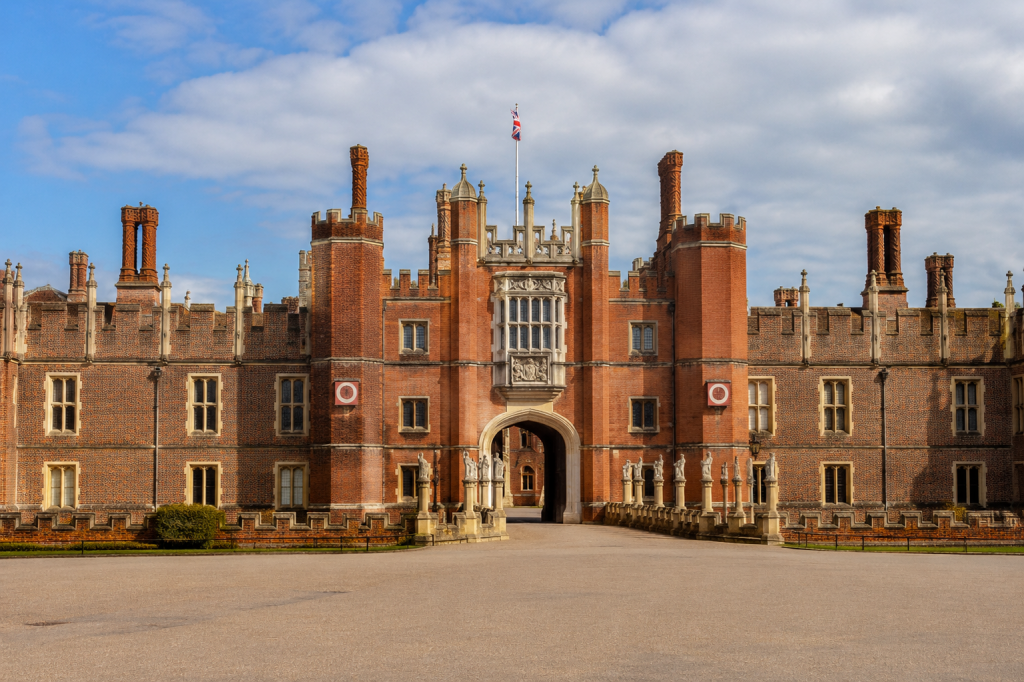
Hampton Court Palace in London, originally built for Cardinal Wolsey before becoming one of Henry VIII’s most famous royal residences.
9 min read

“He called it a gift, and the official record has always politely agreed with him. But a gift offered by a man whose entire career depends on staying in royal favour, to a king who has already begun eyeing the property with open admiration, sits somewhere considerably closer to surrender than generosity ever quite manages to describe.”
Few English royal palaces carry quite so genuinely ambiguous an origin story as Hampton Court, a magnificent riverside residence on the Thames whose own early history raises the question: did Cardinal Thomas Wolsey, the palace’s original builder and owner, genuinely, voluntarily gift this extraordinary property to his king, or did Henry VIII’s own well-documented admiration for Wolsey’s creation, combined with Wolsey’s own increasingly precarious political position, transform what official record describes as generous royal gift into something considerably closer to a forced surrender dressed carefully in the more flattering language of voluntary offering? Examining Hampton Court’s own actual transfer history, considered alongside the broader political circumstances, suggests an answer considerably more complicated, and considerably more genuinely interesting, than either simple explanation alone would allow.
A Cardinal’s Extraordinary Ambition
Hampton Court’s own origins trace to 1515, when Thomas Wolsey, then rising rapidly toward the height of his own considerable political and ecclesiastical power as Henry VIII’s chief minister, acquired the site along the River Thames and began constructing what would become, within a comparatively short span of years, one of the single most magnificent and architecturally ambitious residences anywhere in England. The palace’s sheer scale and lavish construction reflected Wolsey’s own extraordinary personal wealth and, quite possibly, a degree of genuine architectural ambition considerably exceeding what a subject, however powerful, might ordinarily be expected to display before his own reigning monarch.
Wolsey spared little expense in the palace’s construction, employing the finest available craftsmen and materials to produce a residence featuring genuinely extensive courtyards, elaborate state apartments, and architectural sophistication that quickly established Hampton Court’s own reputation as among the most impressive private residences in the entire kingdom. That reputation, as subsequent events would demonstrate, proved considerably more politically dangerous to its own builder than Wolsey himself may have initially appreciated.
A subject who builds a palace more magnificent than several of his own king’s existing residences is, whether he intends it or not, making a genuinely significant statement about his own wealth and standing — a statement that carries real political risk in a court where royal favour remained the ultimate, absolute currency of survival.
A King’s Growing Admiration
Henry VIII’s own well-documented admiration for Hampton Court developed steadily across the years following its construction, with the king becoming an increasingly frequent guest at Wolsey’s own magnificent creation, a pattern of royal visitation that several historians suggest carried genuine, mounting political significance considerably beyond mere social courtesy alone. Henry’s own evident enthusiasm for the property, reflected in his repeated visits and evident personal enjoyment of its considerable comforts and architectural sophistication, placed Wolsey in an increasingly delicate position: continuing to host his king’s evident admiration for a property Wolsey himself had built and owned, while remaining acutely aware, as any experienced courtier of the period certainly would have been, of exactly how dangerous it could prove to appear to possess anything a monarch as personally acquisitive and increasingly assertive as Henry had, by this stage of his reign, clearly come to want for himself.
This mounting royal admiration unfolded against the broader backdrop of Wolsey’s own gradually shifting political position across the 1520s, as his own failure to secure the papal annulment Henry increasingly desperately sought steadily eroded the once seemingly unassailable political standing Wolsey had enjoyed across the earlier years of his own remarkable career.
The “Gift” of 1528
Wolsey formally transferred Hampton Court to Henry VIII in 1528, an act the official historical record has traditionally described, and continues largely to describe, as a genuine, voluntary gift, presented by Wolsey to his king as a mark of loyal service and personal devotion. This framing, however, deserves considerably more careful scrutiny than its own conventional presentation typically receives, given the specific political circumstances surrounding the transfer’s actual timing: 1528 fell squarely within the same period during which Wolsey’s own political position was growing increasingly precarious precisely because of his continued failure to deliver the annulment Henry so urgently demanded, a failure that would, within barely a year, contribute directly to Wolsey’s own complete fall from royal favour.
Considered within this specific political context, Wolsey’s own “gift” of Hampton Court appears, to many historians, considerably less like spontaneous generosity and more like a calculated, genuinely necessary act of political self-preservation, an attempt to shore up his own increasingly vulnerable standing with a king whose favour Wolsey could no longer take for granted, by offering precisely the property Henry had already made so evidently, repeatedly clear he personally coveted.
Whatever language the official transfer documents actually used, a gift offered by a minister whose own political survival has grown genuinely uncertain, to a king who has already made his own desire for the property unmistakably obvious through years of repeated admiring visits, occupies a genuinely ambiguous space between voluntary generosity and calculated, necessary surrender.
A Gift That Failed to Save Its Giver
Whatever combination of genuine generosity and calculated political necessity actually motivated Wolsey’s transfer of Hampton Court, the gesture ultimately failed to achieve whatever protective political purpose it may have been intended to serve. Wolsey fell decisively from royal favour barely a year later, in 1529, stripped of his most significant offices and political authority, and died in 1530 while travelling to face formal charges of treason, having lost not merely his magnificent palace but, within a remarkably short span of time, his entire political career and, ultimately, his own life.
This outcome lends genuine additional weight to the more sceptical reading of the original 1528 transfer, suggesting that whatever protective calculation may have motivated Wolsey’s decision to formally relinquish Hampton Court, the gesture proved, in the end, considerably less effective at securing his own continued political survival than Wolsey himself may have hoped when he first agreed to hand over the property he had built with such evident personal ambition and considerable expense.
Henry’s Transformation of the Palace
Having acquired Hampton Court, Henry VIII proceeded to substantially expand and further embellish the already magnificent property across the following years, adding, among numerous other significant architectural developments, the Great Hall, a genuinely spectacular hammer-beam ceilinged space that remains among the palace’s own most architecturally celebrated features today, alongside extensive additional kitchens, courtyards, and state apartments reflecting Henry’s own evident determination to make the palace unmistakably, thoroughly his own rather than merely an inherited acquisition from his former chief minister.
Hampton Court subsequently served as a genuinely significant royal residence across the remainder of Henry’s own reign and well beyond it, hosting numerous events across the following Tudor and Stuart centuries, including its use as a residence by several of Henry’s own subsequent wives and, in later centuries, undergoing further substantial architectural transformation under King William III and Queen Mary II. They commissioned the celebrated architect Christopher Wren to construct an entirely new baroque wing, creating the genuinely striking architectural juxtaposition between Tudor and baroque styles that still defines the palace’s own distinctive appearance today.
The palace Wolsey built to display his own considerable wealth and taste became, within barely a generation, something considerably larger and more architecturally layered than its original builder could ever have anticipated — a physical monument, quite literally built in stone and brick, to several entirely different eras of English royal history stacked directly on top of one another.
A Palace That Outlived Every Question of Ownership
Considered across the full span of its own subsequent history, Hampton Court’s own genuinely ambiguous origin story, gift or surrender, generosity or necessity, matters considerably less to the palace’s own lasting historical significance than the sheer scale of what actually followed its 1528 transfer: nearly two centuries of continued royal use and architectural development, transforming what began as a single ambitious cardinal’s private residence into one of the genuinely great royal palaces of English history, its Tudor Great Hall and baroque Wren wing standing today as physical testament to considerably more than two hundred years of continuous, evolving royal significance.
Timeline: Hampton Court Palace
- 1515 — Thomas Wolsey acquires the site and begins constructing Hampton Court.
- 1510s–1520s — Wolsey completes an extraordinarily lavish palace, and Henry VIII becomes an increasingly frequent, admiring visitor.
- 1528 — Wolsey formally transfers Hampton Court to Henry VIII, officially described as a gift.
- 1529 — Wolsey falls decisively from royal favour, having failed to secure Henry’s papal annulment.
- 1530 — Wolsey dies while travelling to face formal charges of treason.
- 1530s onward — Henry VIII substantially expands the palace, adding the Great Hall and additional state apartments.
- Later 16th–17th centuries — Hampton Court continues serving as a significant royal residence across the remaining Tudor and Stuart periods.
- 1689 onward — William III and Mary II commission Christopher Wren to construct a new baroque wing, creating the palace’s distinctive mixed architectural character.
author's note
Wolsey’s own fall from favour runs directly through Related to Dracula, since my character Sebastian serves under him, appointed to investigate a series of murders that draw him deeper into court politics than he ever intended. I first read about Hampton Court’s own ambiguous transfer, a gift that may well have been closer to necessary surrender, many years ago, and it gave me a far sharper sense of exactly how precarious Wolsey’s position had already become by the years my novel is set in, and how much that precariousness would eventually put Sebastian himself at risk simply by association with a minister whose own favour was already quietly running out.
sources and further reading
- Thurley, Simon. Hampton Court: A Social and Architectural History. Yale University Press, 2003 — the definitive scholarly history of the palace.
- Worsley, Lucy. Hampton Court Palace: The Official Illustrated History. Merrell, 2005.
- Gunn, S. J. and P. G. Lindley, eds. Cardinal Wolsey: Church, State and Art. Cambridge University Press, 1991.
- Scarisbrick, J. J. Henry VIII. Yale University Press, 1968.
- MacCulloch, Diarmaid. Thomas Cromwell: A Life. Allen Lane, 2018.
- Impey, Edward. The White Tower. Yale University Press, 2008 — useful comparative context on Tudor royal architectural ambition.
A note on sources: the precise motivations behind Wolsey’s 1528 transfer of Hampton Court remain a matter of reasonable historical interpretation rather than settled documentary certainty, and this article has drawn on Thurley’s authoritative architectural and social history, alongside the broader biographical scholarship on Wolsey’s political career, in weighing the more sceptical reading against the palace’s own traditional official framing as a straightforward gift.
related articles
continue your journey through history
Discover the novels inspired by the people, rivalries and legends of medieval Europe.

Historical Fiction Author
History has always fascinated me—not simply for the great battles or famous rulers, but for the people behind the legends. Through years of research into medieval Europe, the Ottoman Empire, Tudor England, and the lives of extraordinary historical figures, I’ve sought to uncover the stories that lie beneath popular myths. My novels blend documented history with compelling fiction, inviting readers to step into the past and experience it as those who lived it might have done.
Join the Related to Dracula Circle