
HISTORY · Castles & Fortresses
Bran Castle: The Truth Behind “Dracula’s Castle”
Seven Centuries of Genuine History, Buried Beneath One Borrowed Legend
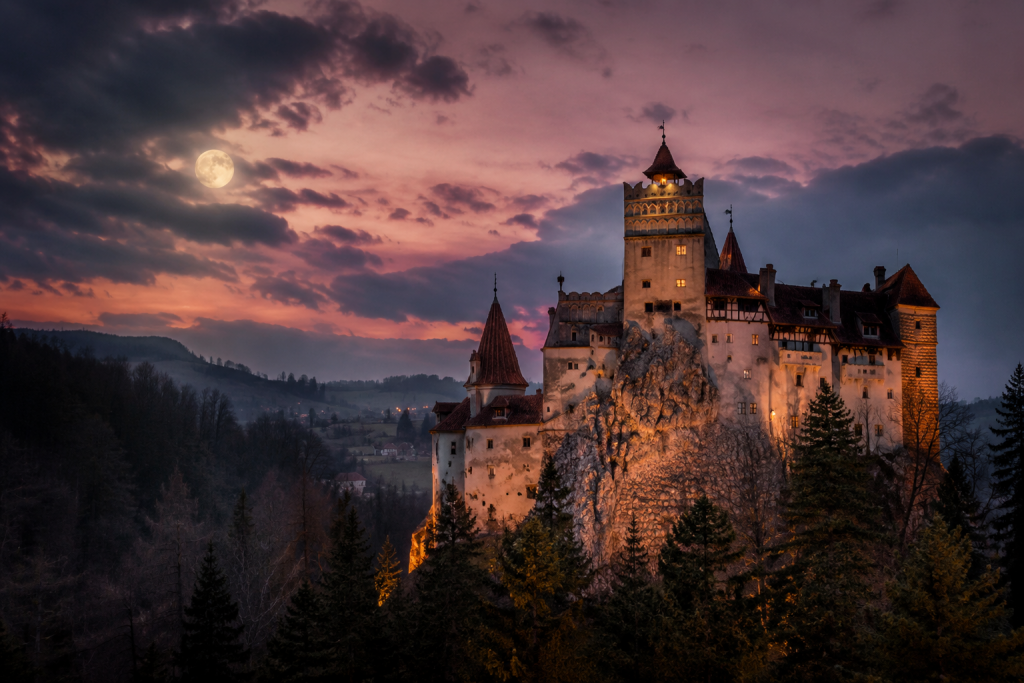
Artistic interpretation of Bran Castle in Transylvania, popularly known as Dracula’s Castle.
9 min read
“Strip away the vampire marketing entirely, and what remains is still a genuinely remarkable castle — a customs post, a royal residence, a wartime prize, and a nationalised museum, each chapter considerably more interesting than the fictional one visitors actually travel there to find.”
No castle in Europe carries quite so heavy a burden of misplaced fame as Bran Castle, perched dramatically above the Transylvanian town of the same name and known to millions of visitors worldwide primarily, and almost exclusively, as “Dracula’s Castle”. Bran’s owes its modern prominence to twentieth-century tourism marketing rather than any solid fifteenth-century historical record of connection with Vlad the Impaler. Vlad’s documented fortress stood somewhere else entirely, at Poenari Castle.
What deserves fuller, dedicated attention here, considered on the castle’s own terms rather than merely in relation to a myth it never actually earned, is the genuinely rich and, in its own right, considerably more historically substantial story Bran actually has to tell: a medieval customs fortress, a beloved royal residence, a prize fought over across two world wars, and a modern museum still working to define its own identity beneath the shadow of a legend that was never really its own.
A Fortress Built for Trade, Not Terror
Bran Castle’s own genuine origins trace back to the early fourteenth century, constructed on the site of an earlier, smaller fortification that had itself stood since at least the early thirteenth century under the brief tenure of the Teutonic Knights, before Transylvanian Saxon communities, acting with the support of the Hungarian crown, undertook the construction of the substantial stone fortress whose walls largely survive today, beginning around 1377. The castle’s specific location, commanding a narrow and strategically vital mountain pass connecting Transylvania to Wallachia, reflects its own genuinely practical original purpose considerably more accurately than any later Gothic reimagining ever could: Bran functioned, from its very construction, primarily as a customs post and defensive checkpoint, controlling and taxing the considerable trade traffic passing through this important commercial route between two economically significant medieval regions.
This original commercial and defensive function shaped the castle’s own physical design considerably more directly than any later vampire mythology would ever acknowledge, with Bran’s fortifications constructed specifically to control passage through the mountain pass below, collecting tolls from merchants and travellers while providing a genuine defensive bulwark against the various military threats, Ottoman expansion very much included, that periodically threatened the wider Transylvanian Saxon trading communities the castle had originally been built to protect.
A castle built to tax merchants and guard a mountain pass carries, in its own actual foundational purpose, considerably less inherent Gothic drama than five centuries of subsequent reimagining would eventually attach to it — though considerably more genuine, practical historical substance.
A Thin, Contested Connection to Vlad
The specific question of Bran’s actual historical connection to Vlad the Impaler deserves brief restatement here for the sake of this own independent completeness. The strongest evidence connecting Vlad directly to Bran suggests, at most, that he may have passed through or briefly stayed at the castle during certain military campaigns or periods of exile, given its position along a route he is documented to have used during his own turbulent career. Still, no solid contemporary evidence establishes that Vlad ever ruled from Bran, held any meaningful residence there, or regarded the castle as anything more than a fortification he occasionally passed near during his broader movements between Wallachia and Transylvania.
This thin historical connection stands in genuinely striking contrast to Bran’s own eventual global fame, a contrast as history records to twentieth-century tourism marketing considerably more than to any fifteenth-century historical record, drawing on Bram Stoker’s own entirely separate, historically disconnected 1897 novel and the castle’s own genuinely dramatic, Gothic-suited physical appearance to construct an association that, however commercially successful, rests on considerably thinner historical foundation than most visitors arriving at the castle today likely appreciate.
A Royal Residence: Queen Marie’s Beloved Retreat
What deserves considerably fuller attention than Bran’s tenuous Vlad connection is the castle’s own genuinely significant twentieth-century royal history, a chapter of its story that receives comparatively little popular attention despite representing, by any reasonable historical measure, a considerably more substantial and better documented period of the castle’s actual significance. Following the formation of Greater Romania after the First World War, the town of Brașov presented Bran Castle as a gift to Queen Marie of Romania in 1920, a genuinely popular and internationally admired monarch whose own considerable personal charisma and diplomatic skill had contributed meaningfully to Romania’s own post-war territorial and diplomatic settlement.
Queen Marie undertook a substantial renovation and modernisation of the ageing medieval fortress, transforming Bran into a genuinely beloved royal residence and summer retreat, incorporating contemporary early twentieth-century comforts and design sensibilities alongside the castle’s own preserved medieval architectural character. Marie’s own personal attachment to Bran proved genuinely significant and well documented. She specified, in her own will, that her heart be preserved within a small chapel constructed specifically for this purpose near the castle, a genuinely striking testament to just how deeply personally significant this particular residence had become to her across the following decades of her own life.
The castle’s own genuine twentieth-century emotional significance belonged not to any vampire legend, but to a queen who loved the place enough to ensure that some physical part of herself would remain there permanently after her own death.
Bran passed, following Queen Marie’s own death in 1938, to her daughter Princess Ileana, who continued using the castle as a residence and, during the difficult years of the Second World War, operated part of the property as a hospital for wounded soldiers, a genuinely significant humanitarian use of the property that receives considerably less popular attention than either its medieval origins or its later vampire association.
Nationalisation and the Communist Era
Bran’s own royal residential chapter came to an abrupt end in 1948, when Romania’s newly established Communist government nationalised the castle along with a great many other private and royal properties across the country, forcing Princess Ileana and the wider royal family into exile and converting Bran into state property administered, across the following decades of Communist rule, as a museum open to public visitation. This nationalisation, while representing a genuine loss for the royal family personally, ironically preserved the castle’s physical structure and considerable historical furnishings in a manner that private, less resourced ownership might not necessarily have guaranteed across the same turbulent decades.
It was during this later twentieth-century period, as Communist Romania increasingly sought to develop international tourism as a source of valuable foreign currency, that Bran’s own association with the internationally famous Dracula legend began to be actively, deliberately promoted by state tourism authorities, recognising in Stoker’s own globally recognised novel a genuinely valuable marketing opportunity considerably more commercially useful than the castle’s own comparatively obscure, if genuinely significant, actual royal and medieval history.
A castle nationalised by a Communist government for entirely practical political reasons found itself, within a matter of decades, repositioned by that same government as a vampire tourist attraction — a genuinely strange, almost accidental convergence of political history and commercial marketing that shaped Bran’s modern global identity considerably more decisively than anything from its own actual medieval or royal past.
Restitution and a Modern Identity Still Being Negotiated
Bran’s own post-Communist history brought a further significant development, as the castle was formally restituted in 2006 to Dominic von Habsburg, a grandson of Princess Ileana and thus a genuine hereditary descendant of the royal family from whom the property had originally been nationalised, following a lengthy and legally complex restitution process addressing property seized during the Communist era. The Habsburg family has, since regaining ownership, continued operating Bran as a privately managed museum open to public visitation, navigating the genuine, ongoing tension between the castle’s own considerably richer documented royal and medieval history and the persistent, commercially valuable popular association with Dracula that continues drawing the overwhelming majority of its annual visitors.
This ongoing tension, between historical accuracy and commercial tourism appeal, has produced a genuinely interesting modern institutional balancing act, with the castle’s own current museum displays and interpretive materials working to present both Bran’s genuine, considerably more substantial documented history and some acknowledgement of the vampire legend that continues driving the bulk of its international visitor traffic, an arrangement that several heritage scholars, including Duncan Light’s own research examined in this earlier chapter on Vlad’s castles, have studied in some detail as a genuinely instructive case study in how historical sites navigate the sometimes uncomfortable gap between documented fact and profitable popular myth.
A Castle Worth Visiting for Its Own Sake
Considered on its own genuine historical merits, entirely apart from its own borrowed vampire association, Bran Castle represents a genuinely significant and well-documented site spanning nearly seven centuries of continuous history: a medieval customs fortress guarding a strategically vital mountain pass, a beloved twentieth-century royal residence whose owner cared enough to leave part of herself there permanently, a wartime hospital, a nationalised Communist-era museum, and, now, a privately restituted heritage site still working to define its own public identity beneath the persistent shadow of a novel its own walls never actually inspired. Bran deserves, on balance, to be remembered and visited for this genuinely rich and considerably better documented actual history, rather than merely as the convenient, photogenic backdrop for a legend that, whatever its own considerable commercial value, was never really Bran’s own story to tell.
Timeline: Bran Castle
- Early 13th century — An earlier, smaller fortification is constructed on the site under the brief tenure of the Teutonic Knights.
- 1377 — Transylvanian Saxon communities, with Hungarian crown support, construct the substantial stone fortress largely surviving today.
- 15th century — Bran functions as a customs post and defensive checkpoint, with only thin, largely undocumented suggestions of any connection to Vlad the Impaler.
- 1920 — The town of Brașov gifts Bran Castle to Queen Marie of Romania, beginning its era as a royal residence.
- 1920s–1930s — Queen Marie undertakes substantial renovation, transforming Bran into a beloved royal retreat.
- 1938 — Queen Marie dies; Bran passes to her daughter, Princess Ileana.
- Early 1940s — Bran is partially used as a hospital for wounded soldiers during the Second World War.
- 1948 — Romania’s Communist government nationalises Bran Castle, forcing the royal family into exile.
- Later 20th century — Communist-era tourism authorities begin actively promoting Bran’s association with Stoker’s Dracula legend.
- 2006 — Bran Castle is formally restituted to Dominic von Habsburg, grandson of Princess Ileana.
author's note
I made a deliberate choice, writing Related to Dracula, not to lean on Bran Castle’s own borrowed Gothic imagery for Ana’s Wallachia, because I had known since childhood how little of that connection genuinely belongs to Vlad’s own story. Bran Castle does appear in my second book, Legacy of Blood, and I was careful to keep it historically honest there: it is likely that Vlad spent the occasional night within its walls, but it was never his primary residence, and that is exactly how I wrote it. Getting that distinction right mattered enormously to me, because it is exactly the kind of detail that shapes whether Sebastian’s own origins feel honestly told or merely borrowed from someone else’s castle.
sources and further reading
- Light, Duncan. The Dracula Dilemma: Tourism, Identity and the State in Romania. Routledge, 2012 — the definitive study of Bran’s tourism history and its relationship to the Dracula legend.
- Florescu, Radu R. and Raymond T. McNally. Dracula, Prince of Many Faces: His Life and His Times. Little, Brown and Company, 1989.
- McNally, Raymond T. and Radu Florescu. In Search of Dracula: The History of Dracula and Vampires. Houghton Mifflin, 1994.
- Pakula, Hannah. The Last Romantic: A Biography of Queen Marie of Romania. Simon & Schuster, 1984 — detailed treatment of Queen Marie’s life and her attachment to Bran.
- Treptow, Kurt W. ed. A History of Romania. Centre for Romanian Studies, 1996.
- Deletant, Dennis. Romania Under Communist Rule. Centre for Romanian Studies, 1998 — useful background on the nationalisation era and its aftermath.
A note on sources: Bran’s own restitution proceedings and its ongoing modern management as a privately operated heritage site are relatively recent developments, meaning some details continue to evolve; this chapter has drawn on the most recent available scholarship, particularly Light’s dedicated study, in describing the castle’s current institutional situation.
related articles
continue your journey through history
Discover the novels inspired by the people, rivalries and legends of medieval Europe.

Historical Fiction Author
History has always fascinated me—not simply for the great battles or famous rulers, but for the people behind the legends. Through years of research into medieval Europe, the Ottoman Empire, Tudor England, and the lives of extraordinary historical figures, I’ve sought to uncover the stories that lie beneath popular myths. My novels blend documented history with compelling fiction, inviting readers to step into the past and experience it as those who lived it might have done.
Join the Related to Dracula Circle