
HISTORY · Legends & Folklore
Ielele: The Beautiful Spirits Romanians Dared Not Name
Dancing Figures of the Night Whose Beauty Carried a Genuine, Documented Danger
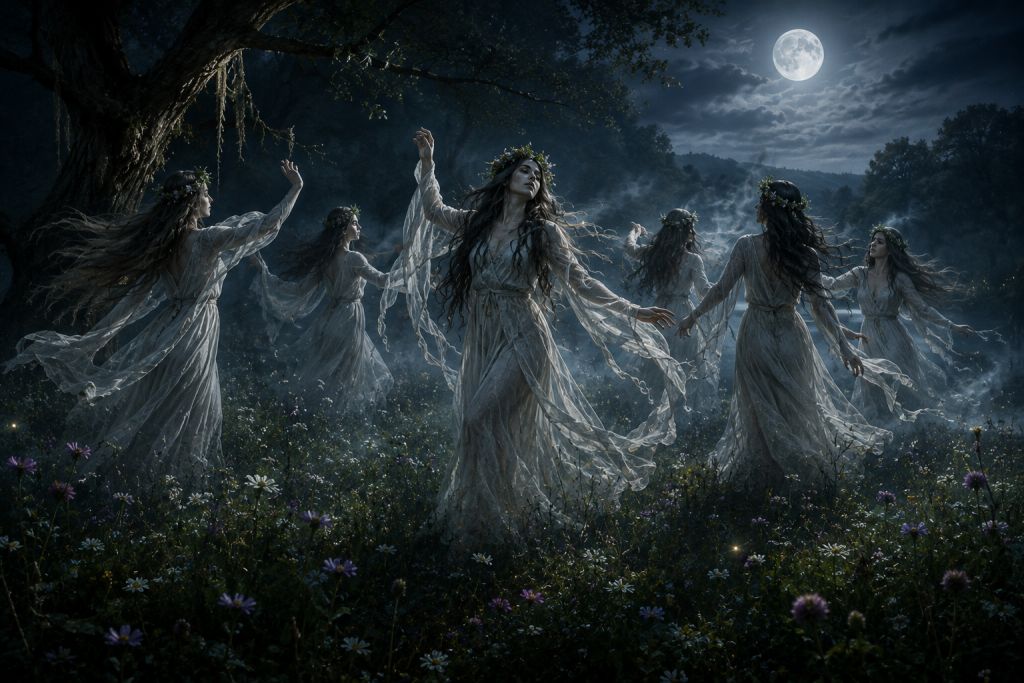
An artistic interpretation of the Iele, the mysterious spirits of Romanian folklore said to dance beneath the moon and enchant those who crossed their path.
9 min read

“To speak their true name aloud was already a risk few villagers were willing to take. Better, tradition held, to call them something gentler instead — the Beautiful Ones, the Merciful Ones, the Ladies of the Wind — and hope that politeness alone might be enough to keep them from noticing you at all.”
Among the supernatural figures populating the broader Wallachian and Romanian folk landscape, few carry quite the same combination of genuine beauty and genuine, documented danger as the Iele, a group of supernatural female spirits associated with nocturnal dancing, seductive beauty, and a capacity to inflict real, sudden harm on anyone unfortunate enough to encounter them at the wrong moment. Unlike the strigoi, a threat arising from the dead, the Iele belong to a different, considerably more ambivalent category of folk being entirely: neither straightforwardly evil nor straightforwardly benevolent, neither fully human nor fully separate from human concerns, existing instead in exactly the kind of dangerous, seductive middle ground that so much of Romanian supernatural folklore reserves for its most feared and most fascinating figures.
Names Too Dangerous to Speak Directly
One of the most immediately striking features of the Iele tradition, and among the clearest signals of just how genuinely feared these figures were within the communities who told stories about them, lies in the sheer number of indirect, euphemistic names used to refer to them rather than their own proper name. Across different regions and different tellings, the Iele appear under names including Frumoasele (“the Beautiful Ones”), Dânsele (“Those Ones,” a deliberately vague, distancing reference), Măiestrele (“the Skilled Ones” or “the Masterful Ones”), Milostivele (“the Merciful Ones”), Șoimanele, Vântoasele (“the Windy Ones”), Sfintele (“the Holy Ones”), and Stăpânele Vântului (“the Ladies of the Wind”), among still further regional variants. This proliferation of indirect names reflects a widespread folk belief, documented across numerous regional traditions, that speaking the Iele’s true name directly risked drawing their attention and their potential wrath, making careful, deliberately softened language a genuine form of practical protection rather than mere linguistic politeness alone.
A community that develops this many different ways of avoiding a single name is telling you something quite clear about how seriously it takes the danger of being overheard.
Origins Both Ancient and Genuinely Contested
Folklorists examining the Iele tradition generally trace its roots to an ancient, likely pre-Christian foundation, shaped by layered Dacian, Roman, and Slavic influence in a pattern consistent with the broader, deeply layered folk inheritance found across Wallachian and Romanian tradition more widely. Scholars have frequently drawn comparison between the Iele and related feminine nature-spirit traditions found across the wider Indo-European folkloric world, including the nymphs of Greek mythology and the vila spirits documented within broader Slavic and Balkan folklore, a comparison suggesting a genuinely deep, shared mythological root running beneath several distinct regional traditions rather than any single, isolated Romanian invention.
The specific question of exactly what the Iele were originally believed to be, however, receives genuinely varied answers across different tellings and different regions. Some versions of the tradition describe the Iele as the spirits of young women who died before marriage, condemned to wander perpetually between the world of the living and the world of the dead, unable to find rest in either. Other tellings describe them instead as wind spirits or magical beings native to an entirely separate, parallel world, with no direct connection to any once-living human person at all. A further, genuinely distinctive strand of the tradition connects the Iele’s origin to Alexander the Great, described in Romanian folk tradition as Alexandru Machedon, whose three daughters, or in an alternative version his three faithful servants, are said to have drunk from a store of “living water” Alexander had preserved against his own old age, and to have been transformed by it into immortal, ever-youthful fairy spirits who subsequently scattered out into the wider world.
A single tradition offering three genuinely different origin stories, unmarried dead, wind spirits, or the transformed companions of an ancient conqueror, suggests less a single settled myth than a genuinely living, continuously reworked body of storytelling, reshaped again and again by successive generations of tellers.
The Dance That Marked the Ground
The Iele’s most consistently documented and most immediately recognisable characteristic across virtually every regional variant of the tradition is their nocturnal circle dance, the hora, performed in remote or liminal locations, open fields, forest clearings, crossroads, and other spaces sitting at the physical margins of ordinary village life. Folk tradition held that the specific ground where the Iele had danced remained visibly marked afterwards, an idea that gave rise to the widespread folk explanation of certain unusual circular patterns of burned, flattened, or otherwise distinctively marked grass as physical evidence of the Iele’s passage, a tangible piece of supposed supernatural evidence that any curious observer could, in principle, actually go and look for.
The Iele themselves were consistently described as young, extraordinarily beautiful, appearing with loose, flowing hair and dressed in thin, flowing garments or, in some tellings, no clothing at all, possessing voices of a genuinely bewitching, crystalline quality capable of enchanting anyone who happened to hear them. This combination of physical beauty and vocal enchantment sits, within the broader tradition, in deliberate and uneasy tension with the very real danger these same figures were consistently believed to represent.
A Beauty That Punished Those Who Looked
The practically consequential danger the Iele were believed to pose forms the core of why this particular folk tradition mattered so much to the communities who maintained it, considerably beyond mere entertaining supernatural storytelling alone. Anyone unfortunate enough to witness the Iele’s dance directly, or even simply to overhear their singing from too close a distance, risked a severe range of consequences according to consistent folk tradition: sudden illness, fainting, paralysis, lameness, loss of speech, loss of eyesight, or a more general, lasting derangement of the mind. Young men in particular were consistently identified across the tradition as especially vulnerable, drawn in by the Iele’s beauty and charm, only to be struck down, in several tellings, by the very kiss that had first seemed to promise something considerably more pleasant.
The Iele offer a striking folkloric embodiment of exactly the kind of danger a rural community most needed a coherent explanatory framework for: sudden, otherwise inexplicable illness, paralysis, or mental collapse striking seemingly at random, given here a specific cause, a specific location, and a specific set of avoidable circumstances a frightened community could actually act upon.
Some scholars examining the tradition have suggested a further, interesting symbolic reading underlying this pattern of danger specifically tied to feminine beauty, autonomy, and nocturnal freedom from ordinary social oversight: the Iele, dancing freely at night, beyond the reach of conventional social or masculine control, can be read as a folkloric projection of broader anxiety surrounding uncontrolled, autonomous femininity itself, a symbolic pattern that recurs, in various forms, across a considerable range of comparable European folk traditions involving dangerous, beautiful, nocturnal female spirits.
Rusalii and the Wider Calendar of Danger
The Iele’s activity was frequently associated, within Romanian folk tradition, with particular points in the religious and seasonal calendar, most notably the period surrounding Rusalii, the Orthodox celebration of Pentecost, a connection reflected directly in one of the Iele’s alternative names. During this period, households in various regions maintained specific protective practices, including covering wells and water containers overnight to prevent the Iele from touching or “kissing” the water, a practice reflecting the broader, genuinely widespread folk concern regarding exactly which ordinary domestic resources might become vulnerable to supernatural contamination during periods of heightened Iele activity.
Protecting Against the Iele
Communities maintaining the Iele tradition developed a specific, practical set of protective measures against the danger these figures were believed to represent, a pattern consistent with the broader, practically oriented character of Wallachian and Romanian folk tradition more generally. Men were advised to carry garlic, basil, or wormwood on their person as protection, plants believed to possess apotropaic properties capable of keeping the Iele at a safe distance. Lovage planted in pots near windows was similarly credited with the power to drive the dangerous fairies away from the household itself. For those already believed to have suffered harm through Iele encounter, specific healing incantations existed, typically performed using water drawn fresh from a spring and not yet used for any other purpose. At the same time, in certain regions, the simple act of making the sign of the cross with one’s own tongue against the roof of the mouth was held to offer protective effect against the danger of an unwanted encounter.
A community frightened enough of a specific supernatural danger to develop an entire practical toolkit against it, specific plants, specific incantations, specific gestures, was a community treating that danger as genuinely real and genuinely worth preparing for, rather than merely as an entertaining story told to pass a long evening.
A Legend That Continues to Resonate
The Iele have continued exercising cultural influence well beyond the specific rural communities that first maintained the tradition in its most literally believed form, providing recurring inspiration for Romanian writers and poets across the nineteenth and twentieth centuries, and continuing to feature prominently within Romanian popular cultural memory even among audiences who no longer hold any literal belief in the tradition’s underlying supernatural claims. Scholars including Mircea Eliade have examined the Iele tradition specifically in connection with the căluşari, a distinctive Romanian ritual dance tradition, exploring the deeper archaic ritual logic several historians believe underlies both traditions alike.
Key Facts and Attested Details
- Also known as: Frumoasele, Dânsele, Măiestrele, Milostivele, Șoimanele, Vântoasele, Sfintele, Stăpânele Vântului, and, in connection with the Pentecost season, Rusaliile.
- Nature: Young, extraordinarily beautiful female supernatural beings associated with nocturnal circle dancing and enchanting song.
- Believed origins: Variously described as the spirits of young women who died unmarried, as wind spirits native to a separate supernatural world, or, in one distinctive tradition, as the transformed daughters or servants of Alexander the Great following their consumption of “living water.”
- Primary danger: Witnessing their dance or hearing their song was believed to risk illness, paralysis, muteness, lameness, or lasting derangement, with young men considered especially vulnerable.
- Associated season: Particularly connected with the period of Rusalii (Pentecost), during which households covered water sources overnight as a protective measure.
- Protective measures: Carrying garlic, basil, or wormwood; planting lovage near windows; specific healing incantations using fresh spring water; and regional gestures such as making the sign of the cross with the tongue.
- Scholarly context: Compared by folklorists to Greek nymphs and Slavic vila spirits, and examined by Mircea Eliade in connection with the căluşari ritual dance tradition.
author's note
The Iele’s uneasy mixture of beauty and danger is exactly the register I wanted for the supernatural elements running through Related to Dracula, and it is a tradition I have known since childhood, long before I thought to write fiction drawing on it. Setting out this tradition properly, the euphemistic names, the real protective customs, the genuine ambivalence at its centre, gave me a much richer, more precisely documented folkloric vocabulary to draw on while writing Sebastian’s own inherited world, even though the underlying fascination itself goes back considerably further than any of my own research for the novels. I found myself wanting his Wallachia to carry some of that same unresolved tension: beautiful, genuinely dangerous, and never quite safe to look at directly.
sources and further reading
- Jurnalul, “Măiestrele: Descântec de Iele, cele mai înfricoșătoare spirite din folclorul românesc” — overview of names, scholarly comparisons, and origin theories.
- Evenimentul Zilei, “Frumoase și periculoase. Cum descriu legendele populare întâlnirea cu ielele” — discussion of comparative Indo-European parallels and symbolic interpretation.
- Adevărul, “Cum au apărut ielele şi de ce nu avem voie să le rostim numele” — detailed treatment of protective plants, incantations, and naming taboos.
- Indygen, “Legenda ielelor in mitologia romaneasca” — description of physical appearance, behaviour, and symbolic function within village life.
- Lumea Cărții, “Legenda ielelor in mitologia romaneasca” — further detail on the circle dance, marked ground, and consequences of encounter.
- Folclor Românesc, “Mitul Ielelor – Stăpânele Vântului” — the Alexandru Machedon origin tradition and connection to Rusalii customs.
- Eliade, Mircea. Writings on Romanian folk ritual and the căluşari tradition, referenced across the above popular sources as foundational to academic understanding of the Iele.
A note on sources: as with several related traditions, the Iele are documented considerably more thoroughly through popular folklore writing, regional storytelling collections, and later ethnographic recovery than through direct medieval or early modern primary sources, and different regions preserve genuinely different, sometimes contradictory versions of the underlying tradition. This article has presented the most widely and consistently attested version of the tradition alongside its most significant documented variants.
related articles
continue your journey through history
Discover the novels inspired by the people, rivalries and legends of medieval Europe.

Historical Fiction Author
History has always fascinated me—not simply for the great battles or famous rulers, but for the people behind the legends. Through years of research into medieval Europe, the Ottoman Empire, Tudor England, and the lives of extraordinary historical figures, I’ve sought to uncover the stories that lie beneath popular myths. My novels blend documented history with compelling fiction, inviting readers to step into the past and experience it as those who lived it might have done.
Join the Related to Dracula Circle