HISTORY · ORDER OF THE DRAGON
The Order of the Dragon: The Brotherhood Behind Dracula
How a Chivalric Order Founded to Defend Christendom Gave a Family Its Most Famous Name

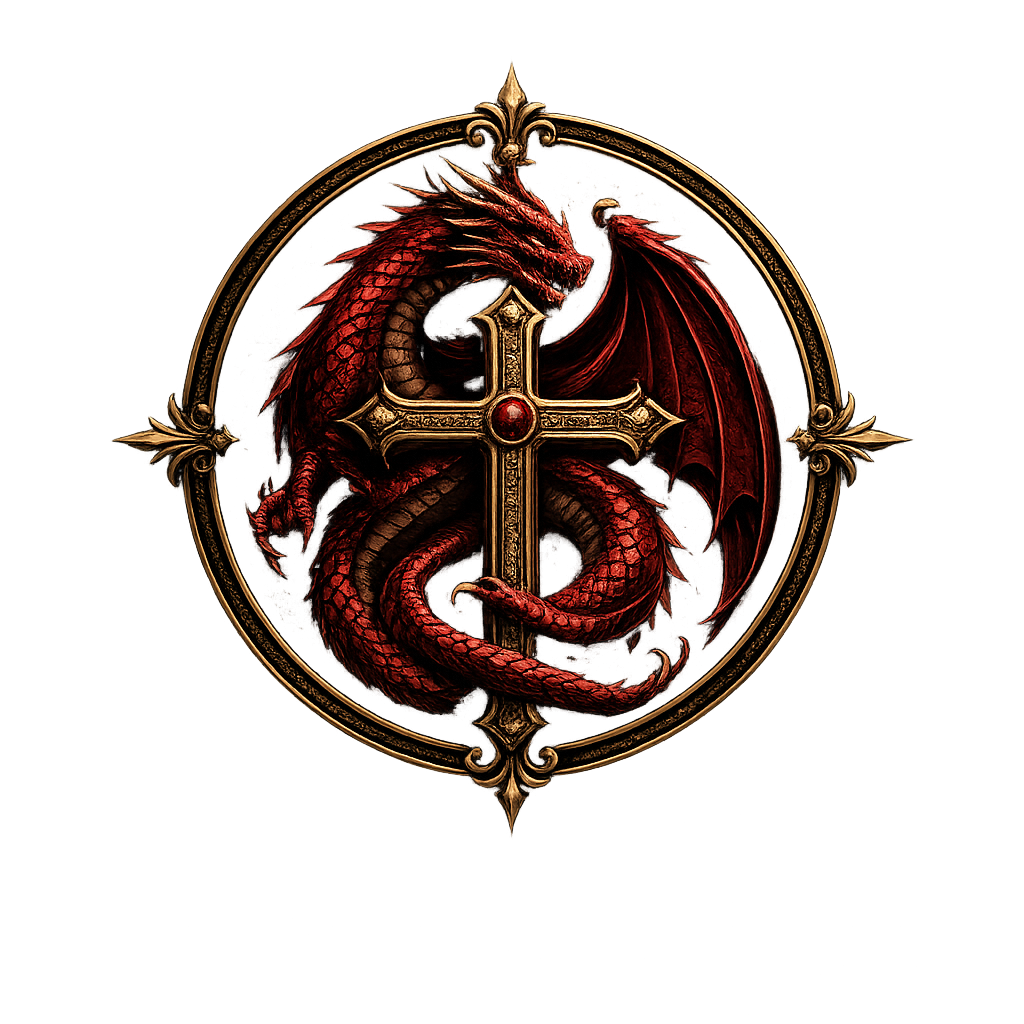
An artistic representation of the Order of the Dragon and its influence on the history of medieval Europe.
8 min read
“Long before anyone called him a monster, his family bore the mark of a dragon — sworn not to darkness, but to defending the light against an empire determined to extinguish it.”
Every legend needs an origin more solid than folklore alone can provide. The legend of Dracula finds one of its sturdiest, most genuinely historical foundations not on any battlefield or in any castle, but within the founding charter of a chivalric brotherhood established in 1408 by the King of Hungary, anxious about the survival of Christian Europe itself. The Order of the Dragon was never created with any vampire mythology in mind, nor with any particular attention to the small Wallachian family that would, within a generation of its founding, become bound to it so completely that the family’s very name would transform to reflect the association. It was, instead, a serious, politically consequential institution of its era, built to unite Christian nobility against the twin threats of Ottoman expansion and internal religious heresy — and it is precisely because the order was so serious, so historically grounded, that its accidental gift of a name to Vlad the Impaler‘s family carries the peculiar weight it still does today.
Sigismund’s Problem and Sigismund’s Solution
The Order of the Dragon emerged from the specific anxieties of Sigismund of Luxembourg, King of Hungary and, from 1433, Holy Roman Emperor, a ruler who spent much of his long and eventful reign confronting threats to Christian European authority on multiple fronts simultaneously. By the early fifteenth century, Ottoman expansion into the Balkans had already advanced far enough to alarm Hungarian and wider Central European observers, threatening territories that bordered Sigismund’s own Hungarian kingdom directly. At the same time, Sigismund faced a further, distinctly internal challenge in the form of the Hussite movement, a religious reform movement originating in Bohemia that Sigismund and much of the wider Catholic establishment regarded as a dangerous heresy requiring firm, coordinated suppression.
Facing these overlapping external and internal threats, Sigismund founded the Order of the Dragon in 1408. He drew loosely on the general concept of monarchical chivalric orders then emerging across Western Europe, such as the Order of the Garter in England, but departed from that model considerably in both structure and purpose. Where the Garter and its Western counterparts were built around courtly prestige, Sigismund’s order was built around urgent, dual-purpose necessity, binding together a select group of powerful noblemen in sworn, mutual commitment to defending Christian authority against both Ottoman military expansion and internal religious heterodoxy. Membership was, from the outset, a genuinely significant honour, extended selectively to rulers and high nobility whose cooperation and loyalty Sigismund considered strategically essential, rather than distributed broadly as a merely decorative courtly distinction.
A chivalric order is, at its most functional, simply an elaborate and solemn method of ensuring that powerful men remember, at the moments that matter most, exactly which side they swore to be on.
The Symbolism of the Dragon
The order’s central emblem, from which it drew both its name and much of its enduring symbolic power, depicted a dragon coiled into a circle, its own tail held within its jaws, overlaid with a cross. The image drew on established Christian iconographic traditions in which the dragon represented the forces of evil and chaos — in this particular context, the perceived threat posed by both Ottoman military power and Hussite religious heresy — while the overlaying cross signified Christian faith’s ultimate triumph over these combined dangers. Members of the order wore this emblem, typically in the form of a distinctive pendant or badge, as a visible, permanent marker of their sworn membership and their corresponding obligations to Sigismund’s broader defensive project.
This deliberately fearsome imagery carried an inherent duality that would prove enormously consequential decades later, once the order’s symbolism became attached to a specific Wallachian ruling family. A dragon defeated by the cross was, within the order’s own intended framing, an image of triumphant Christian defence — but a dragon remained, inescapably, a dragon, an image that could just as easily be read, particularly by observers less invested in the order’s specific Christian symbolism, as an emblem of something considerably more sinister and threatening in its own right.
An emblem designed to frighten one’s enemies carries, built into its very design, the risk of eventually frightening everyone else as well.
Vlad II Dracul’s Induction
Vlad’s father, Vlad II, was inducted into the Order of the Dragon around 1431, during a period when he was cultivating closer ties with Sigismund’s court in pursuit of Hungarian backing for his own ambitions to secure the Wallachian throne. This induction represented a genuinely significant political achievement for a Wallachian nobleman seeking to establish his credentials and secure powerful patronage within the broader Central European Christian political order. Membership in Sigismund’s prestigious brotherhood signalled both Vlad II’s personal reliability as an ally against Ottoman expansion, and his broader integration into the wider network of Christian nobility Sigismund had assembled around the order’s founding purpose.
Following his induction, Vlad II adopted the epithet “Dracul,” derived directly from the order’s central dragon emblem. This nickname functioned simultaneously as a genuine mark of pride in his prestigious new affiliation and, given the word’s secondary meaning of “devil” within the Romanian vernacular of the period, as an epithet carrying an inherent and immediate ambiguity that Vlad II himself may not have fully anticipated when he first embraced it. Contemporary Wallachian coinage minted during Vlad II’s reign notably featured the order’s dragon emblem directly, providing clear material evidence of how seriously he embraced and publicised this new chivalric affiliation.
A father’s proud new title, adopted to honour a prestigious brotherhood, would within a single generation become the very name history remembers most for horror rather than honour.
From Dracul to Dracula
Vlad III inherited both his father’s throne and, through the conventions of Romanian patronymic naming, a derivative form of his father’s dragon-derived epithet, becoming known as Dracula, meaning “son of the dragon,” or, drawing on the same secondary linguistic ambiguity that had already attached itself to his father’s nickname, “son of the devil.” This inherited name, drawn directly and traceably from Sigismund’s chivalric order rather than from any independent invention or later folkloric embellishment, represents one of the few elements of the entire Dracula legend that can be documented with genuine historical confidence, tracing a clear, unbroken line from a specific institutional founding in 1408 through to the name history would eventually attach most famously, if largely inaccurately, to an entirely fictional vampire count four and a half centuries later.
It is worth emphasising precisely how much weight this documented connection actually bears, given how thoroughly later vampire mythology has obscured it. The name Dracula did not emerge from any supernatural folklore, nor did Bram Stoker invent it for his 1897 novel; it was a genuine historical patronymic, inherited through entirely conventional means from a father’s membership in a serious, historically significant chivalric institution.
The Order’s Wider Legacy
Beyond its unexpected role in shaping Vlad’s family name, the Order of the Dragon carried genuine, if more modest, historical significance in its own right as an instrument of Sigismund’s broader anti-Ottoman and anti-Hussite political strategy throughout the early fifteenth century. Membership extended to numerous other prominent Central European and Balkan nobility beyond Vlad II, forming part of Sigismund’s broader effort to construct a genuinely coordinated network of Christian aristocratic resistance against the overlapping threats he perceived to his authority and to wider Christian European stability. The order’s practical military effectiveness proved considerably more limited than its founding ambitions might have suggested, given the ultimate trajectory of Ottoman expansion throughout the century that followed its establishment. Still, its symbolic and dynastic legacy, however unintentionally, proved to be its most lasting historical contribution by a considerable margin.
Sigismund founded his order hoping to defend an empire. What actually survived him, more durably than any military campaign the order ever waged, was a single borrowed word that would eventually travel considerably further than he could ever have imagined.
Timeline: The Order of the Dragon
- 1408 — Sigismund of Luxembourg, King of Hungary, founds the Order of the Dragon to unite Christian nobility against Ottoman expansion and Hussite heresy.
- Early 15th century — The order extends membership to selected rulers and high nobility across Hungary, the Balkans, and wider Central Europe.
- 1433 — Sigismund is crowned Holy Roman Emperor, further elevating the order’s prestige and political significance.
- c. 1431 — Vlad II, father of Vlad the Impaler, is inducted into the Order of the Dragon, subsequently adopting the epithet “Dracul.”
- 1431 — Vlad III (the future Vlad the Impaler) is born, shortly after or around his father’s induction into the order.
- 1430s onward — Vlad II mints Wallachian coinage featuring the order’s dragon emblem, publicising his prestigious affiliation.
- Mid-15th century — Vlad III inherits the derivative patronymic “Dracula” (“son of the dragon”), tracing directly to his father’s order membership.
- 1437 — Sigismund of Luxembourg dies, after which the order’s active political significance gradually diminishes.
- 1897 — Bram Stoker encounters the name “Dracula” and its secondary “devil” translation while researching his novel, unaware of, or at least largely uninterested in, its precise historical origin within Sigismund’s order.
author's note
There is something almost irresistibly ironic sitting at the very root of Vlad’s name. “Dracula” was never invented for horror at all. It is a genuine, documented chivalric inheritance, tracing back to Sigismund of Luxembourg’s earnest attempt, as King of Hungary, to organise Christian resistance against Ottoman expansion — and to the dragon emblem of the order he founded to do it. “Dracul” meant dragon, though it could just as easily be read as devil, and Vlad inherited both meanings folded into a single name long before any novelist ever touched it. A name meant to honour Christian defence eventually became the single most recognisable name in the entire horror genre, and the distance between those two facts says something worth sitting with: even the most seemingly fantastical elements of Vlad’s legend tend to rest on genuine, verifiable history, if only one is willing to trace the name back far enough to find it.
sources and further reading
- Florescu, Radu R., and Raymond T. McNally. Dracula, Prince of Many Faces: His Life and His Times. Little, Brown and Company, 1989 — includes detailed discussion of Vlad II’s induction and the order’s symbolism.
- Treptow, Kurt W. Vlad III Dracula: The Life and Times of the Historical Dracula. Centre for Romanian Studies, 2000.
- Cazacu, Matei. Dracula. Brill, 2017 (English translation of the original French edition).
- Boulton, D’Arcy Jonathan Dacre. The Knights of the Crown: The Monarchical Orders of Knighthood in Later Medieval Europe, 1325–1520. Boydell Press, 1987 — a comprehensive scholarly study of medieval chivalric orders, including the Order of the Dragon’s founding and structure.
- Engel, Pál. The Realm of St Stephen: A History of Medieval Hungary, 895–1526. I.B. Tauris, 2001 — useful context on Sigismund of Luxembourg’s wider reign and political strategy.
- Miller, Elizabeth. Dracula: Sense and Nonsense. Desert Island Books, 2000 — addresses how the historical Order of the Dragon relates, and does not relate, to Stoker’s later fictional treatment of the name.
A note on sources: the order’s precise membership roll and founding statutes survive only partially, meaning some details of its internal structure and full historical membership remain debated among specialists in medieval chivalric institutions. This article has followed the broad, well-documented consensus regarding the order’s founding purpose and its confirmed connection to Vlad II’s induction.
related articles
- Not Just Another Chivalric Order: What Set the Order of the Dragon Apart
- The Other Knights of the Order of the Dragon
- Vlad the Impaler’s Involvement With the Order of the Dragon
- The Achievements of the Order of the Dragon
- Vlad the Impaler: The man behind the Dracula legend
- Vlad the Impaler’s three reigns
- Wallachia: The Kingdom between Two Empires
- The Rise of the Basarab Dynasty
- The Wallachian Voivodes Explained
- Why Wallachia Was Important to Europe
continue your journey through history
Discover the novels inspired by the people, rivalries and legends of medieval Europe.

Historical Fiction Author
History has always fascinated me—not simply for the great battles or famous rulers, but for the people behind the legends. Through years of research into medieval Europe, the Ottoman Empire, Tudor England, and the lives of extraordinary historical figures, I’ve sought to uncover the stories that lie beneath popular myths. My novels blend documented history with compelling fiction, inviting readers to step into the past and experience it as those who lived it might have done.
Join the Related to Dracula Circle