
HISTORY · ORDER OF THE DRAGON
Not Just Another Chivalric Order: What Set the Order of the Dragon Apart
Why Sigismund’s Brotherhood Looked Nothing Like the Garter or the Golden Fleece

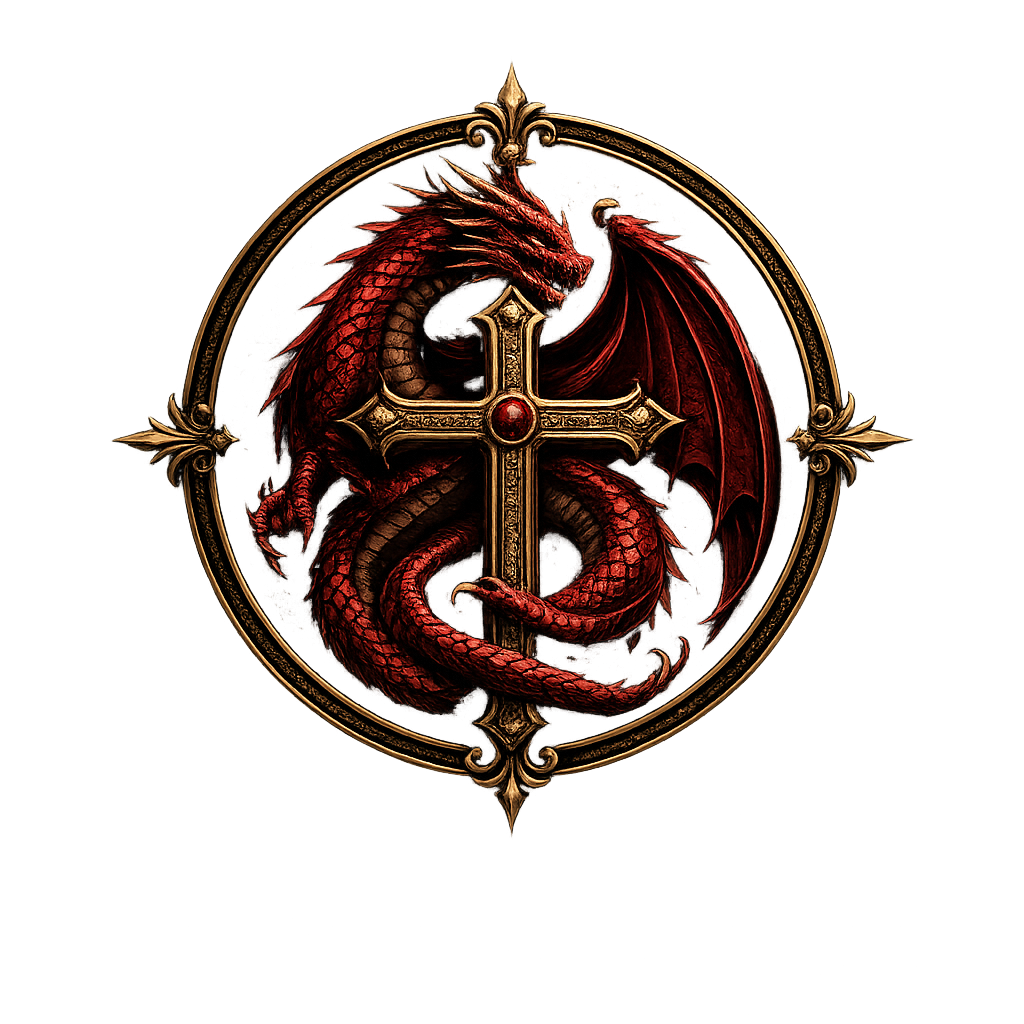
An artistic interpretation of the Order of the Dragon, the medieval chivalric order founded to defend Christian Europe.
8 min read
“Most chivalric orders were built to celebrate a court. The Order of the Dragon was built to survive an emergency — and that single difference in purpose shaped almost everything else about how it actually functioned.”
The late medieval period produced a genuine proliferation of chivalric orders across Christian Europe, brotherhoods of noble knighthood bound together through elaborate ceremony, distinctive emblems, and sworn mutual obligation, each claiming to represent the highest ideals of Christian knighthood in its own particular kingdom or court. England had its Order of the Garter, Burgundy its Order of the Golden Fleece, and numerous smaller kingdoms and principalities across the continent maintained their own comparable institutions, each competing, in its own way, for prestige within a crowded and increasingly formalised chivalric landscape. Sigismund of Luxembourg’s Order of the Dragon, founded in 1408, has often been discussed alongside these more famous contemporaries, grouped within the same broad category of late medieval monarchical chivalric orders — and yet closer examination reveals an institution built around a fundamentally different logic entirely, one shaped less by courtly ceremony and dynastic prestige than by genuine, urgent strategic necessity.
Most Orders Were Built to Celebrate. This One Was Built to Mobilise.
The Order of the Garter, founded by Edward III of England in the 1340s, and the Order of the Golden Fleece, founded by Philip the Good of Burgundy in 1430, both emerged primarily as instruments of dynastic prestige and courtly cohesion, binding a select group of the realm’s highest nobility to their sovereign through elaborate ceremony, shared symbolism, and regular collective gatherings that reinforced royal authority and celebrated an idealised, chivalric vision of noble Christian knighthood. These orders certainly carried genuine political weight, strengthening loyalty networks and offering their founding monarchs valuable tools of patronage and control. Still, their founding purpose remained oriented primarily around internal court cohesion and dynastic display rather than any specific, immediate external military or religious threat requiring urgent coordinated response.
The Order of the Dragon emerged from an entirely different set of pressures. Sigismund founded it not to celebrate an already-secure court, but to respond directly to two overlapping and genuinely urgent crises threatening his own authority and the wider stability of Christian Central Europe: the accelerating advance of Ottoman military power into the Balkans, and the internal religious upheaval of the Hussite movement within Bohemia, both of which demanded immediate, coordinated noble cooperation rather than merely symbolic courtly loyalty. Where the Garter and the Golden Fleece functioned primarily as instruments of prestige that happened to carry secondary political utility, the Order of the Dragon functioned first and foremost as a practical military and political alliance, with ceremonial trappings serving that underlying strategic purpose rather than the reverse.
A brotherhood formed to reinforce an already-comfortable court asks something quite different of its members than a brotherhood formed because the alternative to cooperation might genuinely be catastrophe.
A Membership That Crossed Borders Deliberately
Most contemporary chivalric orders, including both the Garter and the Golden Fleece, drew their membership almost exclusively from within a single kingdom’s own established nobility, reinforcing internal loyalty and cohesion within a comparatively bounded political community. The Order of the Dragon, by contrast, was deliberately structured to extend membership considerably further afield, drawing in rulers and high nobility not only from Sigismund’s own Hungarian kingdom but from across a genuinely wide swathe of Central and South-Eastern Europe, including Wallachian nobility such as Vlad II, various Serbian, Bosnian, and Bulgarian nobles facing direct Ottoman military pressure, and numerous other regional rulers whose cooperation Sigismund considered strategically essential to the Order’s founding purpose.
This deliberately international, cross-border membership reflected the genuinely transnational nature of the threat the Order had been created to address. Ottoman expansion did not respect the borders of any single kingdom. Sigismund’s response, unusually for a chivalric order of this period, was structured accordingly, functioning less like the tightly bounded royal household orders of England or Burgundy and more like an early, loosely structured version of a multinational defensive coalition, bound together through shared chivalric obligation rather than through any single unified command structure or shared national identity.
Where other orders reinforced the boundaries of a single kingdom’s nobility, the Order of the Dragon was built, from the outset, to reach directly across them.
This structural difference explains why a Wallachian nobleman like Vlad II could become a genuinely significant, symbolically important member of an order founded by a Hungarian king and Holy Roman Emperor. This arrangement would have been considerably less likely within the more nationally bounded membership structures of comparable Western European orders during the same period.
A Dual Mission Most Orders Never Attempted
Perhaps the most distinctive structural feature of the Order of the Dragon lay in its explicitly dual founding mission, combining external military defence against Ottoman expansion with internal religious enforcement against Hussite heresy within a single institutional framework. Most comparable chivalric orders of the period maintained a considerably narrower, more singular institutional purpose, whether oriented toward general chivalric ideals, dynastic loyalty, or, in the specific case of orders such as the Teutonic Knights, a more focused crusading mission directed at a particular external frontier.
The Order of the Dragon’s combination of external military mobilisation against a foreign imperial threat with internal doctrinal enforcement against a domestic religious movement represented a genuinely unusual institutional hybrid, reflecting Sigismund’s own particular political predicament as a ruler facing serious, simultaneous threats to his authority from both directions at once. This dual mission meant that order membership carried a correspondingly broader and more demanding set of practical obligations than membership in orders built around a single, more narrowly defined purpose, requiring members to demonstrate genuine, active commitment across two quite different fronts of Sigismund’s broader defensive project.
Most orders asked their members to defend one thing. Sigismund’s Order asked its members to defend two entirely different things simultaneously, and to consider both equally central to what membership actually meant.
Symbolism Built for Fear, Not Just Prestige
The visual symbolism of comparable chivalric orders tended toward emblems emphasising purity, loyalty, and idealised courtly virtue — the Garter’s motto and insignia, for instance, drawing on themes of honour and reproach toward doubt, the Golden Fleece invoking classical mythological associations with heroic quest and reward. The Order of the Dragon’s central emblem, by contrast, depicted a dragon, a creature drawn from established Christian iconographic tradition specifically to represent evil, chaos, and destructive threat, coiled with its own tail held in its jaws and overlaid with a cross signifying ultimate Christian triumph over that threat.
This was, in a genuinely meaningful sense, symbolism built around confronting fear rather than celebrating idealised virtue, reflecting the Order’s underlying founding purpose as an institution mobilised against genuine, immediate danger rather than one built to showcase an already-secure court’s refined chivalric culture. The choice carried real consequences centuries later, when this same fear-oriented dragon symbolism, inherited through Vlad II’s adopted epithet and passed down to his son, would prove considerably more susceptible to reinterpretation as something genuinely sinister than the more purely celebratory emblems of comparable Western European orders ever could have been.
A garter and a golden fleece invite admiration. A dragon, however carefully framed as defeated by the cross above it, invites something closer to unease — and unease, as history eventually demonstrated, travels considerably further across the centuries than admiration usually does.
An Order Judged by Different Standards of Success
Because the Order of the Dragon was built around urgent strategic necessity rather than primarily around courtly prestige, its historical legacy invites a rather different standard of evaluation than that typically applied to comparable institutions. The Garter and the Golden Fleece have generally been judged successful by the standards most relevant to their own founding purpose, having achieved genuine longevity as institutions of dynastic prestige, with the Garter in particular surviving, in modified form, into the present day. The Order of the Dragon, judged by its own explicitly stated founding purpose of coordinating effective resistance against Ottoman expansion and Hussite heresy, achieved considerably more mixed results, with Ottoman advance into the Balkans and beyond continuing steadily throughout the century following the Order’s founding regardless of whatever coordinated noble resistance it managed to mobilise.
And yet the Order’s actual historical legacy, however modest by its own founding military and religious standards, has proven remarkably durable through an entirely different, largely unintended channel: the patronymic inheritance that transformed Vlad II’s induction into his son’s own defining, world-famous name. No comparable chivalric order of the period can claim quite so improbable and enduring a secondary legacy, one that has, in the centuries since, arguably eclipsed the Order’s own original founding purpose entirely in terms of sheer global cultural recognition.
Timeline: The Order of the Dragon in Comparative Context
- 1348 — Edward III of England founds the Order of the Garter, generally regarded as the archetype of the courtly, dynastic-prestige chivalric Order.
- 1408 — Sigismund of Luxembourg founds the Order of the Dragon, structured around urgent, dual military and religious strategic necessity rather than primarily courtly display.
- 1430 — Philip the Good of Burgundy founds the Order of the Golden Fleece, following the more established dynastic-prestige model.
- c. 1431 — Vlad II is inducted into the Order of the Dragon, illustrating the Order’s deliberately cross-border, multinational membership structure.
- 1433 — Sigismund is crowned Holy Roman Emperor, further extending the Order’s political reach across Central Europe.
- 1437 — Sigismund dies, after which the Order’s active coordinating function steadily diminishes, in contrast to the continued institutional longevity of orders such as the Garter.
- Mid-15th century — Vlad III inherits the “Dracula” patronymic, an unintended but historically significant legacy of the Order’s distinctive dragon symbolism.
- Present day — The Order of the Garter continues in modified ceremonial form; the Order of the Dragon survives primarily through its unexpected connection to Vlad III’s name.
author's note
It is tempting to file the Order of the Dragon alongside the Garter or the Golden Fleece as one more entry in the same broad category of medieval chivalric order — but the comparison falls apart the moment you look closely. Sigismund’s order was built around urgency rather than prestige, and it reached deliberately across borders that most comparable orders were built specifically to reinforce. That distinction matters more than it first appears, because it reframes Vlad II’s induction entirely: not a purely ceremonial honour, but active enlistment in what Sigismund clearly intended as a working defensive coalition. The name Vlad III eventually inherited was never simply decorative. It was, from its very origin, a name born out of genuine mobilisation against genuine danger.
sources and further reading
- Boulton, D’Arcy Jonathan Dacre. The Knights of the Crown: The Monarchical Orders of Knighthood in Later Medieval Europe, 1325–1520. Boydell Press, 1987 — the standard comparative study of medieval monarchical chivalric orders, including detailed treatment of the Order of the Dragon alongside the Garter and Golden Fleece.
- Florescu, Radu R., and Raymond T. McNally. Dracula, Prince of Many Faces: His Life and His Times. Little, Brown and Company, 1989.
- Engel, Pál. The Realm of St Stephen: A History of Medieval Hungary, 895–1526. I.B. Tauris, 2001.
- Vale, Malcolm. The Princely Court: Medieval Courts and Culture in North-West Europe, 1270–1380. Oxford University Press, 2001 — useful comparative context on courtly chivalric culture in Western Europe.
- Cazacu, Matei. Dracula. Brill, 2017 (English translation of the original French edition).
- Fudge, Thomas A. The Crusade against Heretics in Bohemia, 1418–1437. Ashgate, 2002 — detailed context on the Hussite threat that shaped part of the Order of the Dragon’s founding mission.
A note on sources: comparative studies of medieval chivalric orders vary in how strictly they categorise the Order of the Dragon alongside more purely ceremonial institutions such as the Garter, given its unusual dual military-religious mission and cross-border membership. This article has drawn on Boulton’s comprehensive comparative framework, generally regarded as the most authoritative treatment of the subject available.
related articles
- The Order of the Dragon: The Brotherhood Behind Dracula
- The Other Knights of the Order of the Dragon
- Vlad the Impaler’s Involvement With the Order of the Dragon
- The Achievements of the Order of the Dragon
- Vlad the Impaler: The man behind the Dracula legend
- Vlad the Impaler’s three reigns
- Wallachia: The Kingdom between Two Empires
- The Rise of the Basarab Dynasty
- The Wallachian Voivodes Explained
- Why Wallachia Was Important to Europe
continue your journey through history
Discover the novels inspired by the people, rivalries and legends of medieval Europe.

Historical Fiction Author
History has always fascinated me—not simply for the great battles or famous rulers, but for the people behind the legends. Through years of research into medieval Europe, the Ottoman Empire, Tudor England, and the lives of extraordinary historical figures, I’ve sought to uncover the stories that lie beneath popular myths. My novels blend documented history with compelling fiction, inviting readers to step into the past and experience it as those who lived it might have done.
Join the Related to Dracula Circle