
HISTORY · Legends & Folklore
Wallachian Legends & Folklore: When History Becomes Myth
How Fourteenth-, Fifteenth-, and Sixteenth-Century Wallachia Turned Memory Into Something Considerably Stranger
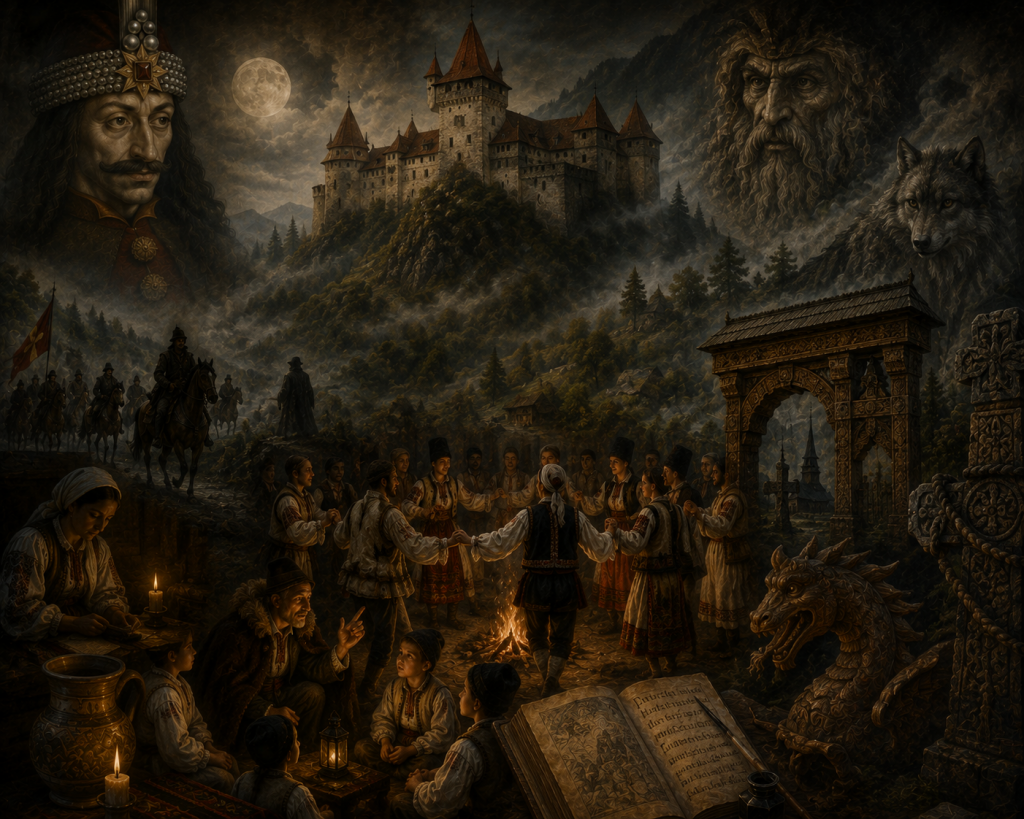
Artistic interpretation depicting the medieval legends, folklore, and historical traditions of Romania, where real people, places, and events inspired the enduring myths behind the Related to Dracula series.
9 min read

“A society does not simply record its history and leave it undisturbed. It tells that history back to itself, generation after generation, and each retelling adds something new — a detail sharpened, a villain darkened, a hero given powers no genuine historical record ever claimed for him. What eventually survives is neither pure history nor pure invention, but something considerably more interesting than either alone.”
There is no more fitting place to start exploring legends and folklore than the specific historical and cultural environment that produced some of Vlad the Impaler‘s own story: fourteenth-, fifteenth-, and sixteenth-century Wallachia, a region whose own turbulent political history unfolded alongside a rich, genuinely distinctive oral folklore tradition. Understanding how Wallachian and broader Romanian folklore actually functioned during this specific period, considered on its own terms rather than merely as backdrop to any single historical figure’s later legend, reveals a genuinely sophisticated cultural tradition through which ordinary people made sense of political upheaval, mortal danger, and the considerable uncertainty of daily life in a principality perpetually caught between two vastly more powerful neighbouring empires.
A Folklore Tradition Considerably Older Than Its Christian Surface
Wallachian and broader Romanian folklore of this period drew on a genuinely deep, layered cultural inheritance considerably older than the Orthodox Christian religious framework that had, by the fourteenth century, become the region’s own dominant formal religious identity. Beneath this Christian surface, a great many pre-Christian beliefs and supernatural traditions, tracing back through the region’s own considerably older Dacian and broader pre-Roman cultural heritage, continued exercising genuine, sustained influence over ordinary popular belief and practice, producing a folklore tradition that Orthodox religious authorities of the period frequently found themselves negotiating with and, at various points, actively attempting to suppress, rather than straightforwardly replacing outright.
This layered cultural inheritance produced a genuinely distinctive body of supernatural belief populated by figures considerably removed from conventional Christian religious framework alone: forest spirits, household protective figures, and various malevolent supernatural beings believed to threaten unwary travellers or vulnerable individuals under specific circumstances, all coexisting, often in genuine tension, alongside the more formally established Orthodox Christian religious practice that governed the region’s own official public religious life.
A peasant attending Orthodox liturgy on a Sunday morning might, within the very same week, take genuinely serious practical precautions against an entirely different, considerably older category of supernatural threat that no priest’s own formal religious teaching had ever fully managed to displace.
The Strigoi: Restless Dead and Living Threat
Among the most historically significant and enduringly influential figures within this broader Wallachian and Romanian folklore tradition stands the strigoi, a category of restless or malevolent dead believed capable of returning from the grave to trouble the living, a folkloric tradition that scholars examining the later development of Western vampire mythology, generally identify as among the most direct and historically significant regional folkloric antecedents to the considerably later, internationally famous vampire legend that would eventually, and largely coincidentally, become associated with Vlad the Impaler’s own borrowed name.
The strigoi tradition itself proved genuinely complex and internally varied, distinguishing between strigoi vii, living individuals believed to possess certain malevolent supernatural capabilities during their own lifetime, and strigoi morți, the considerably more familiar tradition of the restless dead returning from the grave, typically believed to result from improper burial practices, an unresolved grievance from the deceased’s own lifetime, or certain specific circumstances of death considered to carry genuine supernatural danger. Communities across this period maintained genuinely elaborate, carefully specific protective practices intended to prevent strigoi manifestation, including particular burial customs and, in cases of suspected strigoi activity, various ritual practices intended to neutralise the specific threat believed to be troubling a given community.
The strigoi tradition offered fourteenth-, fifteenth-, and sixteenth-century Wallachian communities something genuinely practical alongside its own considerable supernatural drama: a coherent explanatory framework for otherwise inexplicable misfortune, illness, or death, and a set of concrete, actionable practices through which a frightened community could feel it was actively addressing the threat rather than remaining entirely helpless before it.
The Zmeu and the Forest’s Own Dangers
Beyond the strigoi tradition, Wallachian and broader Romanian folklore of this period populated the surrounding natural landscape, particularly the region’s own extensive forests and mountains, with a genuinely rich array of additional supernatural figures, among the most significant being the zmeu, a dragon-like supernatural being appearing across numerous regional folk tales, typically cast as a genuinely formidable antagonist figure confronted by human heroes within the broader narrative tradition of Romanian folk storytelling. The zmeu tradition, while considerably more clearly rooted in narrative folk tale than in the kind of genuinely believed, practically consequential supernatural threat the strigoi tradition represented, nonetheless carried genuine cultural significance, reflecting broader regional anxieties regarding the specific dangers, both natural and supernatural, that the surrounding forested and mountainous landscape genuinely represented to ordinary people navigating it.
Additional folkloric figures populating this same broader supernatural landscape included the Iele, a group of dangerous, seductive supernatural female spirits associated with nocturnal dancing and believed capable of inflicting genuine harm, including illness, blindness or madness, upon anyone unfortunate enough to encounter their activities, a folkloric tradition reflecting broader regional anxieties regarding the specific dangers night-time travel and isolated forest encounters genuinely represented within a period offering considerably fewer practical means of illumination, protection, or emergency assistance than later centuries would eventually provide.
Folklore as Political Commentary
Beyond its more straightforwardly supernatural dimensions, Wallachian and Romanian folklore of this period frequently functioned as a genuine, if necessarily indirect, vehicle for political commentary and popular processing of the considerable political upheaval. Oral folk tradition offered ordinary people, possessing considerably less direct political voice or influence than the boyar nobility, a genuine, if necessarily coded, means of processing and commenting upon the specific rulers and political circumstances shaping their own daily lives, often through folk tales and legendary figures whose own supernatural or exaggerated characteristics allowed genuinely pointed political commentary to circulate under the protective cover of ostensible entertainment or supernatural warning rather than direct, dangerous political criticism.
This dynamic proved directly, genuinely relevant to Vlad the Impaler’s own posthumous folkloric reputation, as the specific Wallachian and broader regional folk memory surrounding his own reign, considered separately from the more formally chronicled historical accounts as history records, developed its own distinctive oral folkloric character across the generations following his death, a character that, as as history records, differed considerably across the various regional traditions in which his own posthumous reputation continued developing.
A folk tale about a fearsome, supernatural ruler could carry genuine, pointed political commentary regarding entirely real, contemporary rulers and their own conduct — commentary considerably safer to voice through the protective distance of legend and exaggeration than through any more direct, dangerous form of open political criticism.
The Church’s Uneasy Negotiation With Popular Belief
Orthodox religious authorities across this period maintained a genuinely complicated, frequently uneasy relationship with the broader folkloric tradition, neither straightforwardly endorsing nor entirely successfully suppressing beliefs and practices that frequently sat in genuine tension with formal Orthodox Christian doctrine. Church authorities periodically issued formal condemnations of specific folk practices considered incompatible with proper Christian belief, while simultaneously, in genuine practical terms, frequently incorporating or accommodating certain folk traditions within broader popular religious practice, producing a genuinely syncretic religious culture in which formally Orthodox Christian practice and considerably older folk tradition coexisted, however uneasily, rather than one straightforwardly replacing the other entirely.
This ongoing negotiation between formal religious authority and popular folk tradition reflects a broader pattern common across a great many regional folklore traditions: formal religious and political authority rarely succeeds in entirely displacing genuinely deep-rooted popular folk belief, however sustained and sincere its own efforts toward doing so, producing instead a genuinely layered cultural inheritance in which older traditions persist, adapt, and continue exercising genuine influence considerably longer than any formal religious or political authority’s own preferred narrative would typically acknowledge.
A Living Tradition, Not a Historical Curiosity Alone
Considered as a whole, the fourteenth-, fifteenth-, and sixteenth-century Wallachian and broader Romanian folklore tradition deserves recognition as considerably more than mere historical curiosity or entertaining supernatural anecdote alone. It represents a genuinely sophisticated cultural framework through which ordinary people, possessing considerably less direct political voice or institutional power than the rulers and nobility, made sense of genuine mortal danger, political upheaval, and the considerable daily uncertainty of life within a principality perpetually caught between vastly more powerful neighbouring empires. This same folkloric tradition would eventually intersect in genuinely unexpected and historically consequential ways with the entirely separate, considerably later Western vampire mythology, a convergence worth examining considerably further in its own right.
Timeline: Wallachian and Romanian Folklore, 14th–16th Centuries
- 14th century — Wallachia’s own political emergence unfolds alongside an already well-established regional folklore tradition drawing on considerably older pre-Christian cultural inheritance.
- 14th–15th centuries — The strigoi tradition and related folk beliefs regarding the restless dead become genuinely well documented within regional oral tradition and associated protective burial practices.
- 15th century — Vlad the Impaler’s own turbulent reign unfolds within this same broader cultural and folkloric environment.
- Late 15th–16th centuries — Posthumous folk memory surrounding Vlad’s own reign begins developing distinctive regional oral characteristics.
- 16th century — Orthodox religious authorities continue their ongoing, genuinely uneasy negotiation with persistent folk beliefs and practices sitting in tension with formal Christian doctrine.
- Later centuries — Regional Romanian folklore, including the strigoi tradition, eventually intersects with the entirely separate development of Western vampire mythology.
author's note
This is where Related to Dracula properly begins, in spirit if not on the page: a Wallachia where the boundary between history and folklore was never as fixed as later retelling suggests. The main character in my books, Sebastian, grows up steeped in exactly this world, a village where old beliefs sit alongside Orthodox faith without much sense of contradiction, and where his own great-grandmother Ana carries knowledge considerably older than anything written down. That folkloric landscape, rather than anything invented wholesale for the novel, mattered enormously to me, because I wanted Sebastian’s own inherited abilities to feel like they belonged to a genuine, coherent tradition.
sources and further reading
- Kligman, Gail. The Wedding of the Dead: Ritual, Poetics, and Popular Culture in Transylvania. University of California Press, 1988 — a detailed anthropological study of Romanian folk ritual and belief.
- Senn, Harry A. Were-Wolf and Vampire in Romania. East European Monographs, 1982 — a dedicated scholarly study of the strigoi tradition and related Romanian folklore.
- Pócs, Éva. Fairies and Witches at the Boundary of South-Eastern and Central Europe. Suomalainen Tiedeakatemia, 1989 — useful comparative context on regional supernatural folklore traditions.
- Eliade, Mircea. Zalmoxis: The Vanishing God. University of Chicago Press, 1972 — examines the pre-Christian religious and folkloric inheritance underlying later Romanian popular belief.
- McNally, Raymond T. and Radu Florescu. In Search of Dracula: The History of Dracula and Vampires. Houghton Mifflin, 1994.
- Vulcănescu, Romulus. Mitologie Română (Romanian Mythology). Editura Academiei, 1985 — a foundational Romanian-language study of the broader regional mythological tradition.
A note on sources: much of what survives regarding this period’s oral folklore tradition was recorded considerably later, often not until the nineteenth or early twentieth centuries, by folklorists and ethnographers working to document rapidly changing rural traditions, meaning historians must exercise genuine care in projecting later recorded folklore back onto the specific fourteenth- to sixteenth-century period. This article has drawn on the broad scholarly consensus regarding the deeper historical roots of these traditions while acknowledging the genuine limitations of the surviving documentary record.
related articles
continue your journey through history
Discover the novels inspired by the people, rivalries and legends of medieval Europe.

Historical Fiction Author
History has always fascinated me—not simply for the great battles or famous rulers, but for the people behind the legends. Through years of research into medieval Europe, the Ottoman Empire, Tudor England, and the lives of extraordinary historical figures, I’ve sought to uncover the stories that lie beneath popular myths. My novels blend documented history with compelling fiction, inviting readers to step into the past and experience it as those who lived it might have done.
Join the Related to Dracula Circle