
HISTORY · wallachia
Wallachia’s Legacy in Modern Romania
How a Medieval Principality Became the Foundation of a Nation It Never Lived to See
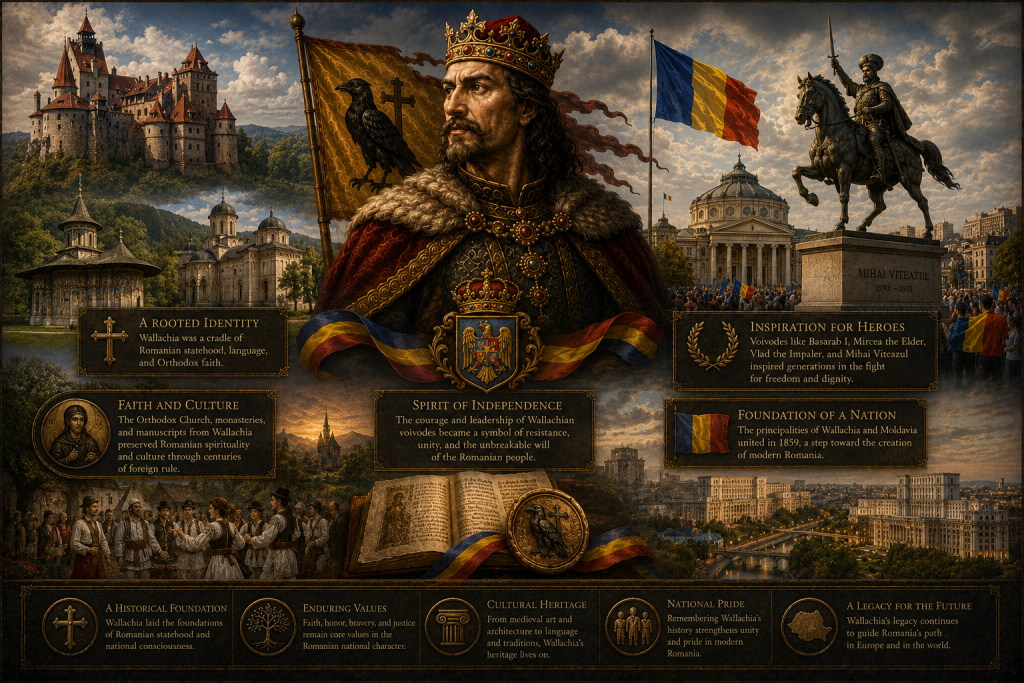
An artistic interpretation of Wallachia’s enduring legacy in modern Romania.
8 min read

“A kingdom can disappear from every map and still remain, quietly, the ground floor of everything built on top of it afterwards. Modern Romania did not simply remember Wallachia. It was, in a very real sense, built directly out of it.”
Medieval Wallachia ceased to exist as an independent political entity long before the modern Romanian state took shape, its later centuries spent under increasingly direct Ottoman administration and, eventually, Phanariot governance that had stripped away nearly every institutional feature its earlier voivodes would have recognised as genuinely their own. And yet to travel through modern Romania today — its currency, its national holidays, its capital city, its school curricula, its enduring popular fascination with figures like Vlad the Impaler — is to encounter Wallachia everywhere, not as a forgotten medieval footnote but as one of the two principal foundations, alongside neighbouring Moldavia, upon which an entire modern nation consciously and deliberately built its own sense of continuous historical identity. Understanding how a medieval principality that formally disappeared centuries ago became so thoroughly woven into a nineteenth and twentieth-century nation-building project reveals a great deal about how modern states construct legitimacy from historical memory, choosing carefully which threads of a genuinely complicated past to weave forward into the present.
From Two Principalities to One Nation
The most direct institutional link between medieval Wallachia and the modern Romanian state runs through the political union of 1859, when Wallachia and its northern neighbour, Moldavia, formally united under a single elected ruler, Alexandru Ioan Cuza, in a development that both principalities’ populations had increasingly come to view, across the preceding decades of growing nationalist sentiment, as the natural and overdue restoration of a shared Romanian identity that centuries of separate Ottoman tributary administration had artificially divided.
This union did not simply create a new state from nothing; it consciously and deliberately fused two distinct medieval political traditions, each carrying its own dynastic history, administrative customs, and regional identity, into a single national project that increasingly emphasised their shared linguistic, cultural, and, crucially, historical inheritance over their centuries of separate political development. Wallachia contributed to this new union not merely territory and population, but an entire accumulated historical narrative — the Basarab dynasty’s founding resistance against Hungarian overlordship, the long medieval struggle against Ottoman expansion, and, prominently among its individual historical figures, the fierce, uncompromising resistance associated with rulers like Vlad the Impaler — that nineteenth-century Romanian nation-builders found genuinely useful in constructing a sense of continuous, deeply rooted national identity stretching back centuries before the new state’s own actual formation.
A new nation rarely invents its founding story from nothing. It usually goes looking through whatever older stories are already lying around, and chooses the ones that serve its present purposes best.
Bucharest: A Wallachian City Becomes a National Capital
Perhaps the single most visible and enduring legacy of medieval Wallachia within modern Romania is Bucharest itself, a city whose origins as a significant Wallachian settlement and, eventually, princely residence date back centuries before it became the unified nation’s capital following the 1859 union, and which has served, ever since, as the undisputed political, cultural, and economic centre of the modern Romanian state. Bucharest’s rise to prominence within Wallachia itself had been gradual, only fully eclipsing Târgoviște as the principality’s primary princely seat in the sixteenth century, well after Vlad’s own reign, during which Târgoviște had remained the dominant Wallachian capital.
That a specifically Wallachian city, rather than one drawn from neighbouring Moldavia’s own historical capital tradition centred on Iași, ultimately became the seat of unified modern Romanian government reflects, in part, straightforward practical considerations of geography and infrastructure by the mid-nineteenth century. Still, it has nonetheless meant that the day-to-day institutional life of the modern Romanian state has, since its very formation, been conducted from within a city whose own historical roots and civic identity trace directly back to medieval Wallachian political tradition, giving that specific regional inheritance a continuing prominence within national life that Moldavia’s own comparably rich medieval history has not enjoyed to quite the same institutional degree.
Vlad the Impaler as National Symbol
No discussion of Wallachia’s legacy within modern Romania would be complete without direct attention to how thoroughly Vlad the Impaler himself has been reclaimed and repurposed as a specifically national symbol across the nineteenth and twentieth centuries. This development deserves fuller attention here as a distinctly Romanian, rather than merely Wallachian, phenomenon. Where centuries of German pamphleteering and, later, Bram Stoker’s international vampire mythology had cast Vlad predominantly as a figure of horror for Western European and broader international audiences, Romanian nationalist historians and cultural figures, particularly from the nineteenth century onward, increasingly emphasised instead his fierce, uncompromising military resistance against both Ottoman and, at various points, Hungarian domination, presenting him as an early and powerful symbol of Romanian determination to resist foreign subjugation.
This reclamation reached a particular institutional high-water mark during the twentieth century, including periods of explicit state promotion of Vlad’s more heroic dimensions under various twentieth-century Romanian governments seeking historical figures capable of embodying national resilience and defiance. The result today is a genuinely dual legacy within Romania itself: Vlad remains simultaneously a figure of considerable domestic historical pride, commemorated through statues, currency imagery, and continued prominence within national historical education, and an inescapable component of the country’s international tourism industry, which has, whatever historians’ discomfort with the association, learned to profitably navigate the considerable gap between Vlad’s genuine Wallachian historical legacy and the largely unrelated Western vampire mythology that draws so many international visitors to Romania in the first place.
A single historical figure now serves two audiences simultaneously — one that sees a national symbol of fierce, principled resistance, and another that sees a convenient doorway into an entirely different, imported legend. Modern Romania has, out of practical necessity, learned to serve both without fully reconciling them.
Wallachian Institutions Within Modern Romanian Memory
Beyond Vlad himself, several more specifically institutional and cultural elements of medieval Wallachian tradition continue to inform modern Romanian national memory and civic identity. The broader historical narrative of Wallachian resistance against Ottoman expansion, extending well beyond Vlad’s own reign to include figures such as Mircea the Elder and later Wallachian rulers who continued to navigate the principality’s precarious position between competing regional powers, forms a significant component of how modern Romanian historical education presents the country’s medieval past more broadly, emphasising themes of persistent resistance and hard-won, if often precarious, autonomy that resonate directly with the broader nineteenth and twentieth-century Romanian nationalist narrative of a people who ultimately succeeded, after centuries of foreign domination in various forms, in achieving genuine national independence and unity.
The Wallachian coat of arms, featuring a golden eagle, has similarly found continued life within modern Romanian heraldic and symbolic tradition, incorporated into the broader Romanian national coat of arms in ways that visibly and deliberately preserve Wallachia’s specific historical contribution to the unified nation’s symbolic identity, standing alongside comparable Moldavian and Transylvanian heraldic elements as a conscious institutional acknowledgement that modern Romania understands itself as the direct historical inheritor of these distinct medieval political traditions, rather than as an entirely new creation disconnected from them.
A Legacy Built From Careful Selection
What emerges from examining Wallachia’s legacy within modern Romania is not simply a story of straightforward, uncomplicated historical continuity, but rather a more deliberate and selective process of national memory-building, in which certain elements of Wallachia’s genuinely complicated medieval history — its fierce resistance against foreign domination, its eventual political union with Moldavia, specific symbols and cultural touchstones capable of serving a unifying national narrative — were emphasised and preserved, while other, less usable elements of that same complicated history, including the considerable internal instability, boyar treachery, and centuries of eventual Ottoman administrative subordination, received comparatively less prominent attention within the resulting national story. This is not, in itself, an unusual process; most modern nations construct their historical identities through some comparable process of selective emphasis rather than complete, undifferentiated preservation of every dimension of a genuinely complex past. But recognising this selective process helps explain precisely why Wallachia’s legacy within modern Romania looks the way it does—a legacy built not from the whole of medieval Wallachian history, but from the specific parts of it that a nineteenth- and twentieth-century nation found most useful in explaining itself to itself.
Timeline: From Medieval Principality to National Legacy
- 1330–1476 — The medieval Wallachian political tradition, from Basarab I’s founding victory through Vlad the Impaler’s reign, establishes the historical narrative later drawn upon by Romanian nation-builders.
- 16th century — Bucharest gradually eclipses Târgoviște as Wallachia’s primary princely capital.
- 1716–1821 — The Phanariot period marks the effective institutional end of the medieval Wallachian political tradition.
- 1821 — The Wallachian uprising led by Tudor Vladimirescu begins the process leading toward the end of Phanariot rule and growing Romanian nationalist sentiment.
- 1859 — Wallachia and Moldavia unite under Alexandru Ioan Cuza, forming the foundation of the modern Romanian state.
- 1862 — The united principalities formally adopt the name Romania, cementing the political fusion of the two medieval traditions.
- 19th–20th centuries — Romanian nationalist historians and cultural figures increasingly reclaim Vlad the Impaler as a symbol of resistance against foreign domination.
- 20th century — Various Romanian governments promote Vlad’s heroic dimensions as part of broader national historical education and identity-building.
- Present day — Modern Romania continues to navigate the dual legacy of Vlad as both a genuine national historical symbol and an international tourism draw connected to the largely separate Western Dracula mythology.
author's note
There is something genuinely strange about watching a medieval principality’s rise, its precarious survival, and its eventual gradual dissolution get carefully, deliberately reassembled centuries later into the founding narrative of an entirely new nation. Nations rarely build their founding stories from nothing; they go looking through whatever older material is already lying around and keep the parts that still serve a purpose. Wallachia’s own complicated history — its resistance, its instability, its centuries of subordination — has been sorted this way too, kept and discarded in roughly equal measure, until what survives in modern memory is considerably tidier than what actually happened. Vlad the Impaler’s own continuing relevance owes a great deal to this same process. He is no longer simply a historical figure to be studied. He has become, for modern Romania specifically, a foundation stone in an ongoing national story that his own turbulent, uncertain reign could never have predicted — and that he would probably find every bit as strange and unfinished as the rest of his afterlife has proven to be.
sources and further reading
- Boia, Lucian. History and Myth in Romanian Consciousness. Central European University Press, 2001.
- Hitchins, Keith. Rumania, 1866–1947. Oxford University Press, 1994 — comprehensive coverage of the nation-building process following the 1859 union.
- Djuvara, Neagu. A Brief Illustrated History of Romanians. Humanitas, 2014.
- Treptow, Kurt W., ed. A History of Romania. Centre for Romanian Studies, 1996.
- Light, Duncan. The Dracula Dilemma: Tourism, Identity and the State in Romania. Routledge, 2012.
- Verdery, Katherine. National Ideology Under Socialism: Identity and Cultural Politics in Ceaușescu’s Romania. University of California Press, 1991 — useful for understanding twentieth-century state promotion of national historical figures, including Vlad the Impaler.
A note on sources: the process by which modern Romania has selectively emphasised particular elements of Wallachian history reflects broader patterns of national memory-construction common to many modern states, rather than any uniquely Romanian phenomenon, and this chapter has drawn on scholarship examining both the specific Romanian case and the wider comparative pattern it reflects.
related articles
- Vlad the Impaler: The man behind the Dracula legend
- The Childhood of Vlad the Impaler
- Vlad the Impaler and Mehmed II
- The Night Attack of Târgoviște
- Vlad the Impaler’s three reigns
- Wallachia: The Kingdom between Two Empires
- The Rise of the Basarab Dynasty
- The Wallachian Voivodes Explained
- Why Wallachia Was Important to Europe
- The Fall of Medieval Wallachia
continue your journey through history
Discover the novels inspired by the people, rivalries and legends of medieval Europe.

Historical Fiction Author
History has always fascinated me—not simply for the great battles or famous rulers, but for the people behind the legends. Through years of research into medieval Europe, the Ottoman Empire, Tudor England, and the lives of extraordinary historical figures, I’ve sought to uncover the stories that lie beneath popular myths. My novels blend documented history with compelling fiction, inviting readers to step into the past and experience it as those who lived it might have done.
Join the Related to Dracula Circle