
HISTORY · wallachia
Wallachia: The Kingdom Between Two Empires
How a Narrow Strip of Land Survived by Never Fully Belonging to Anyone
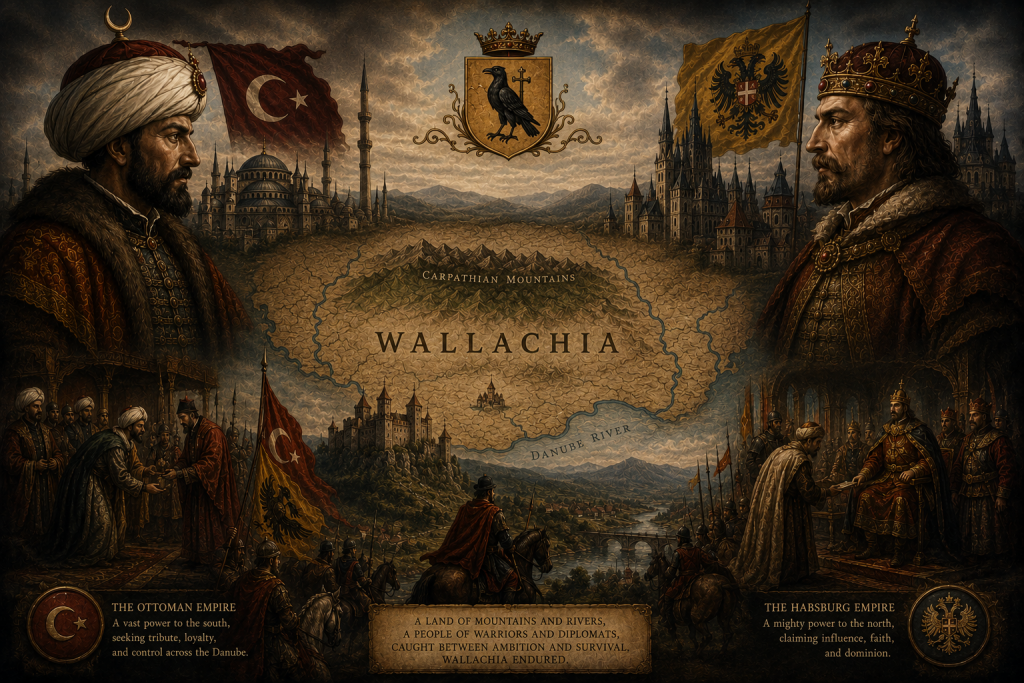
An artistic interpretation of medieval Wallachia between the Ottoman and Christian worlds.
9 min read

“A great power expands by conquest. A small one, wedged between two great powers, survives by something far less glorious and far harder to master — the constant, exhausting art of belonging to neither side completely.”
Most historical kingdoms that endure for centuries do so through some combination of military strength, geographic isolation, or sheer good fortune in their choice of neighbours. Wallachia, the narrow principality stretching along the northern bank of the Danube in what is now southern Romania, enjoyed none of these advantages in any generous measure. It possessed no natural mountain barrier sufficient to keep larger powers permanently at bay, no army capable of matching its neighbours in open battle, and, worst of all, the singularly unfortunate geographic distinction of sitting directly between two of the most ambitious and expansionist powers in fifteenth-century Europe: the Kingdom of Hungary pressing from the north and west, and the rapidly advancing Ottoman Empire pressing from the south. That Wallachia survived at all as a distinct political entity, let alone produced rulers whose names — Vlad the Impaler chief among them — would echo across centuries of European memory, owes less to strength than to an entire political culture built around the delicate, precarious art of never fully belonging to either empire that surrounded it.
A Principality Defined by Its Neighbours
Wallachia emerged as a distinct political entity during the early fourteenth century, traditionally credited to the founding rule of Basarab I, who successfully asserted independence from Hungarian overlordship following a decisive military victory in 1330. From its very origins, then, Wallachia’s identity was defined substantially in relation to a larger neighbouring power rather than through any isolated, self-contained process of state formation — a pattern that would repeat itself, with different neighbours taking different roles, for the remainder of the principality’s medieval existence.
The territory itself offered little in the way of natural defensive advantage. Unlike Transylvania, its mountainous neighbour to the north protected by the natural fortress of the Carpathian range, Wallachia consisted largely of open, rolling terrain well suited to agriculture but poorly suited to sustained military resistance against a determined invading force. This geographic vulnerability shaped nearly every aspect of Wallachian statecraft across the following centuries, forcing its rulers to rely on diplomacy, shifting alliances, and calculated submission far more heavily than on any realistic prospect of outright military victory against either of the major powers pressing in from either direction.
A kingdom without mountains to hide behind must learn, instead, to hide behind cleverness.
Vassalage as Survival Strategy
By the early fifteenth century, Wallachia found itself caught in an increasingly precarious position between two expanding powers whose interests in the region grew steadily more incompatible. The Kingdom of Hungary, itself one of medieval Europe’s more formidable states, regarded Wallachia as falling naturally within its own sphere of influence, a buffer territory protecting Hungarian borders from the Ottoman threat advancing steadily northward through the Balkans. The Ottoman Empire, meanwhile, viewed Wallachia’s submission as strategically essential to its own continued expansion into south-eastern Europe, both for the tribute and resources the principality could provide and for the security its cooperation offered against any Hungarian-led counteroffensive launched from the north.
Wallachian rulers throughout this period generally responded to this impossible bind not through resistance, which was rarely a realistic option against either power individually, let alone both simultaneously, but through a carefully calibrated policy of vassalage, paying tribute and offering nominal submission to whichever power currently held the stronger position, while attempting, wherever possible, to preserve genuine internal autonomy over Wallachian governance itself. This arrangement produced a state that was, by the standards of larger contemporary kingdoms, humiliatingly dependent, forced repeatedly to acknowledge the overlordship of one or both neighbouring powers, yet which nonetheless preserved, across centuries of this uncomfortable balancing act, a genuine and continuous political identity distinct from either empire.
Submission, carefully managed, proved a far more reliable survival strategy for Wallachia than resistance ever could have been — a truth few of its rulers found comfortable, but nearly all of them eventually accepted.
Vlad the Impaler’s father, Vlad II Dracul, embodied this delicate balancing act perhaps more visibly than any ruler before him, shifting his allegiance between Hungarian and Ottoman patronage as circumstances demanded, a pragmatism that ultimately proved insufficient to protect either himself or his eldest son from assassination at the hands of rival domestic factions in 1447. Vlad III inherited not merely a throne but this entire precarious diplomatic tradition, and his own reign can be read, in significant part, as an extended and increasingly desperate experiment in how far a Wallachian ruler could push back against this centuries-old pattern of enforced submission before the neighbouring powers he defied inevitably reasserted their dominance.
The Boyars: A Nobility That Answered to No One Fully
Complicating Wallachia’s external vulnerability was a parallel, and in many ways equally destabilising, internal weakness: the power of the boyar class, Wallachia’s landed nobility, whose loyalty to any given prince rarely proved more durable than the principality’s loyalty to any given foreign overlord. Wallachian succession followed no strict, universally accepted hereditary principle in the way many Western European monarchies did, instead drawing from a relatively wide pool of eligible princely claimants descended from previous rulers, a system that gave the boyar class considerable practical influence over who actually held power at any given moment, since their support, or withdrawal of it, could decisively tip the balance between rival claimants.
This structural instability meant that Wallachian princes faced not merely the external pressure of two competing empires, but a domestic political environment in which the nobility itself functioned as a kind of internal third power, capable of allying with either Hungary or the Ottoman Empire against their own reigning prince whenever doing so served their individual interests. It was precisely this treacherous internal dynamic that had cost Vlad his father and elder brother in 1447, and it was this same dynamic that Vlad’s brutal early consolidation of power — the Easter banquet purge, the forced labour at Poenari, the routine application of impalement against suspected traitors — was explicitly designed to break, even if the methods chosen exceeded, by any measure, what internal political stability alone might reasonably have required.
An empire on either border was dangerous enough. A nobility willing to invite either empire in, whenever doing so proved personally convenient, made the danger very nearly impossible to fully contain.
A Buffer State’s Peculiar Value
For all its structural vulnerability, Wallachia’s position between two great powers was not without a certain peculiar strategic value, one that occasionally worked in the principality’s favour rather than purely against it. Both Hungary and the Ottoman Empire had genuine reasons to prefer a nominally independent, tribute-paying Wallachia over the alternative of direct annexation by their rival, since outright Ottoman conquest of Wallachia would have brought Ottoman forces directly against Hungary’s own southern border, while outright Hungarian annexation would have extended Hungarian territory dangerously close to core Ottoman interests in the Balkans. This mutual wariness meant that, for long stretches of the fifteenth century, both empires found it more convenient to tolerate Wallachian semi-independence, however grudgingly, than to risk the direct confrontation that full annexation by either side would likely have provoked.
Vlad’s own military successes, most notably the psychologically devastating 1462 campaign against Sultan Mehmed II, can be understood partly within this broader context — not as evidence that Wallachia could genuinely defeat the Ottoman Empire outright, an outcome that remained entirely beyond its realistic military capacity, but as evidence that Wallachian resistance, made sufficiently costly and unpredictable, could tip the delicate calculation of convenience back in the principality’s favour, making continued Wallachian autonomy seem preferable, at least temporarily, to the greater expense and risk of outright conquest.
A Legacy of Precarious Independence
Wallachia would continue to exist as a distinct political entity, oscillating between varying degrees of genuine autonomy and increasingly formalised Ottoman vassalage, for centuries beyond Vlad’s death in 1476, eventually uniting with neighbouring Moldavia in the nineteenth century to form the foundation of the modern Romanian state. That this narrow, geographically vulnerable, internally fractious principality managed to preserve any continuous political identity at all across so many centuries of pressure from vastly more powerful neighbours stands as a genuine, if often overlooked, historical achievement in its own right — one considerably less dramatic than any single battle or execution, but arguably far more consequential in the long run than any individual ruler’s reign, however memorable that ruler ultimately proved to be.
Empires rise and empires fall, often within the span of a single dramatic century. A small state, wedged carefully and stubbornly between them, sometimes simply outlasts them both.
Timeline: Wallachia Between Two Empires
- 1330 — Basarab I secures Wallachian independence from Hungarian overlordship, traditionally marking the principality’s founding as a distinct political entity.
- Early–mid 14th century — Wallachia establishes itself as a buffer territory between Hungarian and, increasingly, Ottoman spheres of influence.
- Late 14th–early 15th centuries — Ottoman expansion into the Balkans steadily increases pressure on Wallachian rulers to accept tributary status.
- 1442 — Vlad II Dracul sends his sons Vlad and Radu to the Ottoman court as hostages, illustrating the precarious diplomatic balancing act facing Wallachian rulers of the period.
- 1447 — Vlad II and his eldest son Mircea are killed by rival boyars, demonstrating the destabilising power of Wallachia’s internal nobility.
- 1456–1462 — Vlad III’s second reign sees an unusually assertive challenge to Ottoman tributary demands, culminating in open war.
- 1462 — Sultan Mehmed II’s invasion, though ultimately repelled through Vlad’s scorched-earth and psychological tactics, demonstrates the practical limits of Wallachian military resistance against direct Ottoman force.
- Late 15th–18th centuries — Wallachia continues to oscillate between degrees of autonomy and increasingly formalised Ottoman vassalage under subsequent rulers.
- 1859 — Wallachia unites with neighbouring Moldavia, laying the foundation for the modern Romanian state.
author's note
What has stayed with me most, researching Wallachia’s own history, is just how narrow its margin for survival actually was — not simply for any one ruler navigating personal rivalries, but for an entire state built, almost from its founding, around the exhausting necessity of never fully belonging to either neighbour pressing in against it. It is easy to read Wallachia’s history only through the reigns of its more famous rulers, but the kingdom itself deserves to be understood on its own terms, as a small, resourceful principality that outlasted two much larger empires through sheer persistence rather than strength. Wallachia’s rulers, Vlad the Impaler among them, inherited not simply a crown but an entire inherited habit of survival, and I think any fair account of the kingdom has to be told this way — as the story of a place, not merely of the men who happened to rule it.
sources and further reading
- Treptow, Kurt W., ed. A History of Romania. Centre for Romanian Studies, 1996 — a comprehensive overview of Wallachian and broader Romanian political development.
- Florescu, Radu R., and Raymond T. McNally. Dracula, Prince of Many Faces: His Life and His Times. Little, Brown and Company, 1989.
- Djuvara, Neagu. A Brief Illustrated History of Romanians. Humanitas, 2014 — an accessible overview of Wallachia’s position within broader Romanian and regional history.
- Imber, Colin. The Ottoman Empire, 1300–1650: The Structure of Power. Palgrave Macmillan, 2002 — useful context on Ottoman tributary relationships with Balkan and Danubian principalities.
- Engel, Pál. The Realm of St Stephen: A History of Medieval Hungary, 895–1526. I.B. Tauris, 2001 — valuable for understanding Hungarian interests in Wallachia during this period.
- Cazacu, Matei. Dracula. Brill, 2017 (English translation of the original French edition).
A note on sources: Wallachian political history during this period survives largely through a combination of internal chronicles, Hungarian and Ottoman administrative records, and later scholarly reconstruction, meaning gaps and interpretive disagreements remain common, particularly regarding the precise mechanics of boyar influence over succession. This chapter has drawn on the broad consensus shared across the sources listed above.
related articles
- Vlad the Impaler: The man behind the Dracula legend
- The Childhood of Vlad the Impaler
- Vlad the Impaler and Mehmed II
- The Night Attack of Târgoviște
- Vlad the Impaler’s three reigns
- The Rise of the Basarab Dynasty
- The Wallachian Voivodes Explained
- Why Wallachia Was Important to Europe
- The Fall of Medieval Wallachia
- Wallachia’s Legacy in Modern Romania
continue your journey through history
Discover the novels inspired by the people, rivalries and legends of medieval Europe.

Historical Fiction Author
History has always fascinated me—not simply for the great battles or famous rulers, but for the people behind the legends. Through years of research into medieval Europe, the Ottoman Empire, Tudor England, and the lives of extraordinary historical figures, I’ve sought to uncover the stories that lie beneath popular myths. My novels blend documented history with compelling fiction, inviting readers to step into the past and experience it as those who lived it might have done.
Join the Related to Dracula Circle