
HISTORY · VLAD THE IMPALER
Vlad the Impaler’s Three Reigns
A Throne Won, Lost, and Won Again — Three Times Over
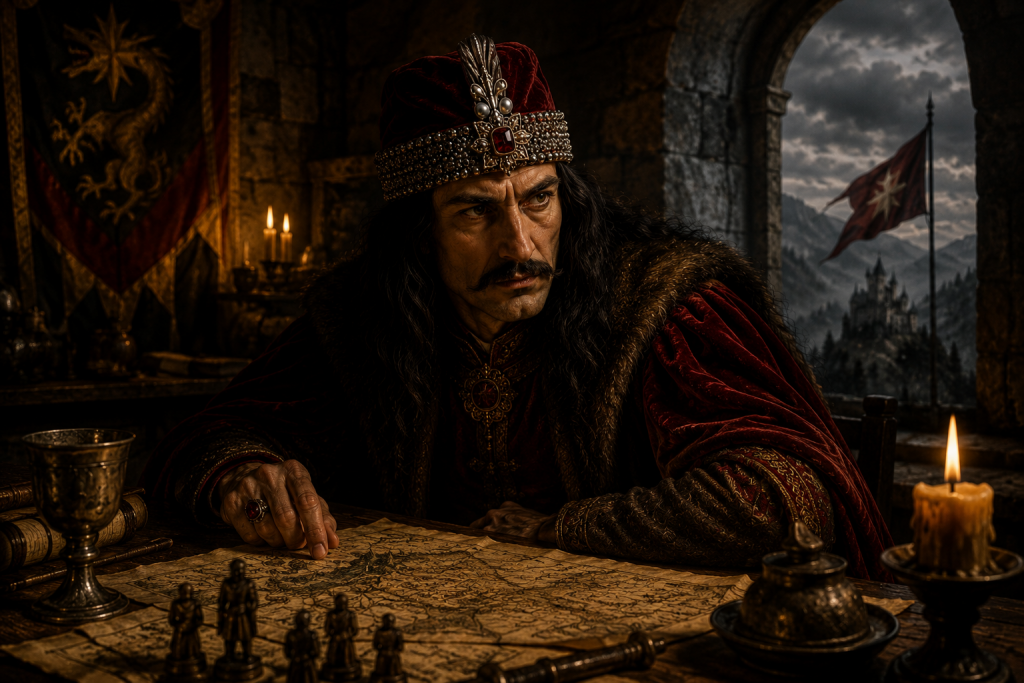
An artistic interpretation of Vlad III, Prince of Wallachia.
9 min read

“A crown claimed once might be luck. A crown claimed twice might be skill. But a crown claimed a third time, after prison and betrayal and years of exile, can only be called defiance.”
Most rulers who leave a mark on history do so across a single, continuous reign — decades of accumulated policy, war, and legacy, building steadily until a name becomes permanent. Vlad III of Wallachia did nothing of the sort. His entire rule, the whole of the notoriety that would eventually mutate into one of the Western world’s most enduring legends, was compressed into three separate, broken periods on the Wallachian throne, adding up to barely six years combined, scattered across nearly three decades of exile, imprisonment, and war. To understand Vlad properly, it is not enough to understand what he did while ruling. One must understand how strange and precarious the very act of ruling was for him — a throne he was forced to seize again and again, each time from a slightly different position of strength or desperation, each time knowing it might be taken from him within months.
The First Reign: A Crown Held for Weeks
Vlad’s first taste of power arrived in 1448, not through patient succession but through Ottoman opportunism. Freshly released from years as a political hostage at the Ottoman court, and only recently informed of his father’s assassination and his elder brother’s brutal death at the hands of rival boyars, the seventeen-year-old Vlad was installed on the Wallachian throne by Ottoman forces who saw in him a useful, indebted ruler — a prince raised partly within their own court, whom they now expected to govern in their interests. It was less a triumphant homecoming than a calculated wager by his former captors.
The wager did not pay off, at least not immediately. Vlad’s first reign lasted only a matter of months, undone almost as swiftly as it began when Hungarian-backed forces, led by rival claimant Vladislav II, drove him from the throne before the year was out. There was no great battle, no dramatic last stand — simply the harsh political mathematics of a small principality where power belonged, in practice, to whichever faction could muster the stronger foreign backing at any given moment. Vlad fled into exile, first to Moldavia and later into Hungarian territory, beginning what would become nearly a decade of watching, waiting, and quietly building the alliances he would need to try again.
A throne seized without allies beneath it is rarely a throne held for long.
These years of exile ought not to be dismissed as a mere gap between more significant events. It was during this period that Vlad’s political education truly deepened, forged through the same unforgiving apprenticeship that had shaped his childhood — observing, from the margins, exactly which alliances held and which crumbled, which rulers survived Ottoman pressure and which were swallowed by it. By the mid-1450s, he had manoeuvred his way into Hungarian favour, aligning himself with the very kingdom that had once helped depose him, a reversal that speaks less to any particular loyalty than to the ruthless pragmatism that would come to define his entire political career.
The Second Reign: The Years of the Stake
Vlad reclaimed the Wallachian throne in 1456, this time with Hungarian backing, and what followed became the six-year reign upon which nearly the entirety of his infamous reputation rests. It began, fittingly, with blood. Almost immediately upon securing power, Vlad turned his attention to the boyar class — the powerful noble families whose shifting allegiances had helped orchestrate his father’s assassination. He had repeatedly destabilised Wallachian rule for a generation. According to chronicled accounts, he invited a large gathering of boyars to an Easter banquet, then had the younger among them arrested and marched to the ruins of Poenari, forced into gruelling labour rebuilding a mountaintop fortress, while the older were executed by the method that would soon define his name entirely: impalement.
This was not, whatever the later legend suggests, indiscriminate cruelty for its own sake. It was, by most modern historical readings, a deliberate and calculated programme of internal consolidation — a young ruler, painfully aware of exactly how his father and brother had died, moving swiftly to neutralise the very class of nobility capable of orchestrating his own downfall. Impalement, employed with growing frequency throughout the reign, became something closer to state policy than isolated punishment, applied to disloyal boyars, foreign merchants accused of dishonest trade, captured enemy soldiers, and common criminals alike, the stakes displayed prominently along roads and outside cities as a standing, visible warning.
Where an army could not guarantee obedience, a landscape of stakes sometimes could.
The defining crisis of this second reign arrived in 1462, when Sultan Mehmed II — the same commander who had conquered Constantinople less than a decade earlier — personally led an Ottoman invasion into Wallachia, furious at Vlad’s increasingly open defiance of Ottoman authority, including his refusal to pay tribute and his brutal treatment of Ottoman envoys. Facing an army many times the size of his own, Vlad adopted a scorched-earth strategy, poisoning wells and emptying villages ahead of the advancing Ottoman force, before launching a daring night raid directly into the Sultan’s camp in an attempt on Mehmed’s life. The attempt failed to kill the Sultan, but the psychological effect of what awaited the Ottoman army as it pressed toward Vlad’s capital proved decisive: a vast stretch of impaled corpses, a spectacle so severe that, according to several chronicles, it contributed to Mehmed’s eventual decision to withdraw rather than continue the campaign.
Victory, however, proved impossible to sustain. Vlad’s own brother, Radu — raised alongside him in Ottoman captivity, but far more amenable to Ottoman favour — was now put forward by the Sultan as a rival claimant to the Wallachian throne, and as Ottoman and boyar support increasingly shifted toward Radu, Vlad’s position collapsed. By late 1462, he had fled north into Hungarian territory, seeking refuge and support from King Matthias Corvinus. What awaited him there was not the alliance he expected, but arrest — Corvinus imprisoned him, reportedly on the strength of forged letters suggesting secret negotiations with the Ottomans, a convenient pretext that allowed the Hungarian king to seize funds intended for anti-Ottoman warfare without ever having to commit to the fight himself.
Imprisonment and the Long Wait
Vlad’s imprisonment under Hungarian custody lasted, by most accounts, somewhere between ten and twelve years, though the precise conditions of his captivity appear to have shifted considerably over that period. Early accounts suggest genuine confinement, while later years seem to have relaxed into something closer to supervised residence, particularly once Vlad married into Corvinus’s circle and, by some accounts, converted to Catholicism as part of his rehabilitation — a conversion many historians treat with scepticism, viewing it as a pragmatic political manoeuvre rather than any genuine change of faith. It was during this same period that the legend of Vlad’s cruelty grew far beyond the reality that had originally inspired it, fed by German-language pamphlets circulating throughout the Holy Roman Empire — some of the earliest bestsellers of the newly invented printing press — which delighted in increasingly lurid, exaggerated tales of his atrocities, shaped as much by political rivalry and a hungry reading public as by any documented fact.
A decade in captivity is more than enough time for a reputation to outgrow the man who earned it.
The Third Reign: A Crown Reclaimed, Briefly
By 1476, political circumstances had shifted once more. Vlad’s brother Radu had died, and the Wallachian throne had fallen into further instability under a new ruler, Basarab Laiotă, whom neither the Hungarians nor a resurgent Ottoman-Wallachian faction found satisfactory. Corvinus, now willing to back his former prisoner, provided Vlad with Hungarian and Moldavian military support to reclaim the throne a third time. This final reign, however, proved shorter than either of the two before it, lasting a matter of months rather than years.
Later that same year, fighting to defend his newly reclaimed throne against Ottoman-backed forces, Vlad was killed near Bucharest under circumstances that remain genuinely disputed among historians — some chronicles suggest betrayal from within his own ranks, others describe a more straightforward death in battle, with his severed head reportedly sent to Constantinople as proof of his demise for Sultan Mehmed II, the same adversary he had humiliated with a forest of stakes fourteen years earlier. He was roughly forty-five years old, and his combined time as ruler of Wallachia, across three fractured reigns separated by years of exile, imprisonment, and war, totalled scarcely six years.
Three crowns, three collapses — and in between them, decades spent simply trying to stay alive.
Timeline of the Three Reigns
- 1442 — Vlad, aged around eleven, is sent as a political hostage to the Ottoman court alongside his younger brother, Radu.
- 1447 — Vlad’s father, Vlad II Dracul, is assassinated; his elder brother, Mircea, is tortured and killed by rival boyars.
- 1448 (First Reign) — With Ottoman backing, Vlad briefly claims the Wallachian throne; he is deposed within months by Hungarian-backed rival Vladislav II.
- 1448–1456 — Years of exile in Moldavia and Hungarian territory, during which Vlad builds the political alliances needed to reclaim power.
- 1456 (Second Reign begins) — Vlad retakes the Wallachian throne with Hungarian support and begins the reign for which he is best remembered.
- 1456–1462 — Systematic consolidation of power against the boyar class, widespread use of impalement as both punishment and political strategy.
- 1462 — Sultan Mehmed II leads a major Ottoman invasion; Vlad’s night raid and scorched-earth tactics, culminating in the infamous “forest of the impaled,” contribute to the Ottoman withdrawal.
- Late 1462 — Losing support to his Ottoman-backed brother Radu, Vlad flees to Hungarian territory and is imprisoned by King Matthias Corvinus.
- c. 1462–1474 — Years of Hungarian captivity, of shifting severity, during which Vlad’s legend grows through printed German pamphlets.
- 1476 (Third Reign) — With renewed Hungarian and Moldavian backing, Vlad reclaims the Wallachian throne for a final time.
- Late 1476 — Vlad is killed fighting Ottoman-backed forces near Bucharest; his reign, and his life, end within months of this final restoration.
author's note
What strikes me most, and has struck me for as long as I can remember reading about this period, is how little of Vlad’s life was actually spent as a ruler at all. We remember him almost entirely for the six years he held power, and yet those six years sit atop nearly three decades of captivity, exile, imprisonment, and quiet manoeuvring — far more time spent losing the throne, or trying to win it back, than time spent sitting upon it. This rhythm — seizure, collapse, exile, return — is something that has fascinated me since childhood, long before Related to Dracula gave me a proper outlet for it, and I still find it far more compelling than any single unbroken reign could ever be. It is the shape of a man who never once got to rule from a position of safety, and I suspect that shape explains a great deal more about his brutality than the brutality alone ever could.
sources and further reading
This article draws upon contemporary chronicles, modern historical research, and the work of scholars including:
- Florescu, Radu R., and Raymond T. McNally. Dracula, Prince of Many Faces: His Life and His Times. Little, Brown and Company, 1989.
- Treptow, Kurt W. Vlad III Dracula: The Life and Times of the Historical Dracula. Centre for Romanian Studies, 2000.
- McNally, Raymond T., and Radu Florescu. In Search of Dracula: The History of Dracula and Vampires. Houghton Mifflin, 1994.
- Cazacu, Matei. Dracula. Brill, 2017 (English translation of the original French edition).
- Andreescu, Ștefan. Vlad the Impaler (Dracula): Between Legend and Historical Reality. Romanian Cultural Institute, 2011.
- Engel, Pál. The Realm of St Stephen: A History of Medieval Hungary, 895–1526. I.B. Tauris, 2001 — useful for the Hungarian political context surrounding Vlad’s imprisonment under Matthias Corvinus.
A note on sources: much of what survives concerning Vlad’s three reigns is filtered through chronicles written by his political enemies, or through the sensationalist German pamphlets produced during and shortly after his imprisonment, meaning the historical record itself is contested territory. Where chroniclers disagree — as they frequently do on matters such as troop numbers, casualty counts, and the precise circumstances of his death — this chapter has favoured the more cautious, consensus reading offered by modern academic historians over the more dramatic claims of earlier or more partisan sources.
related articles
- Vlad the Impaler: The man behind the Dracula legend
- The Childhood of Vlad the Impaler
- Vlad the Impaler and Mehmed II
- The Night Attack of Târgoviște
- Justice or Cruelty? Understanding Vlad the Impaler’s Rule
- The Death of Vlad the Impaler
- The Real Vlad the Impaler vs Dracula: Fact vs Fiction
- How Europe Remembered Vlad the Impaler
- The Real Castles of Vlad the Impaler
continue your journey through history
Discover the novels inspired by the people, rivalries and legends of medieval Europe.

Historical Fiction Author
History has always fascinated me—not simply for the great battles or famous rulers, but for the people behind the legends. Through years of research into medieval Europe, the Ottoman Empire, Tudor England, and the lives of extraordinary historical figures, I’ve sought to uncover the stories that lie beneath popular myths. My novels blend documented history with compelling fiction, inviting readers to step into the past and experience it as those who lived it might have done.
Join the Related to Dracula Circle