
HISTORY · ORDER OF THE DRAGON
Vlad the Impaler’s Involvement With the Order of the Dragon
Did He Actually Belong to His Father’s Brotherhood, or Simply Inherit Its Name?
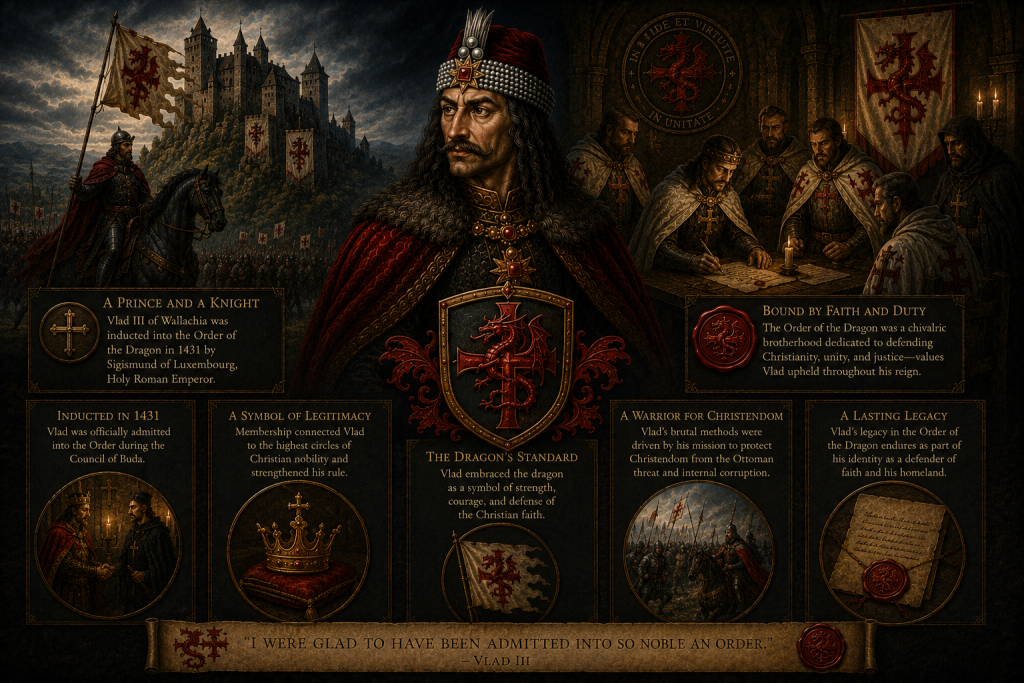
An artistic interpretation of Vlad the Impaler’s connection to the Order of the Dragon and the legacy of his father, Vlad II Dracul.
8 min read
“A son can inherit a name without ever earning the honour attached to it — and whether Vlad III was ever truly a Knight of the Dragon in his own right, rather than simply his father’s most famous by-product, remains one of the quieter, more genuinely unresolved questions in his entire story.”
In most accounts of Vlad the Impaler’s life, the Order of the Dragon appears primarily as background, the institutional origin of a name rather than an active feature of his own adult political life — his father’s induction, providing the documented source of the “Dracula” patronymic that Vlad III would carry for the rest of his career and long after it. This framing, while accurate as far as it goes, leaves an important and genuinely unresolved question sitting quietly unexamined: did Vlad III himself ever hold any direct, personal relationship to the order his father had joined, or did he simply inherit a name and a piece of dynastic symbolism without any active membership or continued institutional connection of his own? The honest answer, as with so much of Vlad’s documented biography, sits somewhere between clear historical fact and considerably murkier inference — and examining that uncertainty carefully reveals as much about the limits of the surviving record as it does about Vlad’s own actual relationship to his father’s chivalric brotherhood.
No Documented Personal Induction
Unlike his father’s induction around 1431, for which reasonably solid, if not perfectly detailed, historical evidence survives, there exists no comparable direct documentary record confirming that Vlad III himself was ever formally inducted into the Order of the Dragon as a member in his own right. This absence is significant, and worth stating plainly rather than glossing over: everything established so far regarding Vlad’s connection to the order concerns his inherited patronymic and his father’s own documented membership, not any confirmed personal induction ceremony or membership status specifically attributed to Vlad III as an adult ruler.
This gap in the record should not necessarily be read as definitive proof that no such induction ever occurred — surviving fifteenth-century Wallachian and Hungarian documentation is genuinely fragmentary across a great many subjects, and the absence of a confirming record does not automatically establish that an event never took place. But it does mean that any claim asserting Vlad III’s own personal, formal membership in the order rests on inference and plausibility rather than on the same kind of solid documentary footing that supports his father’s confirmed induction.
Where his father’s story offers a documented ceremony, Vlad III’s offers mainly a name — and a name, however evocative, is not quite the same thing as proof of continued personal membership.
The Case for Assumed or Symbolic Continuity
Despite this absence of direct confirmation, several considerations lend at least plausible weight to the idea that Vlad III maintained some genuine, ongoing relationship to his father’s order, even without a formally documented induction ceremony of his own. Membership in medieval chivalric orders of this general type was not always strictly limited to individually re-confirmed inductions with each successive generation; in certain contexts, particularly within families whose patriarch had received a hereditary title or association through order membership, descendants sometimes continued to identify with and draw symbolic authority from that inherited connection without necessarily undergoing an entirely separate, formally documented induction ceremony of their own.
Vlad III’s consistent use of the “Dracula” patronymic throughout his adult reign, rather than reverting to some alternative title or abandoning the dragon-derived name once he held power in his own right, suggests at minimum a continued, deliberate embrace of the association his father had established, whatever the precise formal status of that embrace within the order’s own internal membership structures. A ruler with no interest in maintaining continuity with his father’s chivalric affiliation had, after all, every practical opportunity to distance himself from a name carrying an uncomfortable secondary meaning of “devil” in the vernacular of the period, and chose, evidently, not to do so.
Vlad III could have quietly let his father’s borrowed name fade from use once he held the throne in his own right. That he did not do so suggests the association meant something to him beyond a mere accident of birth.
The Coinage Evidence
Some of the more concrete surviving evidence connecting Vlad III to the order’s symbolism, distinct from the simple continuity of his patronymic, comes from surviving Wallachian coinage attributed to his reign, several examples of which appear to incorporate dragon-related imagery drawing directly on the same symbolic tradition his father had publicised so visibly through his own reign’s coinage. This numismatic evidence, while not constituting proof of formal personal order membership in any strict institutional sense, does suggest that Vlad III actively continued to draw on and publicise his family’s dragon-derived symbolic heritage during his own reign, treating the association as a genuine and useful element of his own royal iconography rather than as a purely incidental inherited detail he had simply neglected to discard.
Historians examining this coinage evidence generally treat it as suggestive rather than conclusive, given the genuine difficulty of definitively distinguishing between a ruler’s deliberate continuation of formal order membership and a ruler’s more general, symbolic embrace of dynastic imagery inherited from a father whose own connection to that imagery remains more solidly documented. The distinction matters for historical precision, even if, in practical terms, it may have mattered rather less to Vlad III himself, who appears to have found the dragon symbolism genuinely useful regardless of its precise formal institutional status by the time of his own reign.
A Weakening Institution by the Time of Vlad’s Reign
Any assessment of Vlad III’s personal relationship to the Order of the Dragon also needs to account for the order’s own significantly diminished institutional vitality by the time Vlad reached adulthood and began his own political career. Sigismund of Luxembourg, the order’s founder and its central animating figure, had died in 1437, when Vlad III was still a young child in Wallachia, several years before his own eventual removal to the Ottoman court as a hostage, and the order’s active coordinating function as a genuine, functioning political and military coalition appears to have diminished considerably in the decades following Sigismund’s death, even as its symbolic and dynastic legacy persisted more durably among families, like Vlad’s own, who had already absorbed its emblem into their personal and family identity.
This context matters considerably for understanding why the historical record concerning Vlad III’s own relationship to the order remains comparatively thin. By the time Vlad III held sufficient personal authority to have engaged with the order as an adult ruler in his own right, the institution itself may well have functioned considerably less as an active, structured brotherhood requiring formal induction ceremonies, and considerably more as a diminished, largely symbolic legacy that descendants of earlier members, Vlad III very much included, could draw upon or ignore according to their own personal and political inclination, without the matter necessarily generating the kind of clear documentary record that might otherwise have survived from the order’s more active earlier decades.
A brotherhood can outlive its own founder as a genuine, functioning institution for only so long. By the time Vlad III might have joined it formally himself, it may already have become considerably more of an inheritance than an active membership requiring fresh confirmation.
Symbolic Weight Regardless of Formal Status
Whatever the precise, unresolved technical status of Vlad III’s personal relationship to the Order of the Dragon, the symbolic weight of the association proved, in practical historical terms, every bit as significant as formal membership might have been, and arguably considerably more consequential given how thoroughly it shaped his enduring historical identity. Vlad III fought, for much of his own reign, precisely the kind of anti-Ottoman resistance the order had originally been founded to coordinate and support, making his continued use of the dragon-derived “Dracula” name feel, whatever its precise institutional standing, genuinely consistent with the broader defensive Christian project his father’s order had been established to serve nearly a quarter-century before Vlad’s own birth.
This consistency between inherited symbolism and lived political reality — a ruler bearing a name drawn from an anti-Ottoman chivalric brotherhood, who then spent much of his own career actively resisting Ottoman expansion in exactly the manner that brotherhood had once been founded to encourage — offers a more satisfying, if less definitively documented, resolution to the question of Vlad’s relationship to the order than any surviving induction record could likely provide on its own. Whether or not Vlad III ever formally knelt before an order official and swore the same oath his father once had, he lived out, across his own turbulent three reigns, precisely the kind of committed anti-Ottoman resistance the order’s own dragon-and-cross emblem had always claimed to represent.
Timeline: Vlad III and the Order’s Legacy
- c. 1431 — Vlad II is formally inducted into the Order of the Dragon; Vlad III is born around the same period.
- 1437 — Sigismund of Luxembourg, the order’s founder, dies while Vlad III remains held as an Ottoman hostage, with the order’s active institutional function beginning to diminish.
- 1442 — Vlad III and his brother Radu are sent to the Ottoman court, removing Vlad from any direct engagement with Hungarian court institutions, including the order, during his formative years.
- 1448–1476 — Across his three reigns, Vlad III consistently retains and uses the “Dracula” patronymic, without documented evidence of a separate, formal personal induction into the order.
- Mid-15th century — Surviving Wallachian coinage attributed to Vlad III’s reign incorporates dragon-related imagery consistent with his father’s earlier numismatic practice.
- 1456–1462 — Vlad III’s active military resistance against Ottoman expansion aligns thematically, if not through documented formal membership, with the order’s original founding purpose.
- 1476 — Vlad III’s death ends any possibility of further clarifying his personal relationship to an order that, by this point, had long since ceased functioning as an active coordinating institution.
- Present day — Historians continue to debate whether Vlad III’s connection to the order reflects inherited symbolic identity alone or some form of continued, if undocumented, personal association.
author's note
This has been, in some ways, the most quietly frustrating piece to research, precisely because it resists the kind of clean resolution a founding charter or a membership roll can provide. Going looking for a confirmed induction ceremony, or at least a clear documentary trace of Vlad III’s own formal relationship to his father’s brotherhood, turns up only suggestive fragments — a retained name, some dragon imagery on coinage, a career that thematically fulfilled the order’s founding purpose without ever quite proving formal membership in the institutional sense. That ambiguity is worth sitting with rather than resolving artificially in either direction. Vlad III may never have knelt before an order official himself. But he spent much of his adult life fighting, almost point for point, the exact war his father’s brotherhood had been founded to wage — and that alone feels like a kind of membership that no missing induction record can fully erase.
sources and further reading
- Florescu, Radu R., and Raymond T. McNally. Dracula, Prince of Many Faces: His Life and His Times. Little, Brown and Company, 1989 — discusses the coinage evidence and the broader question of Vlad III’s relationship to his father’s order membership.
- Treptow, Kurt W. Vlad III Dracula: The Life and Times of the Historical Dracula. Centre for Romanian Studies, 2000.
- Cazacu, Matei. Dracula. Brill, 2017 (English translation of the original French edition).
- Boulton, D’Arcy Jonathan Dacre. The Knights of the Crown: The Monarchical Orders of Knighthood in Later Medieval Europe, 1325–1520. Boydell Press, 1987.
- Engel, Pál. The Realm of St Stephen: A History of Medieval Hungary, 895–1526. I.B. Tauris, 2001.
- Miller, Elizabeth. Dracula: Sense and Nonsense. Desert Island Books, 2000 — offers useful caution regarding claims made about Vlad III’s personal order membership that extend beyond what the surviving documentary evidence actually supports.
A note on sources: no surviving fifteenth-century document directly confirms a personal induction ceremony for Vlad III himself, meaning any assessment of his individual relationship to the order necessarily involves a degree of historical inference drawn from circumstantial evidence such as coinage and continued patronymic use. This article has aimed to distinguish clearly between what is documented and what remains, honestly informed speculation.
related articles
- The Order of the Dragon: The Brotherhood Behind Dracula
- Not Just Another Chivalric Order: What Set the Order of the Dragon Apart
- The Other Knights of the Order of the Dragon
- The Achievements of the Order of the Dragon
- Vlad the Impaler: The man behind the Dracula legend
- The childhood of Vlad the Impaler
- Wallachia: The Kingdom between Two Empires
- The Rise of the Basarab Dynasty
- The Wallachian Voivodes Explained
- Why Wallachia Was Important to Europe
continue your journey through history
Discover the novels inspired by the people, rivalries and legends of medieval Europe.

Historical Fiction Author
History has always fascinated me—not simply for the great battles or famous rulers, but for the people behind the legends. Through years of research into medieval Europe, the Ottoman Empire, Tudor England, and the lives of extraordinary historical figures, I’ve sought to uncover the stories that lie beneath popular myths. My novels blend documented history with compelling fiction, inviting readers to step into the past and experience it as those who lived it might have done.
Join the Related to Dracula Circle