
HISTORY · VLAD THE IMPALER
Vlad the Impaler and Mehmed II
Two Rulers, One Empire Between Them, and a Night That Nearly Changed History
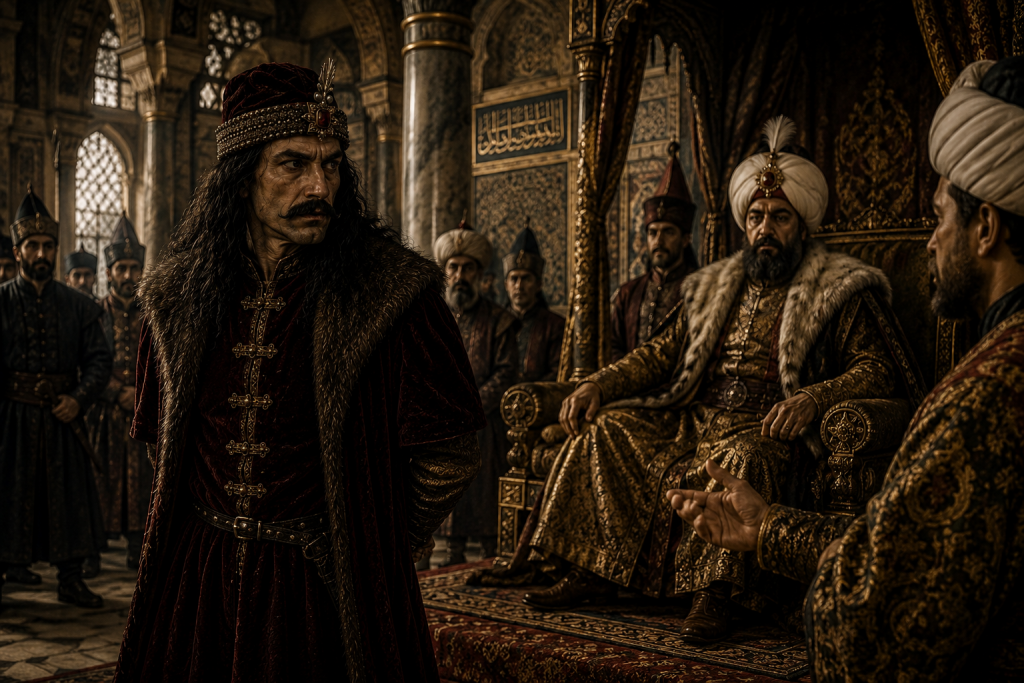
An artistic interpretation of Vlad III, Prince of Wallachia.
9 min read
“An emperor who had already conquered Constantinople expected very little to stand in his way again. What he found instead, on a moonless night in Wallachia, was a smaller enemy prepared to fight like a cornered animal — and a road ahead of him lined with the dead.”
History is generally kind to conquerors and unkind to the small states that resist them, remembering the former in statues and the latter, if it remembers them at all, as footnotes to somebody else’s triumph. The rivalry between Vlad III of Wallachia and Sultan Mehmed II ought, by every reasonable expectation of the period, to have followed exactly that pattern. Mehmed was, by 1462, arguably the most powerful and successful military commander alive in the entire world, the conqueror who had taken Constantinople itself only nine years earlier, ending a thousand years of Byzantine rule and sending shockwaves through every court in Christian Europe. Vlad, by contrast, ruled a narrow, mountainous principality with a fraction of the population, the treasury, and the military resources available to the Ottoman Empire. And yet the confrontation between these two men produced not the swift, predictable conquest history might have expected, but one of the most psychologically unsettling campaigns of the entire fifteenth century — a war won, in the end, less through force than through fear.
Two Boys Who Grew Up in the Same Court
The relationship between Vlad and Mehmed did not begin on any battlefield. It began, strangely, in the same Ottoman court, during the same period, when both men were still boys. Vlad had been sent to the Ottoman court as a political hostage in 1442, alongside his younger brother Radu, part of a diplomatic arrangement securing their father’s continued loyalty to the Sultan. Mehmed, roughly a year younger than Vlad, was at that time a young Ottoman prince himself, being raised and educated within the same court. It is entirely plausible — though not conclusively documented — that the two crossed paths during these formative years, two boys from radically different backgrounds occupying overlapping corners of the same royal household.
Two futures were being written in the same rooms, though neither boy could yet have guessed how violently those futures would eventually collide.
Whatever direct contact existed between them as children, the two young men’s paths diverged sharply as they matured. Mehmed ascended to the Ottoman throne in 1444, briefly, and then more permanently in 1451 following his father’s death, inheriting an empire already among the most formidable military powers in the world. Vlad, meanwhile, endured a far more fractured path — released from Ottoman custody following his father’s assassination, briefly and unsuccessfully claiming the Wallachian throne in 1448, then spending years in exile before finally securing a more lasting hold on power in 1456. By the time these two former courtmates found themselves on opposing sides of open warfare, one ruled an empire that had just extinguished the Byzantine world’s thousand-year capital, and the other ruled a principality that many observers assumed could be absorbed by that same empire with comparatively little effort.
A Relationship Built on Tribute and Tension
For the early years of Vlad’s second reign, relations with the Ottoman Empire followed the familiar, uneasy pattern that had governed Wallachian foreign policy for generations: nominal submission, regular tribute payments, and a careful, exhausting balancing act intended to keep Ottoman forces at a comfortable distance while avoiding outright war. Vlad initially maintained this arrangement, paying the tribute expected of a Wallachian vassal and, for a time, keeping the fragile peace intact. But the relationship began to fracture steadily through the late 1450s, as Vlad grew increasingly resistant to Ottoman demands, most critically the request, extended by Mehmed’s representatives, that Vlad send Wallachian boys into Ottoman service as janissaries — child soldiers raised and trained within the Ottoman military system — alongside continued and increasing tribute payments.
Vlad’s refusal, and his subsequent treatment of the Ottoman envoys sent to press the matter, marked the point of genuine rupture. According to several chronicles, Vlad had two Ottoman emissaries executed after they refused, out of religious custom, to remove their turbans in his presence, reportedly having the turbans nailed to their skulls rather than allowing the perceived insult to pass unanswered — a story that, whatever its precise factual accuracy, reflects a broader and well-documented pattern of Vlad’s escalating, deliberate provocation of Ottoman authority throughout this period. By 1461 and into early 1462, Vlad had stopped paying tribute entirely. He had begun launching cross-border raids into Ottoman-controlled territory south of the Danube, burning towns and killing, by his own later report to Hungarian allies, tens of thousands of Ottoman subjects and soldiers — a figure historians treat with considerable scepticism, but one that nonetheless signals the scale of aggression Vlad was now prepared to commit to.
A tribute unpaid is an insult. A tribute unpaid and answered with fire across the border is closer to a declaration of war.
Mehmed’s Invasion and the Strategy of the Empty Land
Mehmed’s response, when it came in the spring of 1462, was overwhelming by any conventional measure. The Sultan personally led an invasion force into Wallachia that vastly outnumbered anything Vlad could hope to muster in open battle — estimates vary considerably across sources, but even conservative modern figures describe an Ottoman force several times the size of Vlad’s available army. Facing this disparity, Vlad made the calculated decision not to meet Mehmed in a conventional pitched battle he could not realistically win, but to adopt a scorched-earth strategy instead, ordering wells poisoned, villages burned, and the Wallachian population withdrawn deep into the countryside and mountains, leaving the advancing Ottoman army to march through a landscape deliberately emptied of food, water, shelter, and any target worth conquering.
This was, in effect, a war fought as much against logistics and morale as against soldiers, and it set the stage for the single most audacious act of Vlad’s military career.
The Night Attack
On the night of 16 to 17 June 1462, Vlad led a relatively small detachment of Wallachian cavalry in a daring raid directly into the heart of the Ottoman camp, attempting, according to most chronicled accounts, to assassinate Mehmed himself under cover of darkness. The raid did not succeed in killing the Sultan — accounts suggest Vlad’s forces struck the wrong section of the sprawling camp in the confusion of night, missing the Sultan’s own tent by some margin — but it succeeded spectacularly in sowing chaos, panic, and a demoralising sense of vulnerability through the Ottoman ranks, an army that had, until that point, likely regarded the campaign as a foregone conclusion.
An emperor does not need to be killed to be humbled. He merely needs to learn, in the middle of the night, that he can be reached.
The psychological toll of the Night Attack, however, was only a prelude to what awaited the Ottoman army as it continued its advance toward Vlad’s capital at Târgoviște.
The Forest of the Impaled
What Mehmed’s forces encountered approaching Târgoviște has become the single most infamous image associated with Vlad’s entire reign: a vast field, described by some chroniclers as stretching for roughly a mile, lined with thousands of impaled corpses — Ottoman prisoners captured during Vlad’s earlier cross-border raids, left to die slowly and remain displayed as a deliberate, calculated act of psychological warfare aimed squarely at the approaching army. Contemporary and near-contemporary accounts, including those sympathetic to the Ottoman perspective, describe hardened soldiers who had campaigned across three continents recoiling in genuine horror at the sight. Several sources claim that Mehmed himself, confronted with the scale and deliberateness of the display, was sufficiently unsettled that it contributed directly to his decision to abandon the campaign and withdraw rather than press forward to Vlad’s capital.
Whether this decision reflected genuine psychological shock, sound tactical caution given the difficulty of supplying an army through scorched and hostile territory, or some combination of both, the outcome remains historically remarkable regardless of the precise motivation behind it: a vastly outnumbered Wallachian force had halted an Ottoman invasion personally led by the conqueror of Constantinople, achieving through terror and scorched earth what conventional military resistance could almost certainly never have accomplished.
A field of the dead succeeded where an army of the living could not — it made the most powerful man in the region choose retreat over conquest.
An Unfinished Rivalry
Mehmed’s withdrawal did not end the contest between the two men so much as redirect it. Unable to defeat Vlad outright through direct invasion, Mehmed instead turned to a subtler strategy, backing Vlad’s own brother, Radu — raised alongside Vlad in Ottoman captivity, but far more favourably disposed toward Ottoman rule — as a rival claimant to the Wallachian throne. As Ottoman-backed forces and increasingly wavering Wallachian nobility shifted their support toward Radu throughout the remainder of 1462, Vlad’s position collapsed, and by the end of the year he had fled north into Hungarian territory, where, in a further twist of fate entirely unconnected to Mehmed, he was promptly imprisoned by King Matthias Corvinus rather than welcomed as an ally.
Vlad and Mehmed never again met directly in open warfare. By the time Vlad reclaimed the Wallachian throne for a third and final time in 1476, it was Vlad’s own death, later that same year, fighting Ottoman-backed forces near Bucharest, that finally closed the rivalry — his severed head reportedly sent to Constantinople as proof of his demise, delivered, in a grim final irony, to the very city and the very court where his strange, entangled relationship with Mehmed had first quietly begun decades earlier, when both were still boys within the same royal household.
Timeline: Vlad and Mehmed
- 1432 — Mehmed II is born, several years after Vlad, within the Ottoman royal family.
- 1442 — Vlad and his brother Radu are sent as political hostages to the Ottoman court, potentially overlapping with the young Mehmed’s own upbringing there.
- 1451 — Mehmed II ascends the Ottoman throne on a permanent basis following his father’s death.
- 1453 — Mehmed conquers Constantinople, ending the Byzantine Empire and cementing his reputation as one of history’s most formidable military commanders.
- 1456 — Vlad secures the Wallachian throne for his defining second reign, initially maintaining tribute payments to the Ottoman Empire.
- Late 1450s — Relations deteriorate as Vlad resists demands for janissary conscripts and increasingly provokes Ottoman authority.
- 1461 — Vlad allegedly orders the execution of Ottoman envoys and ceases tribute payments entirely.
- Early 1462 — Vlad launches cross-border raids into Ottoman territory south of the Danube.
- Spring 1462 — Mehmed personally leads a major invasion force into Wallachia.
- 16–17 June 1462 — Vlad leads the Night Attack, a raid into the Ottoman camp aimed at assassinating Mehmed.
- Mid-1462 — Ottoman forces encounter the “forest of the impaled” approaching Târgoviște; Mehmed subsequently withdraws from the campaign.
- Late 1462 — With Ottoman backing, Vlad’s brother Radu claims the Wallachian throne; Vlad flees to Hungarian territory and is imprisoned.
- 1476 — Vlad, having briefly reclaimed the throne, is killed fighting Ottoman-backed forces near Bucharest, ending the rivalry permanently.
author's note
Of everyone Vlad crossed paths with across his turbulent life, Mehmed II remains, for me, the most fascinating counterpart — not simply because of the scale of the empire he commanded, but because of how strangely intimate their rivalry actually was, rooted in a shared childhood neither man could have chosen. Writing Related to Dracula, I found myself drawn to the quieter, earlier image of two boys occupying the same court, one destined to conquer Constantinople and the other destined to become the single fear that briefly made that conqueror turn back. Rivalries built on genuine strategic conviction are common enough in history. Rivalries built on shared childhood proximity are far rarer, and far harder to look away from.
sources and further reading
- Florescu, Radu R., and Raymond T. McNally. Dracula, Prince of Many Faces: His Life and His Times. Little, Brown and Company, 1989.
- Treptow, Kurt W. Vlad III Dracula: The Life and Times of the Historical Dracula. Centre for Romanian Studies, 2000.
- Babinger, Franz. Mehmed the Conqueror and His Time. Princeton University Press, 1978 — the standard scholarly biography of Mehmed II, offering valuable context on the Ottoman perspective of the Wallachian campaign.
- Cazacu, Matei. Dracula. Brill, 2017 (English translation of the original French edition).
- Imber, Colin. The Ottoman Empire, 1300–1650: The Structure of Power. Palgrave Macmillan, 2002 — useful background on Ottoman hostage diplomacy and military campaigning during this period.
- Andreescu, Ștefan. Vlad the Impaler (Dracula): Between Legend and Historical Reality. Romanian Cultural Institute, 2011.
A note on sources: accounts of the 1462 campaign, including troop numbers and the precise scale of the “forest of the impaled”, derive largely from chronicles written after the fact by both Wallachian and Ottoman-sympathetic sources, each with their own reasons to exaggerate certain details. This chapter has favoured figures and interpretations broadly supported across multiple independent traditions, while treating the more extreme individual claims with appropriate caution.
related articles
- Vlad the Impaler: The man behind the Dracula legend
- The Childhood of Vlad the Impaler
- The real Vlad the Impaler vs Dracula: Fact vs Fiction
- The Night Attack of Târgoviște
- Vlad the Impaler’s three reigns
- The Death of Vlad the Impaler
- Justice or cruelty? Understanding Vlad the Impaler’s rule
- How Europe Remembered Vlad the Impaler
- The Real Castles of Vlad the Impaler
continue your journey through history
Discover the novels inspired by the people, rivalries and legends of medieval Europe.

Historical Fiction Author
History has always fascinated me—not simply for the great battles or famous rulers, but for the people behind the legends. Through years of research into medieval Europe, the Ottoman Empire, Tudor England, and the lives of extraordinary historical figures, I’ve sought to uncover the stories that lie beneath popular myths. My novels blend documented history with compelling fiction, inviting readers to step into the past and experience it as those who lived it might have done.
Join the Related to Dracula Circle