
HISTORY · Tudor England
Tudor England: The Dynasty That Transformed a Kingdom
How a Century of Rule by a Single Family Rebuilt England From the Ground Up
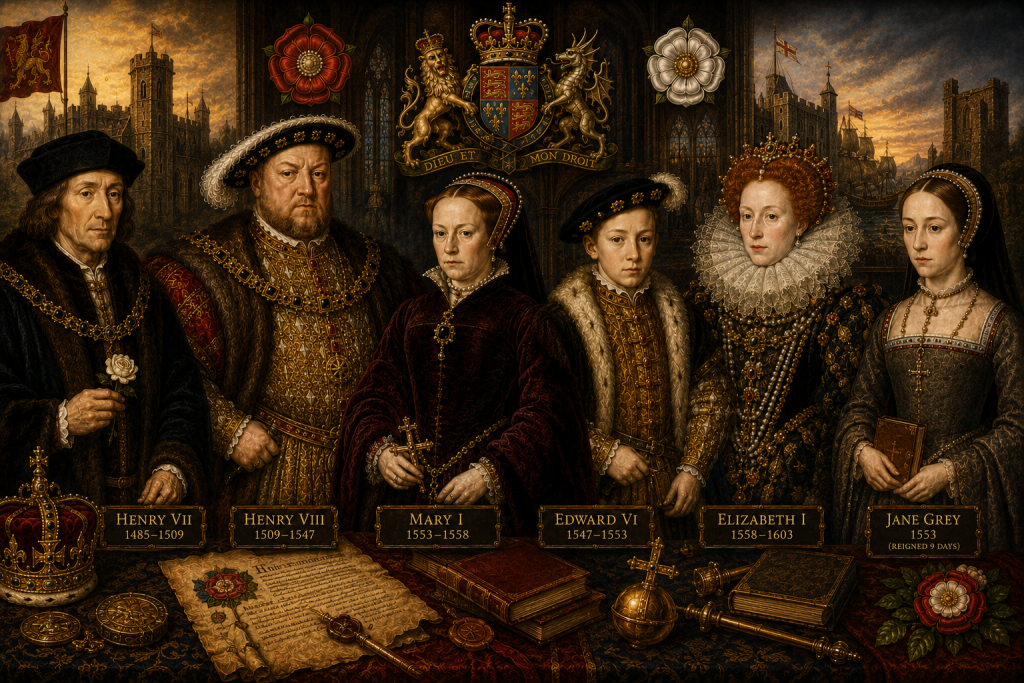
An artistic interpretation of the Tudor dynasty, whose reign reshaped England’s monarchy, religion, and place in Europe.
9 min read
“A dynasty is usually judged by how long it lasted. The Tudors deserve to be judged, instead, by how thoroughly they managed to change everything around them in barely a century — leaving behind a kingdom that no longer resembled, in almost any meaningful respect, the one they had first claimed.”
Few ruling families in English history achieved so complete and so lasting a transformation of their kingdom in so comparatively brief a span of time as the House of Tudor, whose rule stretched across barely a century, from Henry VII‘s improbable victory at Bosworth Field in 1485 to Elizabeth I’s death without direct heir in 1603. Measured purely in years, the Tudor dynasty’s reign was considerably shorter than several of the great ruling houses that preceded and followed it on the English throne. Measured by consequence, however, the Tudor century stands among the most genuinely transformative periods in the entire span of English history, encompassing the definitive end of medieval dynastic civil war, a complete reordering of English religious life and its relationship to Rome, the establishment of England as a genuine emerging naval and colonial power, and a flourishing of English cultural, literary, and intellectual life whose influence would extend for centuries beyond the dynasty’s own eventual end. Understanding Tudor England as a coherent, connected century, rather than merely a sequence of individually famous monarchs, reveals just how deliberately, and how consequentially, this single family reshaped nearly every dimension of English national life.
Emerging From Civil War
The Tudor dynasty’s very origin lay in resolution rather than continuity, arising directly from the conclusion of the protracted, destructive dynastic conflict generally remembered as the Wars of the Roses, a decades-long struggle between the rival houses of Lancaster and York that had consumed English political life for much of the fifteenth century. Henry Tudor, a claimant with a comparatively modest and, by strict hereditary standards, somewhat contestable link to the Lancastrian royal line, achieved a decisive and genuinely improbable military victory over the reigning Yorkist king Richard III at the Battle of Bosworth Field in August 1485, an outcome that few informed contemporary observers would confidently have predicted in the months immediately preceding the battle itself.
Henry’s subsequent marriage to Elizabeth of York, uniting the rival houses of Lancaster and York within a single royal line, provided the new Tudor dynasty with genuine, carefully constructed symbolic legitimacy, formally closing the dynastic wound that had driven decades of preceding conflict. This founding act of unification, deliberately woven into Tudor royal symbolism through the distinctive combined Tudor rose emblem still recognisable today, established from the very outset of the dynasty’s existence a governing preoccupation that would persist across the following century: a genuine, sustained anxiety regarding dynastic security and stable succession, born directly from the recent, painful memory of exactly what English political life looked like when royal succession remained genuinely, violently contested.
Every dynasty carries forward the specific anxieties of its own founding circumstances. The Tudors were born from civil war, and spent the following century governing as though that war might, without constant vigilance, return at any moment.
Henry VII: Consolidation Through Caution
Henry VII’s own reign, stretching from 1485 until his death in 1509, established the practical administrative and financial foundations on which the following century of considerably more dramatic Tudor rule would eventually be built. Rather than pursuing the kind of expansive military glory or dramatic institutional transformation that would characterise several of his successors’ reigns, Henry VII governed with careful, often notoriously severe fiscal caution, rebuilding a royal treasury depleted by decades of preceding civil conflict, suppressing rival claimants who might otherwise have reignited dynastic instability, and establishing administrative practices that would provide his son and eventual successor with a considerably more stable and well-resourced kingdom than England had experienced in generations.
This foundational, comparatively unglamorous work of consolidation deserves genuine historical credit disproportionate to the popular attention it typically receives, standing in useful contrast to the far more dramatic transformations that would follow under his son. Henry VII built, through careful and occasionally ruthless political management, the stable platform without which the following century’s more dramatic Tudor achievements would likely have proven considerably more difficult to sustain.
Henry VIII: Transformation Through Unchecked Will
The reign of Henry VIII brought to the Tudor century its single most consequential transformation: the complete legal and institutional severance of English religious life from nearly a millennium of papal authority. What deserves emphasis within this broader dynastic overview is simply the scale of what this transformation meant for Tudor England as a coherent historical period: a kingdom that began the century as an entirely conventional participant within Western European Catholic Christianity ended Henry’s own reign as a religiously distinct, institutionally reordered nation, with its monarch rather than the Pope standing as supreme head of its established church.
This religious transformation rippled outward across virtually every dimension of subsequent Tudor governance, reshaping the relationship between crown and church, redistributing enormous monastic landholdings and wealth through the dissolution of the monasteries, and establishing patterns of royal religious authority that Henry’s own children would spend the remainder of the Tudor century variously extending, contesting, and reversing according to their own individual religious convictions.
A single king’s search for a specific personal and dynastic solution produced, almost as an unintended by-product, the single most consequential institutional transformation of the entire Tudor century — a pattern of disproportionate consequence that would recur, in varying forms, across several of his successors’ own reigns.
A Century of Religious Whiplash
What followed Henry VIII’s own death in 1547 was a period of genuinely striking religious instability, as successive Tudor monarchs pursued sharply divergent religious policies across a comparatively brief span of years, producing a level of institutional and doctrinal whiplash that placed considerable strain on ordinary English religious and communal life. Edward VI, Henry’s young son by Jane Seymour, ascended the throne as a minor in 1547 and, under the influence of strongly Protestant regents and advisers, pursued a considerably more thoroughgoing Protestant religious reform than his own father had ever fully embraced, before his own early death in 1553 brought this brief Protestant ascendancy to an abrupt halt.
Mary I, Henry’s elder daughter by Catherine of Aragon, succeeded Edward and pursued an equally decisive reversal, working to restore Catholic religious practice and papal authority across her own comparatively brief reign, a restoration effort that earned her the lasting popular epithet “Bloody Mary” owing to the severe persecution of Protestant dissenters carried out under her authority. Mary’s own death in 1558, without a surviving heir, brought the throne finally to Elizabeth I, Henry’s younger daughter by Anne Boleyn, whose own considerably longer and more stable reign would establish the durable Protestant religious settlement that would define English religious identity for centuries beyond the Tudor dynasty’s own eventual conclusion.
Three of Henry’s own children ruled England in rapid succession, each pursuing a genuinely different religious vision for the same kingdom — a pattern of institutional instability that any ordinary English subject living through these decades would have experienced not as abstract historical transformation, but as a genuinely disorienting, repeatedly shifting demand regarding which specific version of Christian faith and practice their own kingdom now required of them.
Elizabeth I: Stability, Culture, and Emerging Empire
Elizabeth I’s own reign, stretching from 1558 until her death in 1603, brought the Tudor century to its final, and by most historical assessments its most genuinely accomplished, chapter. Elizabeth achieved a level of sustained religious and political stability that had eluded her immediate predecessors, establishing a durable Protestant religious settlement while avoiding, for the most part, the severe persecution that had characterised her sister Mary’s own preceding reign. Her reign also coincided with, and actively encouraged, a genuine flourishing of English cultural and literary achievement. This era produced, among other significant cultural developments, the early career of William Shakespeare and a broader flourishing of English literary and theatrical culture that would exert influence extending centuries beyond Elizabeth’s own reign.
Beyond this cultural flourishing, Elizabeth’s reign established England as a genuine, if still comparatively modest, emerging naval and colonial power, marked by England’s celebrated naval defeat of the Spanish Armada in 1588 and the early, tentative beginnings of English overseas exploration and colonial ambition that would, across the following century, eventually produce the far more extensive global English and, subsequently, British imperial project. Elizabeth’s own decision to remain unmarried throughout her reign, whatever its complex personal and political motivations, meant that the Tudor dynasty’s own carefully maintained preoccupation with secure hereditary succession, present from the very outset of Henry VII’s own reign, would ultimately end unresolved, bringing the dynasty itself to a close upon Elizabeth’s own death in 1603 without a direct heir.
A Century Judged by Its Consequences
Considered as a single, connected century rather than as five individually notable reigns, the Tudor period accomplished a transformation of English national life whose consequences would extend considerably beyond the dynasty’s own comparatively brief formal duration. England emerged from the Tudor century religiously and institutionally distinct from the broader Catholic European world it had unremarkably belonged to at the century’s outset, culturally and literarily accomplished to a degree that would shape English identity for centuries to come, and positioned, through Elizabeth’s own reign specifically, at the genuine early threshold of the global naval and colonial ambitions that would define British national identity for centuries beyond the Tudor dynasty’s own eventual end.
A single family, ruling for barely a century, took a kingdom still recovering from decades of civil war and left behind, upon their own dynasty’s quiet conclusion, an entirely different nation — religiously transformed, culturally accomplished, and standing, for the first time in its history, at the genuine edge of the wider world.
Timeline: The Tudor Century
- 1485 — Henry Tudor defeats Richard III at the Battle of Bosworth Field, founding the Tudor dynasty.
- 1486 — Henry VII marries Elizabeth of York, symbolically uniting the houses of Lancaster and York.
- 1509 — Henry VII dies; Henry VIII ascends the throne.
- 1533–1534 — Henry VIII’s break with Rome establishes royal supremacy over the Church of England.
- 1536–1541 — The dissolution of the monasteries reshapes English religious, economic, and social life.
- 1547 — Henry VIII dies; the young Edward VI ascends the throne and pursues thoroughgoing Protestant reform.
- 1553 — Edward VI dies; Mary I ascends the throne and restores Catholic religious practice.
- 1558 — Mary I dies; Elizabeth I ascends the throne, establishing a durable Protestant religious settlement.
- 1588 — England defeats the Spanish Armada under Elizabeth I’s reign.
- 1603 — Elizabeth I dies without a direct heir, ending the Tudor dynasty and passing the throne to the Stuart line.
author's note
Stepping back to trace the whole Tudor century in one sweep draws on a fascination with English history I have carried since childhood, long before I ever thought to write fiction set within it. My novels drop Sebastian into only one comparatively narrow slice of this much longer story, the early, turbulent years of Henry VIII’s reign, but understanding the fuller arc, what came before Henry and what his own children would do with the kingdom afterwards, is something I had already spent years reading about on my own. That fuller picture has helped me write the Tudor court Sebastian encounters as a place that feels genuinely lived-in and consequential, rather than a static backdrop for one outsider’s story. This article is, in a sense, the wider map my own, considerably more focused novels only ever show one corner of.
sources and further reading
- Guy, John. Tudor England. Oxford University Press, 1988 — the standard comprehensive survey of the entire Tudor period.
- Loades, David. The Tudor Court. Headstart History, 1992.
- Williams, Penry. The Tudor Regime. Oxford University Press, 1979 — a detailed study of Tudor governance and administration across the century.
- MacCulloch, Diarmaid. Tudor Church Militant: Edward VI and the Protestant Reformation. Allen Lane, 1999.
- Duffy, Eamon. Fires of Faith: Catholic England Under Mary Tudor. Yale University Press, 2009.
- Wallace MacCaffrey, Elizabeth I: War and Politics, 1588–1603. Princeton University Press, 1992.
A note on sources: this article has drawn on broad survey scholarship covering the full Tudor century, while reserving more detailed source recommendations regarding Henry VIII’s own reign specifically for its own dedicated telling elsewhere.
related articles
- Henry VIII: The King Who Changed England
- The Spare Prince: Henry VIII’s Childhood Before He Was Ever Meant to Wear the Crown
- The King’s Choice: Henry VIII’s Accession and the Courtship of Catherine of Aragon
- Henry VIII’s First Queen: Catherine of Aragon, the Forgotten Queen
- The English Reformation: Henry VIII and the Break with Rome
- The Six Wives of Henry VIII: Marriage, Power and the Making of Tudor England
- Henry VIII: King, Reformer or Tyrant?
- Henry VII: The King Who Founded the Tudor Dynasty
- The Wars of the Roses: The Conflict That Created the Tudors
- How Henry VIII Fell in Love With Anne Boleyn: The Courtship That Changed England
continue your journey through history
Discover the novels inspired by the people, rivalries and legends of medieval Europe.

Historical Fiction Author
History has always fascinated me—not simply for the great battles or famous rulers, but for the people behind the legends. Through years of research into medieval Europe, the Ottoman Empire, Tudor England, and the lives of extraordinary historical figures, I’ve sought to uncover the stories that lie beneath popular myths. My novels blend documented history with compelling fiction, inviting readers to step into the past and experience it as those who lived it might have done.
Join the Related to Dracula Circle