
HISTORY · wallachia
The Rise of the Basarab Dynasty
How One Victory Against a King Created a Kingdom That Would Outlast Him
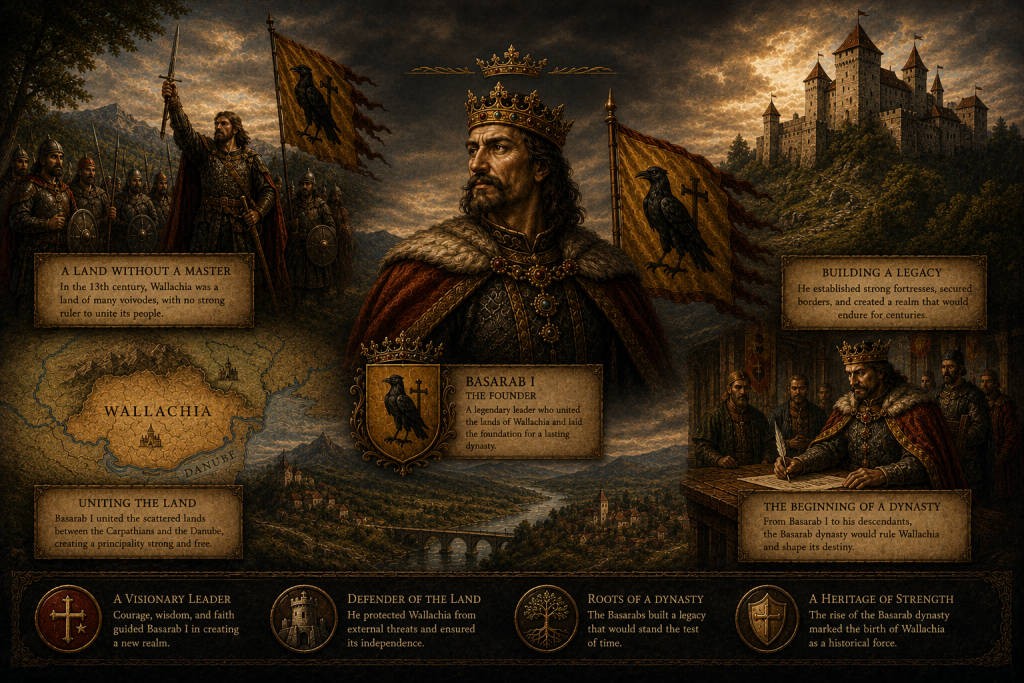
An artistic interpretation of Basarab I, founder of Wallachia and the Basarab dynasty.
8 min read

“A dynasty rarely announces itself with a coronation. More often, it announces itself with a single battle so decisive that the losing side is forced, however reluctantly, to admit that something new and permanent has just been born.”
Every enduring dynasty needs an origin story capable of bearing the weight of everything built upon it afterward, and the Basarab dynasty of Wallachia — the family line from which Vlad the Impaler himself would eventually descend more than a century later — found that origin story on a narrow, poorly documented battlefield in the autumn of 1330, when a Hungarian king marched south with every expectation of reasserting control over a troublesome vassal territory, and instead rode home having lost both the battle and, in a very real sense, any lasting claim to rule Wallachia directly ever again. The man who inflicted that defeat, Basarab I, did not simply win a single military engagement; he effectively founded a state, establishing a ruling line that would govern Wallachia, through numerous branches, rivalries, and interruptions, for the better part of the next three centuries.
Before Basarab: A Contested, Unformed Land
Before the early fourteenth century, the territory that would become Wallachia existed less as a unified political entity than as a loosely governed region of local Romanian-speaking lordships, subject at various points to Hungarian claims of overlordship extending southward from Transylvania and the broader Carpathian basin. Hungarian kings had, for generations, regarded the lands south and east of the Carpathian mountain range as falling naturally within their own sphere of influence, appointing or endorsing local voivodes — a title denoting a regional military and political leader — who governed with varying degrees of genuine autonomy, always nominally subordinate to the Hungarian crown.
Basarab himself emerged from within this system rather than outside it, initially serving, by most historical accounts, as a Hungarian-appointed or Hungarian-recognised voivode governing Wallachian territory on behalf of the Hungarian crown. What distinguished Basarab from his predecessors was not the position he initially held, but his evident unwillingness to remain permanently confined by it, steadily consolidating personal authority and territorial control throughout the early decades of the fourteenth century in ways that increasingly resembled genuine, independent rule rather than delegated Hungarian administration.
Every vassal begins by governing on someone else’s authority. Only a rare few end their careers having quietly rewritten whose authority that actually was.
Charles Robert’s Campaign and the Battle of Posada
By 1330, Basarab’s growing independence had become sufficiently alarming to the Hungarian crown, then held by King Charles Robert of Anjou, that the king determined direct military intervention was necessary to reassert Hungarian authority and forcibly restore Basarab to a properly subordinate position. Charles Robert assembled a substantial invasion force and marched into Wallachian territory, evidently expecting a campaign that would swiftly demonstrate Hungarian military superiority and compel Basarab’s renewed submission without excessive difficulty.
What followed instead, over several days of fighting in a narrow mountain pass generally identified with the location known as Posada, proved catastrophic for the Hungarian king. Basarab’s forces, employing tactics suited to the difficult, confined terrain rather than attempting to meet the larger and better-equipped Hungarian army in open battle, inflicted a severe defeat on Charles Robert’s forces, reportedly trapping significant portions of the Hungarian army within the narrow pass itself, where their numerical and equipment advantages counted for considerably less than local knowledge of the surrounding terrain. Charles Robert himself narrowly escaped capture, according to several chronicled accounts, only through a fortunate exchange of armour with one of his own knights. This substitution allowed the king to slip away while his double drew the pursuing Wallachian forces’ attention.
A king who must trade armour with his own soldier to escape a battlefield alive has, whatever the official diplomatic language later used to describe the outcome, unmistakably lost.
The Battle of Posada did not immediately or formally end Hungarian claims over Wallachia in any clean, documented legal sense — medieval diplomacy rarely produced such tidy conclusions — but it accomplished something arguably more significant in practical terms, demonstrating decisively that Hungarian military force could no longer be relied upon to compel Wallachian submission whenever convenient, and establishing Basarab, in the eyes of both his own subjects and the wider region, as a ruler genuinely capable of defending independent Wallachian authority rather than merely administering it on Hungary’s behalf.
Founding a Dynasty, Not Merely Winning a Battle
What transformed Basarab’s victory at Posada from a single successful military engagement into the foundation of an enduring dynasty was the political and institutional consolidation that followed in its wake. Basarab used the prestige and practical independence secured through his victory to establish Wallachia as a genuinely distinct principality, with its own court, its own emerging administrative structures, and, crucially, a ruling family whose claim to govern no longer depended on continuous Hungarian endorsement to remain legitimate in the eyes of the wider region.
This consolidation proved durable enough to survive Basarab’s own death around 1352, passing to successors who, whatever their individual struggles and rivalries, continued to govern as recognisably Wallachian rulers rather than reverting to any earlier pattern of direct Hungarian administration. Basarab’s son and successor, Nicolae Alexandru, continued this process of state consolidation, and later descendants, including the notably successful Mircea the Elder at the turn of the fifteenth century, would further expand and strengthen the principality Basarab had first carved into genuine, defensible existence.
A single battle rarely builds a dynasty on its own. It merely creates the opening through which a sufficiently capable family can build one afterwards.
A Dynasty of Branches, Not a Single Unbroken Line
It is worth noting, for the sake of historical precision, that “the Basarab dynasty” describes less a single, unbroken hereditary succession in the manner of many Western European royal houses, and more a broader ruling clan from which numerous branches, sometimes cooperating and frequently rivalling one another, would claim descent and compete for the Wallachian throne across the following centuries. Wallachian succession practices, unlike stricter primogeniture systems elsewhere in medieval Europe, drew from a comparatively wide pool of eligible claimants descended from previous rulers, a system that gave considerable practical influence to the boyar nobility, whose support could decisively determine which Basarab-descended claimant actually secured the throne at any given moment, and which produced, as a direct consequence, the recurring instability and internal rivalry that would characterise Wallachian politics for generations to come.
Vlad III himself descended from this same broad dynastic tradition, tracing his lineage back through his father, Vlad II Dracul, to the original line Basarab had established more than a century earlier, meaning that when Vlad fought so fiercely and brutally to secure and hold the Wallachian throne across his own three fractured reigns, he was, in a very real sense, fighting to preserve a specific claim within a dynastic tradition whose very existence depended on the precedent Basarab had first established at Posada — that Wallachian independence, however precarious, was worth defending even against vastly superior neighbouring force.
A Legacy Measured in Centuries, Not Battles
The Basarab dynasty, in its various branches, would go on to rule Wallachia, with numerous interruptions and rival claims, for roughly three centuries following Basarab’s founding victory, a remarkable span of institutional continuity for a principality that never possessed the natural defensive advantages, the population, or the military resources of either neighbouring power pressing against it. That continuity owed less to any single subsequent ruler’s individual brilliance than to the foundational precedent Basarab himself established in 1330 — the demonstrated, hard-won proof that a small Danubian principality, employing tactics suited to its own terrain and its own limitations rather than attempting to match its larger neighbours on their own terms, could carve out and defend a genuinely independent political existence.
Basarab did not build Wallachia to last three centuries. He simply proved, in a single narrow mountain pass, that it was possible to try.
Timeline: The Founding of a Dynasty
- Early 14th century — Basarab consolidates growing personal authority over Wallachian territory while nominally serving as a vassal loyal to the Hungarian crown.
- c. 1324–1330 — Tensions between Basarab and King Charles Robert of Hungary escalate as Basarab’s independence becomes increasingly difficult for Hungary to tolerate.
- 1330 — King Charles Robert leads a major invasion force into Wallachia intending to forcibly restore Hungarian authority.
- 1330 (Battle of Posada) — Basarab’s forces inflict a decisive defeat on the Hungarian army in a narrow mountain pass, with Charles Robert narrowly escaping capture.
- Post-1330 — Basarab consolidates Wallachian independence, establishing the institutional and dynastic foundations of the principality.
- c. 1352 — Basarab dies, succeeded by his son Nicolae Alexandru, continuing the dynastic line.
- Late 14th–early 15th centuries — Successive Basarab-descended rulers, including the notably successful Mircea the Elder, further consolidate and expand Wallachian territory and influence.
- 15th century — Vlad II Dracul and, subsequently, Vlad III (Vlad the Impaler) claim the Wallachian throne as descendants of the broader Basarab dynastic tradition.
- 17th century — Various branches of the Basarab dynasty continue to claim and, at various points, hold the Wallachian throne, before the principality’s political structures eventually give way to later Phanariot and, ultimately, modern Romanian state formation.
author's note
There is something quietly humbling about a story like Posada, a battle almost nobody outside Romania has heard of, on which an entire principality’s later survival somehow hinged. It is easy, focusing so closely on Vlad III’s own dramatic and violent reign, to treat Wallachia’s independence as something he alone was fighting to preserve, almost from scratch, against overwhelming odds. But he was never inventing Wallachian defiance in the fifteenth century. He was inheriting a precedent already a century old, first established by a nobleman willing to gamble everything on a narrow mountain pass against a king who badly underestimated him. Basarab’s victory deserves to be remembered as the true opening chapter of everything that followed — including, eventually, the prince my own novel series, Related to Dracula, is named for.
sources and further reading
- Treptow, Kurt W., ed. A History of Romania. Centre for Romanian Studies, 1996.
- Djuvara, Neagu. A Brief Illustrated History of Romanians. Humanitas, 2014.
- Engel, Pál. The Realm of St Stephen: A History of Medieval Hungary, 895–1526. I.B. Tauris, 2001 — includes detailed discussion of the Battle of Posada from the Hungarian perspective.
- Giurescu, Constantin C. Istoria Românilor (History of the Romanians). Editura Științifică, 1975 — a foundational Romanian-language study of the Basarab dynasty’s origins and consolidation.
- Florescu, Radu R., and Raymond T. McNally. Dracula, Prince of Many Faces: His Life and His Times. Little, Brown and Company, 1989 — includes background on Vlad III’s dynastic descent from the Basarab line.
- Spinei, Victor. The Romanians and the Turkic Nomads North of the Danube Delta from the Tenth to the Mid-Thirteenth Century. Brill, 2009 — useful background on the region’s political landscape prior to Basarab’s consolidation.
A note on sources: the precise details of the Battle of Posada, including exact troop numbers and the specific location of the pass itself, remain debated among historians, owing to the limited and sometimes contradictory nature of surviving fourteenth-century chronicles from both the Hungarian and Wallachian sides. This chapter has followed the broad narrative outline on which the majority of modern scholarly accounts converge.
related articles
- Vlad the Impaler: The man behind the Dracula legend
- The Childhood of Vlad the Impaler
- Vlad the Impaler and Mehmed II
- The Night Attack of Târgoviște
- Vlad the Impaler’s three reigns
- Wallachia: The Kingdom between Two Empires
- The Wallachian Voivodes Explained
- Why Wallachia Was Important to Europe
- The Fall of Medieval Wallachia
- Wallachia’s Legacy in Modern Romania
continue your journey through history
Discover the novels inspired by the people, rivalries and legends of medieval Europe.

Historical Fiction Author
History has always fascinated me—not simply for the great battles or famous rulers, but for the people behind the legends. Through years of research into medieval Europe, the Ottoman Empire, Tudor England, and the lives of extraordinary historical figures, I’ve sought to uncover the stories that lie beneath popular myths. My novels blend documented history with compelling fiction, inviting readers to step into the past and experience it as those who lived it might have done.
Join the Related to Dracula Circle