
HISTORY · Henry VIII
The Six Wives of Henry VIII: Marriage, Power and the Making of Tudor England
One King, Six Queens, and a Kingdom Permanently Reshaped by the Search for an Heir
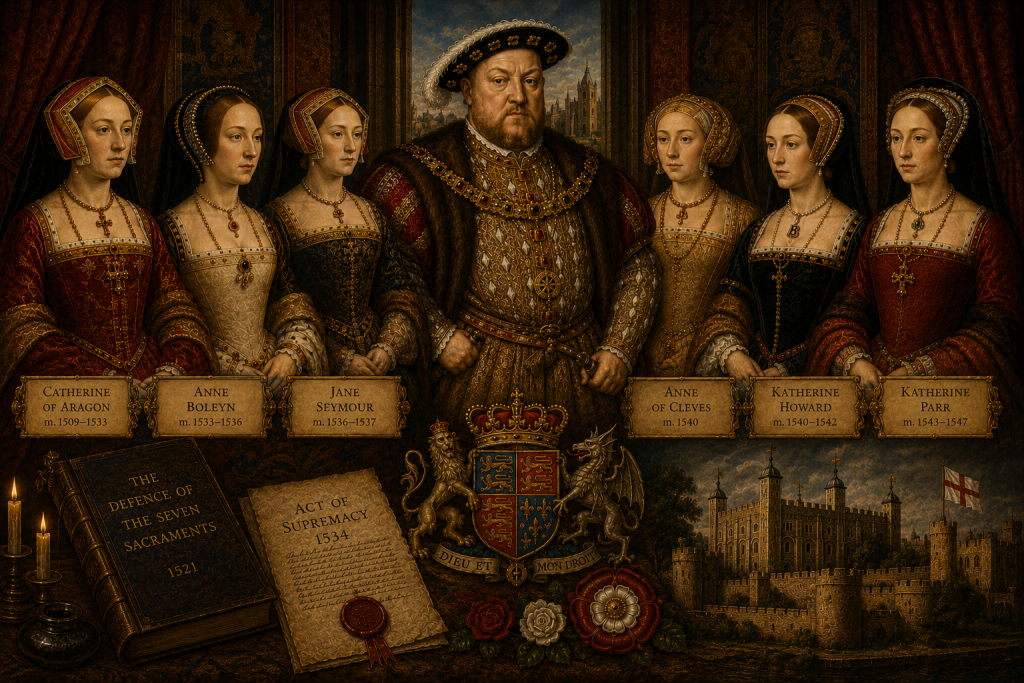
An artistic interpretation of Henry VIII and his six queens, whose marriages reshaped the Tudor dynasty and English history.
10 min read

“Divorced, beheaded, died, divorced, beheaded, survived — a schoolroom rhyme reduces six entire lives to six single words. Behind each word stood a woman who was, however briefly or however long, the reigning Queen of England, and whose own story deserves rather more than its allotted syllable.”
No single detail of Henry VIII‘s reign has embedded itself more firmly in popular memory than the sheer number of his marriages, six in total, each ending through annulment, execution, death, or survival in a sequence so dramatic that it has overshadowed, in much popular retelling, almost everything else his nearly four-decade reign actually accomplished. This popular fascination is not, in itself, misplaced — Henry’s marriages carried genuine, sweeping political and religious consequences, reshaping England’s relationship with Rome, its succession, and its very structure of royal authority. But the familiar schoolroom mnemonic, reducing each queen to a single fate-word, risks flattening six genuinely distinct women, six genuinely distinct political circumstances, and six genuinely distinct chapters of Tudor history into a repetitive, almost cartoonish sequence of royal misfortune. This article offers a broader survey of all six marriages together, tracing the pattern that connects them, while reserving the fuller, more detailed individual portraits of Catherine of Aragon and the wives still to come for their own dedicated instalments elsewhere.
A Search That Began With Genuine Devotion
Henry’s marital history began with genuine personal conviction rather than the calculating pragmatism that would come to characterise so much of what followed. His marriage to Catherine of Aragon in 1509 endured for nearly twenty-four years, considerably longer than any of Henry’s subsequent marriages combined, and produced, across those decades, genuine political partnership, sustained personal affection for a considerable stretch of years, and one surviving child, Princess Mary, born in 1516.
What eventually unravelled this first, longest marriage was not personal dissatisfaction alone, but the mounting weight of an unresolved dynastic crisis: Catherine’s inability, across numerous pregnancies, to produce a surviving male heir, combined with Henry’s own growing, genuinely held conviction that this failure reflected a fundamental flaw in the marriage’s original canonical legitimacy. This conviction ultimately drove Henry toward the sweeping legal and religious transformation that severed England from papal authority entirely, providing the institutional mechanism through which his marriage to Catherine was finally, formally annulled in 1533.
The first marriage lasted longest, and ended not through any sudden personal betrayal alone, but through the accumulated weight of an entire kingdom’s anxiety about what might happen to it without a secure male succession.
A Pattern Takes Shape
What followed Catherine’s marriage established a pattern that would recur, with variation, across the remainder of Henry’s marital history: each subsequent marriage carried its own distinct personal and political circumstances, yet each was shaped, to varying degrees, by the same underlying dynastic anxiety that had driven the end of Henry’s first marriage — the pressing, unresolved need to secure a stable male succession sufficient to prevent any return to the kind of destructive dynastic uncertainty that had characterised the Wars of the Roses before his own father’s reign had finally brought it to an end.
Henry’s second marriage, to Anne Boleyn, followed almost immediately upon the legal conclusion of his first, and carried consequences of genuinely staggering historical significance, providing the immediate personal catalyst for the broader institutional break with Rome. This marriage produced one surviving child, Princess Elizabeth, born in 1533, before ending in 1536 through Anne’s execution on charges of treason and adultery, charges whose full historical complexity, contested nature, and lasting consequence deserve, and will receive, their own considerably fuller dedicated treatment elsewhere rather than compressed summary here.
Even a broad survey piece such as this one cannot do justice to a marriage whose consequences reshaped an entire kingdom’s religious identity — some stories require considerably more room than a single paragraph within a wider survey can honestly provide.
Jane Seymour: The Queen Who Gave Henry What He Wanted Most
Henry’s third marriage, to Jane Seymour in 1536, arrived swiftly following Anne Boleyn’s execution, and proved, in dynastic terms at least, the marriage Henry had spent years pursuing across his two previous unions: Jane gave birth in October 1537 to Prince Edward, Henry’s long-desired male heir, finally providing the secure succession that had driven so much of the preceding decade’s dramatic upheaval. This achievement, however, came at devastating personal cost. Jane died less than two weeks after Edward’s birth, most likely from complications arising from the birth itself, a genuine tragedy that contemporary accounts suggest affected Henry considerably more deeply and more visibly than the endings of his other marriages, reflecting both genuine personal affection and profound relief at having finally secured his long-sought male heir.
Jane’s brief tenure as queen, cut short by her death rather than by any of the more dramatic political ruptures that ended Henry’s other marriages, has left her, in most popular retellings, as the quietest and least dramatically remembered of Henry’s six wives, despite achieving, in purely dynastic terms, precisely the outcome the entire preceding decade of marital upheaval had been oriented toward securing.
Anne of Cleves: A Diplomatic Marriage Undone by Personal Disappointment
Henry’s fourth marriage, arranged in 1540 to Anne of Cleves, a German noblewoman, reflected considerably more conventional diplomatic calculation than personal attraction, engineered largely by Thomas Cromwell as part of a broader strategy to secure useful continental Protestant alliances during a period of genuine diplomatic uncertainty regarding England’s relationship with the major Catholic powers of continental Europe. The marriage, however, proved almost immediately unsatisfactory to Henry on personal grounds, reportedly disappointed by Anne’s appearance upon their actual meeting in England, a disappointment that contemporary accounts suggest was compounded by genuine personal awkwardness and mutual discomfort between the two.
The marriage was formally annulled after only six months, in 1540, through a comparatively amicable legal process that Anne herself appears to have navigated with genuine practical skill, accepting a generous financial settlement and the honorary status of the King’s Beloved Sister in exchange for her cooperation, allowing her to live out the remainder of her life in England with considerable independence and financial security, an outcome that stands in genuinely striking contrast to the more dramatic and consequential endings of several of Henry’s other marriages. The marriage’s rapid failure also carried significant political consequence for Thomas Cromwell himself, whose role in arranging the unsuccessful match contributed directly to his own subsequent fall from royal favour and execution later that same year.
Of all six marriages, this is perhaps the one that ended most quietly, and, for the queen involved at least, most comfortably — a genuinely rare outcome within the broader pattern of Henry’s marital history.
Catherine Howard: A Brief, Catastrophic Marriage
Henry’s fifth marriage, to the considerably younger Catherine Howard in 1540, followed almost immediately upon the annulment of his marriage to Anne of Cleves, and proved, within little more than a year, the most swiftly and catastrophically concluded of all six unions. Catherine, a cousin of Anne Boleyn connected to the same prominent Howard family, was accused within eighteen months of the marriage of prior sexual relationships before her marriage to Henry and, more seriously and dangerously, of ongoing infidelity during the marriage itself, accusations that, whatever their precise underlying factual basis, were treated with the utmost political severity given the direct threat they posed to the security and legitimacy of Henry’s succession.
Catherine was executed in February 1542, following a formal parliamentary act of attainder rather than a conventional trial, a legal mechanism that itself reflects the severity and political urgency with which Henry’s government treated the accusations against her. Her brief tenure as queen, and its swift, violent conclusion, echoed with genuine and unsettling precision the earlier fate of her own cousin Anne Boleyn, a pattern that contemporary and later observers alike have found difficult to view as mere historical coincidence alone.
Catherine Parr: The Queen Who Outlived Him
Henry’s sixth and final marriage, to Catherine Parr in 1543, proved, by most historical assessments, considerably more stable and personally companionate than several of his preceding unions, bringing to the ageing, increasingly unwell king a genuinely capable, intellectually accomplished, and diplomatically skilled queen who navigated the considerable challenges of Henry’s final years with real political and personal competence. Catherine Parr, already twice widowed before her marriage to Henry, brought genuine intellectual seriousness to her role, publishing her own religious writings and taking an active, substantive interest in the education of Henry’s three surviving children, Mary, Elizabeth, and the young Prince Edward, across the final years of Henry’s life.
Catherine also served, on at least one occasion, as regent during Henry’s own continental military absence in 1544, echoing, in a striking historical parallel, Catherine of Aragon’s own earlier, similarly capable regency during Henry’s 1513 French campaign. Unlike five of Henry’s preceding marriages, this final union ended not through annulment or execution but simply through Henry’s own death in January 1547, leaving Catherine Parr as the only one of his six wives to survive him as his still-married, reigning queen consort.
The marriage that began last was also, in its own way, the marriage that most closely echoed the genuine partnership and competence Henry’s very first marriage, to Catherine of Aragon, had once demonstrated — a quiet, almost circular symmetry closing out an otherwise turbulent and dramatically varied marital history.
Reading the Pattern as a Whole
Considered together, rather than as six isolated dramatic episodes, Henry’s six marriages reveal a genuinely consistent underlying pattern. Across nearly four decades, his marital decisions remained persistently shaped by the same fundamental dynastic anxiety regarding secure male succession that had first driven the end of his marriage to Catherine of Aragon. Alongside that anxiety grew an escalating willingness, increasingly unchecked by any surviving institutional or personal restraint, to reshape or discard whatever marital arrangement no longer served that underlying dynastic priority, whatever the genuine human cost such decisions imposed on the women involved.
This pattern does not, and should not, flatten the genuine individual distinctiveness of each of the six women who occupied the position of Henry’s queen across these nearly four decades — their own individual educations, political engagements, personal convictions, and, in several tragic cases, their own individual deaths, deserve consideration on their own terms rather than mere absorption into a single repetitive narrative of royal marital instability. But the broader pattern connecting all six marriages together does illuminate something genuinely significant about Henry’s own reign as a whole: a king whose personal will, once firmly settled on a particular course, proved increasingly difficult for any institution, minister, or marriage to meaningfully restrain.
Timeline: The Six Marriages of Henry VIII
- 1509–1533 — Marriage to Catherine of Aragon, ending through annulment following the break with Rome.
- 1533–1536 — Marriage to Anne Boleyn, ending through her execution on charges of treason and adultery.
- 1536–1537 — Marriage to Jane Seymour, ending through her death shortly after giving birth to Prince Edward.
- 1540 — Marriage to Anne of Cleves, ending after six months through comparatively amicable annulment.
- 1540–1542 — Marriage to Catherine Howard, ending through her execution on charges of infidelity.
- 1543–1547 — Marriage to Catherine Parr, ending through Henry’s own death, the only marriage among the six to conclude this way.
author's note
Surveying all six marriages together draws on a fascination with Henry’s reign I have carried since childhood, and it has been genuinely useful groundwork for Related to Dracula, since my own novels follow only the earliest chapter of this much longer story, Henry’s courtship of Anne Boleyn, through the eyes of an outsider newly arrived at court. Sebastian meets Anne while she is still simply Lady Anne, ambitious, romantic, and increasingly desperate for his help in matters he insists he cannot provide. Knowing the fuller shape of what follows across Henry’s later marriages, a shape I have carried in my head since long before I began writing, even the chapters my own books don’t dramatise directly, has helped me understand exactly how much weight and foreboding to let sit quietly beneath Anne’s own scenes in the novel, without ever letting the story get ahead of itself.
sources and further reading
- Fraser, Antonia. The Wives of Henry VIII. Weidenfeld & Nicolson, 1992 — the standard comprehensive survey of all six marriages.
- Starkey, David. Six Wives: The Queens of Henry VIII. Chatto & Windus, 2003.
- Weir, Alison. The Six Wives of Henry VIII. Bodley Head, 1991.
- Tremlett, Giles. Catherine of Aragon: Henry’s Spanish Queen. Faber & Faber, 2010.
- Loades, David. The Six Wives of Henry VIII. Amberley Publishing, 2009.
- James, Susan E. Catherine Parr: Henry VIII’s Last Love. The History Press, 2008 — a detailed study of Henry’s final marriage and Catherine Parr’s own considerable political and intellectual achievements.
A note on sources: this article has deliberately provided a broader survey treatment of all six marriages together, drawing on the comprehensive comparative scholarship listed above, while reserving fuller individual biographical detail, particularly regarding Anne Boleyn and Catherine Howard, for their own separate, dedicated telling elsewhere.
related articles
- Henry VIII: The King Who Changed England
- The Spare Prince: Henry VIII’s Childhood Before He Was Ever Meant to Wear the Crown
- The King’s Choice: Henry VIII’s Accession and the Courtship of Catherine of Aragon
- Henry VIII’s First Queen: Catherine of Aragon, the Forgotten Queen
- The English Reformation: Henry VIII and the Break with Rome
- Henry VIII: King, Reformer or Tyrant?
- Tudor England: The Dynasty That Transformed a Kingdom
- Henry VII: The King Who Founded the Tudor Dynasty
- The Wars of the Roses: The Conflict That Created the Tudors
- How Henry VIII Fell in Love With Anne Boleyn: The Courtship That Changed England
continue your journey through history
Discover the novels inspired by the people, rivalries and legends of medieval Europe.

Historical Fiction Author
History has always fascinated me—not simply for the great battles or famous rulers, but for the people behind the legends. Through years of research into medieval Europe, the Ottoman Empire, Tudor England, and the lives of extraordinary historical figures, I’ve sought to uncover the stories that lie beneath popular myths. My novels blend documented history with compelling fiction, inviting readers to step into the past and experience it as those who lived it might have done.
Join the Related to Dracula Circle