
HISTORY · AUTHOR'S DESK
The Research Behind the Related to Dracula Series
How Forgotten Chronicles, Conflicting Accounts, and Centuries-Old Legends Became the Foundation of My Novels
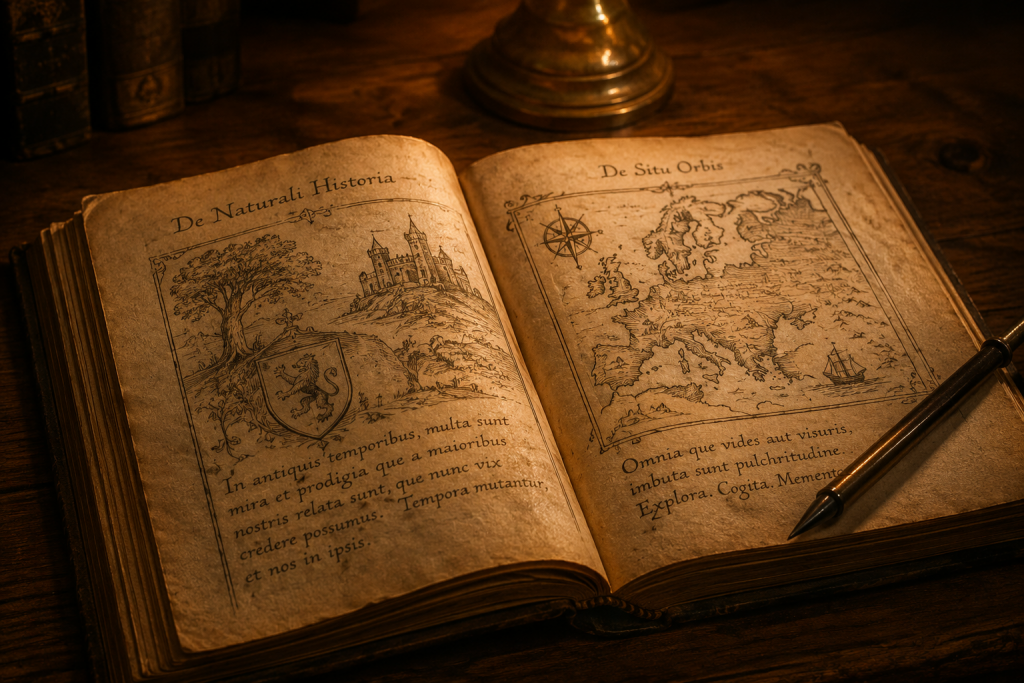
Artistic interpretation of an old manuscript.
8 min read
“History has always fascinated me — not because it gives us all the answers, but because it so rarely does.”
I learned to light a fire without matches before I learned most of what I now know about Vlad the Impaler, and I have come to think the two things taught me roughly the same lesson. I spent my childhood summers in a remote mountain village in Romania, at my grandparents’ house, where the land still ran on older rhythms than the rest of the world seemed to. I fished. I worked alongside my grandparents in the fields. I looked after the farm animals, learned to ride, and found my way home across the hills without a compass, trusting the shape of the land the way people there had trusted it for generations before me. In the evenings, when the work was done, the stories came out, and the story that returned most often, told and retold until it had worn smooth as a river stone, was the story of Vlad.
That was where it started, long before I ever thought of myself as a writer. Not in an archive. Not in a library. In a village kitchen, with the fire going and my grandmother’s voice carrying the same tale she must have heard from her own grandmother, about a prince who had once ruled the same mountains, and who had become, depending entirely on who was doing the telling, either a monster or a hero.
Growing Up Between Two Histories
Outside Romania, Vlad is remembered, almost without exception, as a byword for cruelty, the ruthless ruler whose name Bram Stoker borrowed and forever bound to a fictional vampire. Inside Romania, the picture I grew up with was very different. There, Vlad remains, for a great many people, something closer to a national hero: a prince who ruled during one of Wallachia‘s most dangerous centuries, defending a small and desperately vulnerable principality against the full weight of the expanding Ottoman Empire, with no ally he could fully trust and no margin for a single mistake. His methods were undeniably brutal. So, in fairness, was the age that produced him. And to many of the people who still tell his story today, he represents something closer to courage and defiance than to horror.
That contradiction has fascinated me since I was old enough to notice it. How could the same man be a monster in one country and a hero in the next? I came to understand, slowly, that the answer depends almost entirely on who is holding the pen. History is never simply recorded. It is told, and retold, by people who each carried their own fears and loyalties into the telling, and Vlad’s story, more than almost any other I know, wears the fingerprints of every single one of them.
As I grew older, a second world began pulling at my imagination with just as much force: the Tudor court, Henry VIII, Anne Boleyn. Thomas Cromwell. The same currents that had shaped Vlad’s Wallachia: power, loyalty, betrayal, religion, dynastic ambition, ran just as strongly through sixteenth-century England, in a court a world apart in climate and character from the mountains of my childhood. Two worlds, separated by geography and language and everything else that might have kept them apart, and yet built, underneath it all, from remarkably similar struggles.
I was born in Romania, but I have spent most of my adult life in England, and somewhere along the way I stopped thinking of these two histories as separate interests competing for my attention, and started recognising them as two halves of the same person. Rather than choosing between them, I eventually decided to bring them together. The Related to Dracula series became my way of honouring both countries that shaped me: Romania, where my story began, and England, where it has continued ever since.
Where History Ends, and Fiction Begins
People often ask how much research actually goes into writing historical fiction, and the honest answer is: a great deal more than most readers ever see on the page. Before I write a single scene, I spend months living inside chronicles, biographies, archaeological reports, letters, academic papers, contemporary accounts, comparing sources against one another, hunting for the places where they contradict, and trying to understand not only what happened but why the historians studying it still cannot always agree.
Historical documents are rarely as tidy as we would like them to be. One chronicler praises a ruler that another condemns in the very same breath. One source records an event that a second source, writing from the same country in the same decade, never thought worth mentioning at all. Sometimes entire decades survive only in fragments, a handful of surviving letters standing in for years of a person’s actual life. For a historian, this is frustrating. For a novelist, I have come to believe, it is something closer to an invitation. Every gap in the record is a door left quietly ajar, and historical fiction is largely the art of deciding what might be waiting on the other side of it: the conversations no one wrote down, the private thoughts no document preserved, the small human choices hiding behind the famous events history actually remembered to record.
The Legend That Refuses to Disappear
One of my favourite examples of this comes from Poenari Castle, the real fortress perched high in the Carpathian Mountains that is genuinely, documentedly associated with Vlad III, and which remains one of Romania’s most dramatic surviving medieval sites. Below its walls, the Argeș River still runs, exactly as it did in Vlad’s own century.
According to one of Romania’s best-known legends, during an Ottoman siege of the castle, Vlad’s own wife chose death over capture, throwing herself from the walls into the river rather than fall into enemy hands. Local tradition holds that the river ran red with her blood that day; since then, it has been called The Lady’s River. Whether every detail of that story is strictly, historically accurate is something historians still debate, and probably always will. But I have come to believe that legends carry their own particular kind of truth, one that has little to do with verified fact and everything to do with what generations of people actually believed, feared, and chose to pass down rather than let slip away.
Writing Related to Dracula: At Tudor Court, I found myself returning to that legend again and again, unable to leave it alone. Rather than simply retelling it as I had first heard it in that mountain kitchen, I found myself asking the question every novelist eventually asks of the history they love most: what if it had gone differently? Without giving too much away, I took that familiar, well-worn story and gave it an entirely new turn, one that still lives rooted in the same history and the same folklore that first gave it to me, but that now belongs to my own fictional world as much as it belongs to Romania’s. Moments like that one remain, for me, the purest pleasure of writing historical fiction at all.
Respecting the Past While Telling a New Story
Every writer of historical fiction eventually runs headlong into the same question: how do you stay faithful to history while still telling a story that actually moves? For me, the answer has always come down to respect. The people at the centre of these novels were real. Their victories and their losses, their ambitions and their fears, genuinely shaped the world the rest of us inherited, and I owe them the care of getting the shape of their lives right wherever I possibly can. Wherever it is feasible, I keep the events, the dates, and the places accurate, and let the fiction grow up carefully around that scaffolding rather than replacing it. The result, I hope, is a story where real history forms the foundation and imagination simply fills in the rooms history itself left standing empty.
Why the Truth Is Often More Fascinating Than the Myth
One of the genuine surprises of years spent doing this research is discovering, again and again, that the real history rarely needs any embellishment from me at all. The shifting political alliances that surrounded Vlad III. The rival claimants circling the Wallachian throne. The impossibly delicate relationship between the Ottoman Empire, Hungary, and the Romanian principalities caught between them. The genuinely dangerous, high-stakes politics of Henry VIII’s own court. None of it needed inventing to be dramatic. Reality had already supplied more intrigue than any novelist could reasonably ask for.
An Ongoing Journey
Research, I have learned, never really ends. Every new article I read, every documentary I watch late at night, every historical site I finally get to visit in person carries the potential to reshape a scene I thought was already finished, or to hand me an entirely new story I hadn’t known I was looking for. That restlessness is exactly why I created the History and Articles sections of this website, as a place to share some of the remarkable people, places, and events that first inspired my novels, and to gently separate documented history from popular legend wherever I can.
The Related to Dracula series began with a lifelong fascination for two extraordinary periods of history and two countries that shaped nearly everything about who I am. It continues because every forgotten chronicle, every disputed account, and every legend still being told somewhere by a fireside reminds me that history is rarely as simple as we would like it to be. Sometimes the greatest stories are not invented at all. They are only waiting, patiently, to be rediscovered.
related articles

Historical Fiction Author
History has always fascinated me—not simply for the great battles or famous rulers, but for the people behind the legends. Through years of research into medieval Europe, the Ottoman Empire, Tudor England, and the lives of extraordinary historical figures, I’ve sought to uncover the stories that lie beneath popular myths. My novels blend documented history with compelling fiction, inviting readers to step into the past and experience it as those who lived it might have done.
Join the Related to Dracula Circle