
HISTORY · VLAD THE IMPALER
The Real Castles of Vlad the Impaler
Stone Walls, Mountain Fortresses, and the One Famous Castle That Was Never Really His
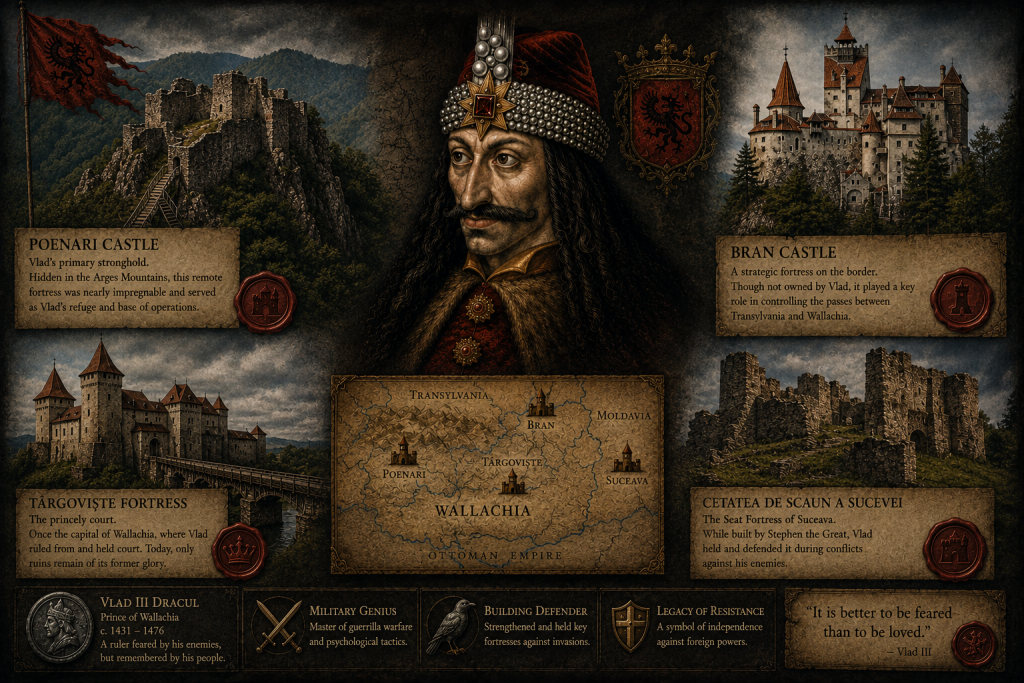
An artistic interpretation of Vlad III, Prince of Wallachia.
8 min read

“Tourists climb one castle believing it holds his ghost. Historians climb another, further into the mountains, knowing it holds his actual footsteps. The two, frustratingly for the tourism board, are not the same building.”
Ask most visitors to Romania today which castle belonged to Vlad the Impaler, and the overwhelming majority will point, without hesitation, to a single dramatic silhouette perched above the Transylvanian town of Bran — turreted, fog-wrapped, instantly recognisable from a thousand postcards and film backdrops. It is, by any measure, an extraordinary building, and it is also, by any serious historical measure, almost entirely disconnected from the man whose name now draws millions of visitors through its gates each year. The actual architecture of Vlad’s life is scattered elsewhere entirely, across a handful of far less photogenic sites — a crumbling mountaintop ruin reached only by several hundred exhausting steps, a princely court whose surviving tower still bears his family’s dragon emblem, and a scattering of monasteries and lesser fortifications that never made it onto any postcard at all. Understanding where Vlad actually lived, fought, and ruled means, somewhat ironically, learning to look past the one castle everybody already knows.
Bran Castle: A Beautiful Building, Borrowed for the Wrong Story
It is worth addressing Bran Castle directly and immediately, precisely because its association with Vlad has become so deeply, almost irreversibly embedded in popular imagination that any honest account of his real architectural legacy has to begin by clearing the ground. Bran Castle is a genuine, historically significant medieval fortification, built in the fourteenth century by Transylvanian Saxons primarily as a customs post and defensive structure guarding a mountain pass between Transylvania and Wallachia. Its connection to Vlad, however, rests on remarkably thin historical ground — at most, a handful of scholars have proposed that Vlad may have passed through or briefly stayed at Bran during certain military campaigns or periods of exile, given its position along a route he is known to have used, but there exists no solid documentary evidence that he ever ruled from it, held any meaningful residence there, or regarded it as anything more than a fortification he occasionally passed near.
A castle can be genuinely ancient, genuinely beautiful, and still be almost entirely the wrong building for the story visitors have travelled to hear.
The association took firm hold largely through twentieth-century marketing rather than fifteenth-century fact, gaining particular momentum after Bram Stoker’s novel made “Dracula’s castle” an object of international fascination, at which point Bran’s dramatic, suitably Gothic appearance made it an irresistible candidate for tourism boards eager to give visitors a physical destination matching their imagination, regardless of the comparatively weak historical claim underpinning the connection. Romanian heritage authorities and serious historians have long acknowledged this discrepancy, even as the tourism industry, quite understandably from a purely commercial standpoint, has shown little appetite for correcting a myth so profitable. Bran remains very much worth visiting as a medieval fortress in its own right; it simply is not, in any historically grounded sense, Vlad’s castle.
Poenari Fortress: The Ruin That Actually Was His
If any single structure deserves the title most popularly, if inaccurately, attached to Bran, it is Poenari Fortress, a genuinely remote and dramatic ruin perched atop a steep mountain ridge above the Argeș River, reachable today only by climbing roughly one thousand five hundred steps carved into the mountainside — a detail that alone helps explain why Poenari has never rivalled Bran as a tourist destination, despite possessing the far stronger historical claim. Poenari had existed in some earlier form before Vlad’s reign, but it was Vlad himself who rebuilt and substantially reinforced the fortress during the late 1450s, transforming it into a genuine mountain stronghold intended to serve as a defensible retreat and strategic outpost overlooking the surrounding valley.
The circumstances of that rebuilding project carry their own dark historical weight. According to chronicled accounts, much of the labour used to reconstruct Poenari was drawn from boyars arrested during Vlad’s infamous Easter banquet purge in the early years of his second reign, nobles implicated in his father’s assassination and his brother’s torture-death, forced to march to the ruined fortress and rebuild it under gruelling conditions, a punishment that doubled as both practical fortress reconstruction and a further, brutal demonstration of Vlad’s determination to break the power of a treacherous nobility. The fortress that resulted from this forced labour became, by most historical accounts, a genuine site of personal significance to Vlad, used as a strategic retreat and, according to persistent local tradition, the location from which his first wife is said to have thrown herself from the fortress walls into the river below rather than face capture during a later Ottoman assault, a story that, whatever its precise factual reliability, has become deeply woven into local memory surrounding the site.
Where Bran offers visitors a beautiful building with almost nothing genuinely Vlad about it, Poenari offers the opposite bargain entirely — an exhausting climb to a crumbling ruin that actually witnessed his life.
Today, Poenari survives only as a partial ruin, its walls significantly reduced by earthquakes and centuries of neglect, but its authenticity, confirmed through both documentary evidence and archaeological investigation, makes it, by any reasonable historical standard, the single site most deserving of the “Dracula’s castle” title so persistently misapplied to Bran.
Curtea Domnească at Târgoviște: The Princely Court
Beyond Poenari’s mountain isolation, Vlad’s more regular seat of governance lay at Curtea Domnească, the princely court complex in Târgoviște, which served as Wallachia’s capital during much of his reign. Unlike Poenari’s role as a defensive mountain retreat, Târgoviște functioned as the actual administrative and ceremonial heart of Vlad’s rule, the site from which he governed, received envoys, and, according to persistent tradition, ordered at least some of the executions for which his reign became infamous.
The most visually striking surviving element of this complex today is the Chindia Tower, a watchtower reconstructed in the nineteenth century on the foundations of an earlier tower genuinely associated with Vlad’s reign, offering, according to local tradition, a vantage point from which he could observe the surrounding city and, some accounts suggest, the very executions carried out on his orders. It was also from Târgoviște, and the surrounding countryside, that Ottoman forces advancing under Sultan Mehmed II encountered the infamous field of impaled corpses during the 1462 campaign, making the city and its immediate surroundings the setting for one of the single most consequential episodes of Vlad’s entire reign.
A tower rebuilt long after his death still marks, close enough, the ground where his actual rule was administered — which is more than Bran, for all its fame, can genuinely claim.
Much of the original Curtea Domnească complex has been lost or substantially altered over the centuries, but archaeological work and partial reconstruction have preserved enough of the site to give visitors a genuine, if considerably less dramatic, sense of where Vlad actually conducted the business of ruling Wallachia.
Snagov Monastery: A Quieter, Disputed Connection
A further site frequently connected to Vlad, though for reasons of burial rather than residence or governance, is Snagov Monastery, a secluded religious complex on an island north of Bucharest with which Vlad maintained documented connections during his reign, including reported financial patronage of the monastery itself. Tradition holds that Vlad was buried at Snagov following his death in 1476, a claim that gained considerable public attention following early twentieth-century excavations, though subsequent scholarly re-examination has raised significant doubts about whether the remains uncovered there genuinely belong to him. Whatever the ultimate truth of his burial location, Snagov’s documented historical relationship with Vlad during his lifetime makes it a legitimate, if quieter and less architecturally dramatic, addition to the map of sites genuinely connected to his life, standing in useful contrast to Bran’s far louder but considerably weaker claim.
Reading the Map Correctly
Taken together, these sites sketch a far more accurate, if considerably less cinematic, picture of Vlad’s actual physical world than the one most visitors arrive expecting. He ruled not from a single Gothic castle perched dramatically above a mountain pass, but from a scattered network of fortifications and courts suited to the practical demands of governing and defending a small, embattled principality — a remote mountain stronghold rebuilt through the forced labour of defeated enemies, a princely court from which the ordinary, unglamorous business of ruling actually took place, and a quiet monastic island that may or may not hold his remains. None of these sites offers quite the same immediate, fog-wrapped drama as Bran’s silhouette, and that, in the end, may be precisely the point. The real architecture of Vlad’s life was built for survival and strategic necessity, not for atmosphere, and it has taken visitors considerably longer to appreciate that a thousand-step climb to a crumbling mountain ruin tells his actual story far more faithfully than any castle he never set foot in ever could.
Timeline: Vlad and His Strongholds
- Pre-1450s — An earlier fortress already exists at Poenari, though in a state requiring significant reconstruction.
- 1456 onward — Vlad establishes his primary seat of governance at Curtea Domnească in Târgoviște following the start of his second reign.
- Late 1450s — Following the Easter banquet purge, Vlad forces surviving boyars to march to Poenari and rebuild the fortress under brutal conditions.
- 1456–1462 — Vlad governs primarily from Târgoviște, while Poenari serves as a fortified mountain retreat.
- 1462 — Ottoman forces under Mehmed II advance toward Târgoviște, encountering the infamous field of impaled corpses near the city.
- 1462 — Following the collapse of his second reign, tradition holds that Vlad’s first wife dies at Poenari rather than face Ottoman capture, though the precise circumstances remain disputed.
- 1476 — Following Vlad’s death, tradition holds that he is buried at Snagov Monastery, a site with documented connections to his reign.
- 19th century — The Chindia Tower at Târgoviște is reconstructed on the foundations of the earlier tower associated with Vlad’s rule.
- 1930s — Archaeological excavations at Snagov Monastery uncover a grave initially, though inconclusively, linked to Vlad.
- 20th century onward — Bran Castle, despite its weak historical connection to Vlad, becomes internationally established as “Dracula’s castle” through tourism marketing following the popularity of Stoker’s novel.
author's note
I never had to “unlearn” Bran the way so many readers do, because I never learned it in the first place. I was born in Romanian, and the version of Vlad’s world I grew up with came from my own family, not from a tourism brochure — a remote mountain ruin at Poenari, a princely court at Târgoviște, places that meant something to the people who actually told me his story, long before I understood that the rest of the world had quietly attached his name to a completely different castle in a completely different mountain range. Writing this chapter felt less like correcting a mistake I once made myself, and more like finally putting into writing something I had always known: that the real architecture of Vlad’s life was never the beautiful one, and that Poenari’s obscurity, a ruin nobody bothers marketing, is exactly what makes it worth the climb. It simply was his, in a way Bran never was.
sources and further reading
- Florescu, Radu R., and Raymond T. McNally. Dracula, Prince of Many Faces: His Life and His Times. Little, Brown and Company, 1989.
- McNally, Raymond T., and Radu Florescu. In Search of Dracula: The History of Dracula and Vampires. Houghton Mifflin, 1994 — includes detailed discussion of Poenari, Snagov, and the historical weakness of the Bran Castle connection.
- Treptow, Kurt W. Vlad III Dracula: The Life and Times of the Historical Dracula. Centre for Romanian Studies, 2000.
- Cazacu, Matei. Dracula. Brill, 2017 (English translation of the original French edition).
- Giurescu, Constantin C. Istoria Bucureștilor (The History of Bucharest). Editura pentru Literatură, 1966 — useful background on Curtea Domnească and Wallachian princely courts of the period.
- Light, Duncan. The Dracula Dilemma: Tourism, Identity and the State in Romania. Routledge, 2012 — an excellent study of how Romania has navigated the gap between historical accuracy and tourism demand at sites such as Bran Castle.
A note on sources: Duncan Light’s research in particular has been valuable in tracing precisely how and when the Bran Castle association took hold, demonstrating that the connection owes far more to twentieth-century tourism strategy than to any fifteenth-century historical record.
related articles
- Vlad the Impaler: The man behind the Dracula legend
- The Childhood of Vlad the Impaler
- Vlad the Impaler and Mehmed II
- The Night Attack of Târgoviște
- Vlad the Impaler’s three reigns
- The real Vlad the Impaler vs Dracula: Fact vs Fiction
- Justice or cruelty? Understanding Vlad the Impaler’s rule
- The Death of Vlad the Impaler
- How Europe remembered Vlad the Impaler
continue your journey through history
Discover the novels inspired by the people, rivalries and legends of medieval Europe.

Historical Fiction Author
History has always fascinated me—not simply for the great battles or famous rulers, but for the people behind the legends. Through years of research into medieval Europe, the Ottoman Empire, Tudor England, and the lives of extraordinary historical figures, I’ve sought to uncover the stories that lie beneath popular myths. My novels blend documented history with compelling fiction, inviting readers to step into the past and experience it as those who lived it might have done.
Join the Related to Dracula Circle