
HISTORY · Tudor England
Prince Arthur Tudor: The Death That Changed the Course of English History
The Carefully Prepared Heir Whose Sudden Loss Rewrote an Entire Dynasty’s Future
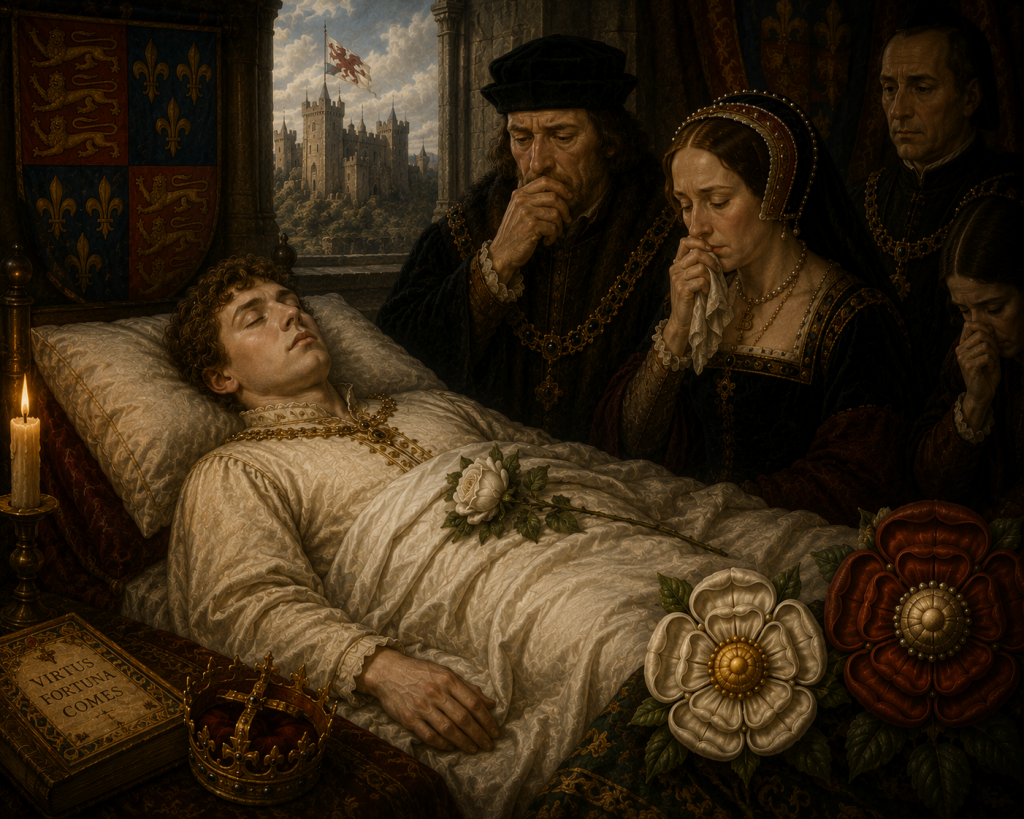
An artistic interpretation of Prince Arthur Tudor, eldest son of Henry VII, whose early death transformed the future of the Tudor dynasty.
8 min read
“He was raised, from his very first breath, to be England’s next king. He died before he ever had the chance — and in dying, handed that same destiny, entirely unprepared, to a younger brother history would remember considerably more vividly than it ever remembered him.”
Some historical figures earn their significance through what they actually achieved during long, eventful lives. Prince Arthur Tudor earns his significance through something considerably stranger and more poignant: the sheer scale of what his early, unexpected death set in motion, despite a life lasting barely fifteen years and a reign he never actually got the chance to hold. Arthur was, from the very moment of his birth in 1486, the single most carefully prepared and dynastically significant figure of his entire generation, the living embodiment of everything his father Henry VII‘s own hard-won victory at Bosworth Field had been fought to secure. His death in 1502 did not merely end one promising young life; it redirected the entire subsequent trajectory of the Tudor dynasty, English religious history, and, indirectly, the fate of an entire kingdom, handing an unexpected destiny to a younger brother whose own considerably more famous reign would never have occurred at all had Arthur lived.
Born to Fulfil a Dynasty’s Every Hope
Arthur was born on 20 September 1486, arriving barely eight months after his parents’ own carefully constructed dynastic marriage, and his birth carried a symbolic weight considerably beyond the ordinary celebration typically afforded any royal firstborn son. Henry VII deliberately chose the name Arthur specifically to evoke the legendary British king of Camelot, a name carrying deliberate, carefully calculated associations with a golden, unified, and gloriously successful English monarchy, a symbolic choice explicitly designed to announce, from the very moment of this child’s birth, exactly the triumphant, historically resonant reign Henry VII intended his own new dynasty’s future to embody.
This deliberate symbolic weight shaped virtually every aspect of Arthur’s upbringing, which unfolded along lines considerably more intensively structured and deliberately calibrated toward eventual kingship than his younger brother’s more conventional royal education. Arthur was invested as Prince of Wales while still a small child and, from a comparatively young age, maintained his own dedicated household at Ludlow Castle in the Welsh Marches, a location carrying its own considerable symbolic and practical significance as the traditional seat from which English heirs to the throne were expected to gain direct experience of regional governance and administration.
A name chosen to evoke Camelot’s own legendary golden age carries with it an almost unbearable weight of expectation — and Arthur spent the whole of his short life growing up directly beneath that weight.
An Education Built for a King, Not Merely a Prince
Arthur’s education at Ludlow proceeded under close, deliberate supervision reflecting his father’s evident determination to prepare him thoroughly and specifically for the practical demands of eventual kingship, encompassing rigorous instruction in Latin and classical literature, languages, law, and the practical administrative responsibilities a future English monarch would genuinely need to master. Surviving evidence, including correspondence and contemporary accounts from tutors and household officials, consistently describes Arthur as a genuinely conscientious and intellectually capable student, applying himself with evident seriousness to an educational programme considerably more demanding and specifically purposeful than the broader, less narrowly targeted humanist education his younger brother Henry received during these same years within the more conventional royal nursery environment.
This distinction between Arthur’s own deliberately structured preparation for kingship and Henry’s own comparatively less targeted upbringing reflects the genuine, sustained difference in how Tudor court planning treated its two sons: Arthur as the specifically groomed future king, Henry as a valuable but dynastically secondary son whose own eventual adult role remained, throughout Arthur’s own lifetime, considerably less precisely defined.
A Marriage Years in the Making
Arthur’s own marriage to Catherine of Aragon represented the culmination of years of careful, sustained diplomatic negotiation between Henry VII and the powerful Spanish monarchs Ferdinand and Isabella, an alliance considered genuinely significant to England’s own broader diplomatic standing and to the continued security and prestige of the still comparatively young Tudor dynasty. The marriage, following Catherine’s own difficult sea voyage to England, finally proceeded in November 1501, celebrated with considerable public ceremony and magnificence reflecting the genuine diplomatic and dynastic significance both royal houses attached to the union.
Arthur was fifteen years old at the time of his marriage, Catherine herself slightly older, and the young couple, following the marriage celebrations in London, subsequently travelled together to take up residence at Ludlow Castle, continuing what appeared, from the outside at least, to be Arthur’s own carefully planned, entirely conventional preparation for his eventual accession to the throne, now accompanied by the wife whose own royal Spanish lineage had been so carefully secured to strengthen his future reign’s diplomatic standing still further.
Everything about Arthur’s marriage had been planned with the same meticulous care that had shaped every other aspect of his upbringing — a fitting final piece in a dynastic project that had, up to this point, proceeded almost exactly as Henry VII had originally intended.
A Sudden, Catastrophic Illness
The sequence of events that followed Arthur and Catherine’s arrival at Ludlow proved shockingly, catastrophically different from anything the preceding years of careful dynastic planning had anticipated. Within months of the marriage, both Arthur and Catherine fell seriously ill, most likely from a virulent illness that swept through the Ludlow household during this period, quite possibly the mysterious ailment known to contemporaries as the sweating sickness. However, the precise nature of the illness that ultimately proved fatal to Arthur remains, even now, a matter of some genuine historical uncertainty given the considerable limitations of contemporary medical description and diagnosis.
Arthur died on 2 April 1502, at just fifteen years old, a mere five months after his long-anticipated marriage had finally taken place, and barely a matter of weeks after the couple arrived at what was meant to have been the site of Arthur’s own continued preparation for eventual kingship rather than the location of his own sudden, entirely unexpected death. Catherine herself, though seriously ill during this same period, survived. However, her own recovery unfolded amid the genuine, devastating grief of having lost her new husband within months of a marriage that had itself taken years of careful diplomatic negotiation to finally secure.
A Kingdom’s Carefully Built Plan Collapses Overnight
The shock Arthur’s sudden death produced within the royal family and the wider kingdom can scarcely be overstated, a devastation considered here specifically from Arthur’s own perspective as the primary, intended subject of this catastrophic loss. Henry VII and Elizabeth of York had invested the entirety of their own dynastic hopes, and considerable practical preparation in Arthur specifically, and his death threw the kingdom’s entire carefully constructed succession plan into sudden, genuine crisis, precisely the kind of dynastic uncertainty the Tudor dynasty’s own founding project, born from decades of preceding civil war, had been explicitly designed to prevent from ever recurring.
Contemporary accounts describe Henry VII’s own profound grief upon receiving news of his eldest son’s death, grief that several historians suggest marked a genuine, lasting change in Henry’s own subsequent temperament and conduct, compounding, within less than a year, the further devastating loss of his wife Elizabeth in February 1503. The dynasty Henry had fought so hard to establish and secure now depended entirely on his surviving younger son, a boy who had spent his own childhood being raised for an altogether different, less dynastically central future than the one Arthur’s sudden death had now thrust upon him with such unexpected urgency.
A single unexpected illness, arriving within months of what should have been a triumphant beginning to years of carefully planned preparation, undid nearly two decades of deliberate dynastic planning within the space of a few devastating weeks.
The Question That Followed Him Into History
Arthur’s death carried one further, genuinely momentous historical consequence extending considerably beyond the immediate crisis of succession it produced: the question of whether his brief marriage to Catherine had actually been consummated during their short time together as husband and wife would, more than two decades later, become a matter of genuine legal and theological significance central to Henry VIII‘s own eventual pursuit of marital annulment. This question, impossible to resolve with any real historical certainty given the private nature of the matter and the conflicting testimony later produced on both sides of the eventual dispute, meant that Arthur’s own brief life and sudden death continued exerting genuine historical influence for decades after his own death, shaping arguments and legal proceedings that would eventually help produce the English Reformation itself.
Arthur never lived to become king. But the specific, unresolved circumstances of his brief marriage would go on, more than two decades after his own death, to help reshape an entire kingdom’s religious identity — a strange, indirect legacy considerably larger than anything his own short life might otherwise have been expected to produce.
A Life Measured by What It Made Possible
Considered as a whole, Arthur Tudor’s own historical significance rests almost entirely on the consequences of his death rather than on any achievement of his own brief life, a genuinely unusual historical distinction for a figure who was, throughout his own short lifetime, the single most carefully prepared and dynastically significant person of his entire generation. His death redirected the Tudor succession toward a brother whose own considerably more famous and consequential reign would never have occurred at all had Arthur survived, and the unresolved question of his own brief marriage would, decades later, help precipitate one of the most significant religious transformations in the whole of English history. Arthur Tudor remains, in the most genuine historical sense, the prince whose absence shaped his own country’s future considerably more profoundly than his presence, however carefully prepared and however dynastically central, ever actually had the chance to.
Timeline: The Life of Prince Arthur
- 20 September 1486 — Arthur is born, the eldest son of Henry VII and Elizabeth of York.
- Early childhood — Arthur is invested as Prince of Wales and begins an intensive, deliberately structured education preparing him for eventual kingship.
- c. 1490s — Arthur maintains his own dedicated household at Ludlow Castle, receiving direct experience of regional governance.
- 1501 — Following years of diplomatic negotiation, arrangements for Arthur’s marriage to Catherine of Aragon are finalised.
- November 1501 — Arthur marries Catherine of Aragon in London amid considerable public celebration.
- Early 1502 — Arthur and Catherine travel to Ludlow Castle, where both subsequently fall seriously ill.
- 2 April 1502 — Arthur dies at Ludlow Castle, aged fifteen.
- 1502–1504 — The Tudor succession is urgently reoriented toward Arthur’s younger brother, the future Henry VIII.
- Late 1520s onward — The unresolved question of Arthur’s marriage to Catherine becomes central to Henry VIII’s own pursuit of marital annulment.
author's note
Arthur’s death is the quiet hinge on which the entire world of Related to Dracula actually turns, even though he is never a character in the novels themselves. Had Arthur lived, there is no Henry VIII for Sebastian to meet, no succession crisis, no court for Anne Boleyn to navigate at all. Researching Arthur properly, rather than treating him as a mere footnote to his younger brother’s story, gave me a much sharper sense of just how contingent and fragile the entire Tudor world my characters inhabit actually was, built, in the end, on a single unexpected illness at Ludlow Castle that could easily have gone the other way.
sources and further reading
- Penn, Thomas. Winter King: Henry VII and the Dawn of Tudor England. Allen Lane, 2011.
- Sicca, Cinzia, and Louis A. Waldman, eds. The Anglo-Florentine Renaissance: Art for the Early Tudors. Yale University Press, 2012.
- Tremlett, Giles. Catherine of Aragon: Henry’s Spanish Queen. Faber & Faber, 2010 — includes detailed treatment of Arthur’s marriage and death from Catherine’s own perspective.
- Gunn, Steven. Henry VII. Routledge, 2007.
- Starkey, David. Henry: Virtuous Prince. HarperPress, 2008.
- Mattingly, Garrett. Catherine of Aragon. Little, Brown and Company, 1941.
A note on sources: the precise cause of Arthur’s fatal illness remains genuinely uncertain given the limitations of contemporary medical record-keeping, and the equally unresolved question of whether his marriage to Catherine was consummated rests on conflicting later testimony that historians continue to weigh without any definitive resolution. This article has drawn on the broad biographical consensus represented across the scholarship listed above.
related articles
- Henry VIII: The King Who Changed England
- The Spare Prince: Henry VIII’s Childhood Before He Was Ever Meant to Wear the Crown
- The King’s Choice: Henry VIII’s Accession and the Courtship of Catherine of Aragon
- Henry VIII’s First Queen: Catherine of Aragon, the Forgotten Queen
- The English Reformation: Henry VIII and the Break with Rome
- The Six Wives of Henry VIII: Marriage, Power and the Making of Tudor England
- Henry VIII: King, Reformer or Tyrant?
- Tudor England: The Dynasty That Transformed a Kingdom
- Henry VII: The King Who Founded the Tudor Dynasty
- Elizabeth of York: The Rose That United a Kingdom
continue your journey through history
Discover the novels inspired by the people, rivalries and legends of medieval Europe.

Historical Fiction Author
History has always fascinated me—not simply for the great battles or famous rulers, but for the people behind the legends. Through years of research into medieval Europe, the Ottoman Empire, Tudor England, and the lives of extraordinary historical figures, I’ve sought to uncover the stories that lie beneath popular myths. My novels blend documented history with compelling fiction, inviting readers to step into the past and experience it as those who lived it might have done.
Join the Related to Dracula Circle