
HISTORY · ORDER OF THE DRAGON
The Other Knights of the Order of the Dragon
Vlad II Was Never the Only Nobleman Sigismund Trusted With His Emblem
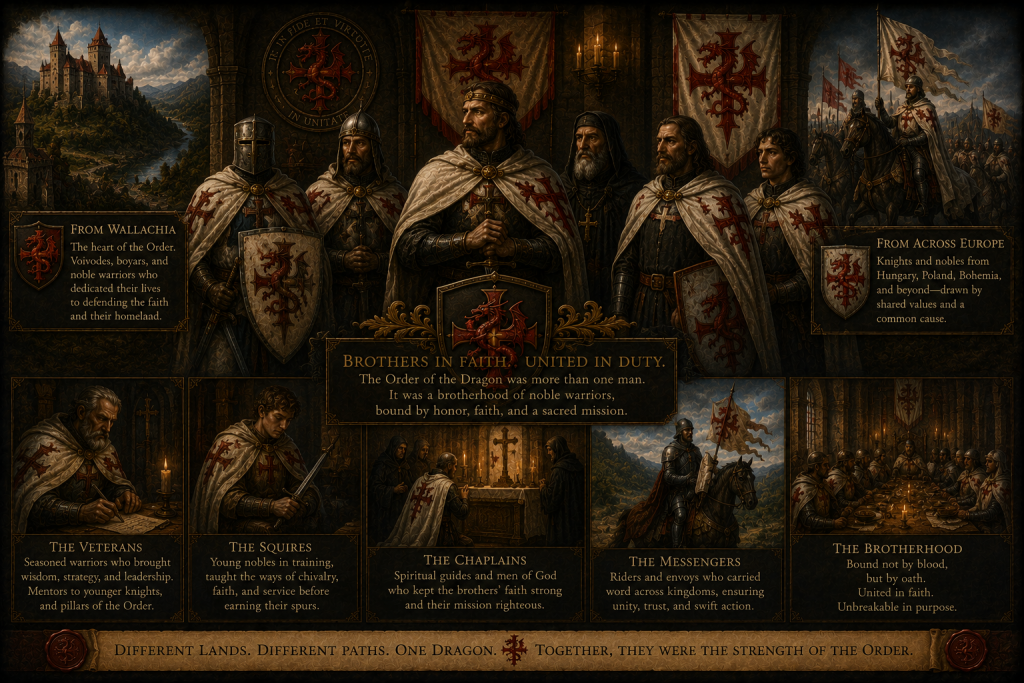
An artistic interpretation of prominent members of the Order of the Dragon during the fifteenth century.
8 min read
“History remembers the order almost entirely through one borrowed name. But Sigismund’s dragon was pinned to the chests of kings, despots, and crusading knights across half a continent, most of whom left no vampire legend behind them at all — only the far quieter, far less remembered work of trying to hold a crumbling frontier together.”
It is easy, after spending so much time tracing the connection between the Order of the Dragon and the name Vlad III eventually inherited, to imagine Sigismund of Luxembourg’s brotherhood as though it existed primarily to produce that single, famous patronymic — as though Vlad II’s induction were the Order’s defining act of membership, with everyone else who ever wore the dragon emblem reduced to background detail. This is, in every meaningful sense, a distortion of the actual historical institution. The Order of the Dragon extended membership to a genuinely wide and politically significant roster of Central and South-Eastern European nobility across the early and mid-fifteenth century, many of whom played roles in the region’s turbulent history considerably larger, in their own lifetimes, than the comparatively minor Wallachian nobleman who happened to father history’s most famous Impaler. Looking beyond Vlad II reveals an institution considerably more consequential, and considerably better connected to the actual military and political struggles of the age, than its later fame as a footnote to Dracula’s origin story might otherwise suggest.
Founding Members and the Original Core
When Sigismund formally established the Order in 1408, its founding membership was drawn primarily from within his own immediate Hungarian court and closely allied Central European nobility, individuals whose loyalty and cooperation Sigismund considered essential to consolidating his own authority as King of Hungary during a period of considerable internal and external instability. This founding core included prominent Hungarian magnates and several of Sigismund’s closest allied rulers from neighbouring territories, forming the initial nucleus around which the Order’s later, considerably wider membership would eventually be built.
Among this founding generation, Sigismund’s own wife, Barbara of Cilli, stood as a genuine co-founder of the Order rather than a mere honorary or peripheral participant, appearing alongside Sigismund as an equal partner in the Order’s own founding charter of December 1408. This was a genuinely unusual arrangement for a chivalric institution of this period, most of which restricted membership and founding authority exclusively to male nobility engaged directly in military and political affairs. Barbara’s considerable political influence within Sigismund’s court, including her periods governing as regent during his absences, makes her co-founding role a distinctive feature that sets the Order of the Dragon apart from many of its more strictly gendered contemporary institutions.
An order built around urgent political necessity, rather than purely ceremonial tradition, apparently found rather less use for excluding a genuinely influential political actor simply on the grounds of her sex.
Stefan Lazarević: A Serbian Despot on the Frontline
Among the Order’s most militarily significant members stood Stefan Lazarević, the Despot of Serbia, whose territory sat directly exposed to advancing Ottoman military pressure throughout the early fifteenth century, making his cooperation with Sigismund’s broader defensive project considerably more than a merely symbolic gesture. Stefan’s own political position required him to navigate an extraordinarily precarious relationship with Ottoman power; at various points serving as an Ottoman vassal himself while simultaneously maintaining his membership within Sigismund’s explicitly anti-Ottoman chivalric brotherhood, a genuinely difficult balancing act that illustrates just how complicated loyalty and survival had become for rulers positioned along the actual frontier of Ottoman expansion.
Stefan’s inclusion within the Order underscores an important point about its actual membership logic: Sigismund was not simply assembling a club of comfortably distant Central European nobility content to express solidarity from a safe remove, but actively recruiting rulers whose own territories bore the immediate, practical brunt of the very threat the Order had been founded to address, men for whom Ottoman expansion represented not an abstract strategic concern but a daily, existential political reality.
Members Drawn From Bosnia, Wallachia, and Beyond
Beyond Stefan Lazarević and Vlad II, the Order’s membership rolls included a range of further Balkan and Central European nobility whose territories similarly bordered or lay within reach of continued Ottoman expansion, including figures connected to Bosnian and, at various points, Bulgarian noble houses navigating comparably precarious political circumstances. This wider membership reflected the Order’s genuinely transnational founding logic, discussed in previous articles, deliberately extending Sigismund’s defensive coalition across a considerably wider swathe of territory than any single kingdom’s own native nobility could have provided on its own.
Vlad II’s own induction, considered within this wider context, appears considerably less exceptional than it can seem when viewed in isolation, focused purely through the lens of his son’s later fame. He was, in reality, one among a genuinely substantial roster of regional rulers whom Sigismund had determined were strategically important enough to bind formally into his broader anti-Ottoman coalition. His own Wallachian territory represented simply one further frontier segment within a considerably larger defensive network Sigismund was attempting to construct and maintain across the entire contested Balkan and Danubian region.
Vlad II joined a genuinely crowded roster of frontier rulers, all bound by the same emblem, all facing some version of the same encroaching threat — a fact easily lost when history chooses, centuries later, to remember only the one member whose son became famous for entirely different reasons.
Wider European Nobility and the Order’s Reach Beyond the Frontier
The Order’s membership was not confined exclusively to rulers whose territories bordered the immediate Ottoman frontier. Sigismund also extended membership to selected nobility from considerably further afield within wider Christian Europe, individuals whose direct military exposure to Ottoman expansion remained comparatively limited but whose broader political influence, wealth, or symbolic prestige Sigismund considered valuable to the Order’s overall standing and effectiveness as an instrument of coordinated Christian solidarity. This wider reach reflected Sigismund’s own considerable ambitions, extending well beyond his Hungarian kingdom given his eventual accession to the position of Holy Roman Emperor, and his corresponding interest in cultivating an order whose prestige and membership network extended across the full breadth of his eventual imperial authority rather than remaining narrowly confined to the immediate Balkan frontier alone.
This combination of frontline frontier rulers and more distant, prestige-orientated European nobility gave the Order a genuinely unusual internal character. It functioned simultaneously as a working military-political coalition among rulers facing immediate shared danger and as a more conventional instrument of courtly prestige and dynastic networking among wider Christian European nobility whose engagement with the Order’s founding anti-Ottoman purpose remained considerably more symbolic than practical.
What Membership Actually Required
It would be a mistake to imagine that every individual who received the Order’s emblem experienced membership identically, given the considerable range of political circumstances and practical obligations that separated frontline rulers such as Stefan Lazarević and Vlad II from more distant, prestige-orientated members drawn from wider Christian Europe. For rulers positioned directly along the contested frontier, membership carried genuine, ongoing practical obligations, requiring active military cooperation, intelligence sharing, and coordinated resistance against continued Ottoman advance whenever circumstances demanded it. For more distant members, membership functioned considerably closer to the ceremonial, prestige-orientated model more typical of comparable Western European chivalric orders, signalling solidarity and shared Christian identity without necessarily requiring the same immediate, practical wartime cooperation.
The same emblem, worn by two different members, could represent an active, daily military alliance for one and a comparatively distant, ceremonial gesture of solidarity for the other — a genuine tension built into the Order’s own deliberately wide-reaching membership structure from the very beginning.
A Roster Largely Forgotten, Save for One Name
What ultimately happened to most of the Order’s wider membership across the following decades illustrates, with a certain quiet irony, precisely how selective historical memory can be. Stefan Lazarević’s own considerable political and military achievements navigating Serbia’s precarious position between Hungarian and Ottoman power have, for the most part, remained matters of specialist Balkan historical scholarship rather than wider popular recognition. The broader roster of Bosnian, Bulgarian, and wider Central European nobility who once wore Sigismund’s dragon emblem have, in the vast majority of cases, faded from popular memory almost entirely, their own considerable historical significance overshadowed by a single Wallachian nobleman’s son, whose fame ultimately derived not from his own order membership at all, but from an entirely separate combination of brutal reputation and, four centuries later, an Irish novelist’s unrelated fictional invention.
Timeline: The Order’s Wider Membership
- 12 December 1408 — Sigismund founds the Order of the Dragon jointly with his wife, Barbara of Cilli, who appears as an equal co-founding partner in the order’s own founding charter, drawing its founding core from his immediate Hungarian court and closely allied nobility.
- 1410s–1420s — Stefan Lazarević, Despot of Serbia, becomes a prominent order member, navigating his own precarious position between Hungarian alliance and Ottoman vassalage.
- 1420s–1430s — The Order’s membership extends further to include selected Bosnian, Bulgarian, and wider Balkan nobility facing continued Ottoman pressure.
- c. 1431 — Vlad II is inducted into the Order, joining a considerably wider existing roster of frontier and wider European nobility.
- 1433 — Sigismund’s coronation as Holy Roman Emperor further extends the Order’s reach and prestige across wider Christian Europe.
- 1437 — Sigismund’s death marks the beginning of the Order’s steady decline as an active coordinating institution.
- Mid-15th century onward — Most of the Order’s wider membership fades from popular historical memory, with Vlad II’s own induction eventually gaining outsized retrospective attention due to his son’s later fame.
author's note
Writing this article left me with a genuinely humbling reminder of how selective fame can be. Stefan Lazarević spent decades navigating an extraordinarily difficult position between two great powers, achieving real, sustained political survival for Serbia under circumstances at least as precarious as anything Vlad II or Vlad III ever faced — and yet his name means comparatively little to most people, while Vlad II’s own considerably more modest historical footprint has become permanently, inescapably famous, purely as a consequence of his son’s later reputation. I have tried to resist treating the Order of the Dragon as though it existed solely to produce one famous patronymic, because doing so would genuinely misrepresent an institution that mattered, in its own right, to a great many rulers whose own stories deserve to be remembered on their own considerable merits, whether or not any of them ever inspired a vampire novel four centuries later.
sources and further reading
- Boulton, D’Arcy Jonathan Dacre. The Knights of the Crown: The Monarchical Orders of Knighthood in Later Medieval Europe, 1325–1520. Boydell Press, 1987.
- Fine, John V. A. The Late Medieval Balkans: A Critical Survey from the Late Twelfth Century to the Ottoman Conquest. University of Michigan Press, 1994 — includes detailed treatment of Stefan Lazarević and Serbia’s precarious position between Hungary and the Ottoman Empire.
- Engel, Pál. The Realm of St Stephen: A History of Medieval Hungary, 895–1526. I.B. Tauris, 2001.
- Florescu, Radu R., and Raymond T. McNally. Dracula, Prince of Many Faces: His Life and His Times. Little, Brown and Company, 1989.
- Cazacu, Matei. Dracula. Brill, 2017 (English translation of the original French edition).
- Ćirković, Sima M. The Serbs. Blackwell Publishing, 2004 — useful further context on Stefan Lazarević’s reign and Serbia’s broader fifteenth-century political position.
A note on sources: the order’s complete membership roll has not survived intact, meaning historians continue to work partly from secondary references, charters, and genealogical records scattered across Hungarian, Serbian, and wider Central European archives rather than from any single comprehensive founding document. This article has drawn on the members whose inclusion is most consistently documented across the specialist scholarship listed above.
related articles
- The Order of the Dragon: The Brotherhood Behind Dracula
- Not Just Another Chivalric Order: What Set the Order of the Dragon Apart
- Vlad the Impaler’s Involvement With the Order of the Dragon
- The Achievements of the Order of the Dragon
- Vlad the Impaler: The man behind the Dracula legend
- Vlad the Impaler’s three reigns
- Wallachia: The Kingdom between Two Empires
- The Rise of the Basarab Dynasty
- The Wallachian Voivodes Explained
- Why Wallachia Was Important to Europe
continue your journey through history
Discover the novels inspired by the people, rivalries and legends of medieval Europe.

Historical Fiction Author
History has always fascinated me—not simply for the great battles or famous rulers, but for the people behind the legends. Through years of research into medieval Europe, the Ottoman Empire, Tudor England, and the lives of extraordinary historical figures, I’ve sought to uncover the stories that lie beneath popular myths. My novels blend documented history with compelling fiction, inviting readers to step into the past and experience it as those who lived it might have done.
Join the Related to Dracula Circle