
HISTORY · ORDER OF THE DRAGON
The Achievements of the Order of the Dragon
Weighing What Sigismund’s Brotherhood Actually Accomplished Against What It Was Built to Achieve
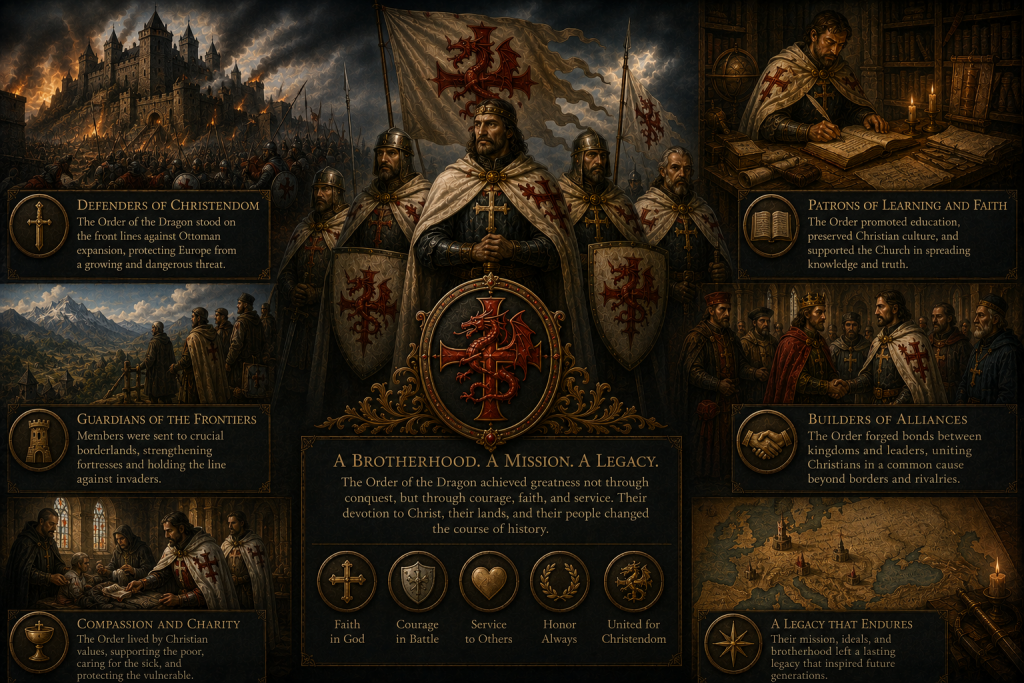
An artistic interpretation of the Order of the Dragon’s achievements in defending Christian Europe during the fifteenth century.
8 min read
“An institution founded to hold back an empire will always, in the end, be measured against an empire that kept advancing regardless. The fairer question is not whether the order stopped the Ottomans outright, but whether the resistance it helped organise mattered anyway, even in defeat.”
Judged against its own most ambitious founding aspiration — the durable, coordinated defence of Christian Central and South-Eastern Europe against continued Ottoman expansion — the Order of the Dragon cannot honestly be called an unqualified success. The Ottoman Empire continued advancing steadily through the Balkans and beyond across the century following the Order’s 1408 founding, absorbing territory ruled by several of the Order’s own former members and their successors, a trajectory the Order’s existence plainly did not reverse or permanently halt. And yet judging any institution solely by whether it achieved its most sweeping possible aim risks obscuring the more genuine, more measurable accomplishments an organisation can achieve along the way. The Order of the Dragon, examined more closely and on somewhat narrower terms, produced a genuinely substantial record of coordinated resistance, diplomatic cohesion, and durable symbolic legacy that deserves assessment on its own considerable merits, distinct from the larger geopolitical tide it was never realistically going to reverse single-handedly.
Coordinating a Coalition That Otherwise Would Not Have Existed
Perhaps the Order’s single most concrete and defensible achievement lay simply in its success at binding together a genuinely diverse, often mutually suspicious collection of Central and South-Eastern European rulers into something resembling a coordinated defensive network, at a moment when the region’s fractured political landscape offered little natural incentive toward this kind of cooperation on its own. Hungarian nobility, Serbian despots, Wallachian voivodes, and various Bosnian and Bulgarian lords did not share an obvious, pre-existing tradition of close political cooperation before the Order’s founding, separated as they were by considerable linguistic, religious, and political differences even within their shared broad category of Christian Balkan nobility facing common Ottoman pressure.
Sigismund of Luxembourg’s Order provided a genuine institutional framework capable of drawing these otherwise disparate rulers into at least nominal, sworn cooperation, creating channels of communication, mutual obligation, and shared symbolic identity that would likely not have developed organically without some comparable coordinating institution. This achievement, while difficult to measure in the same concrete terms as a battlefield victory, represents a genuine and historically significant accomplishment in its own right, particularly given how consistently the region’s own internal political fragmentation undermined effective resistance against external threats throughout the period.
An empire advancing against a fractured, mutually suspicious collection of small states faces a considerably easier task than one advancing against even a loosely coordinated coalition — and building that coalition, however imperfectly, was no small thing in itself.
Practical Military Cooperation Along the Frontier
Beyond its more abstract diplomatic and coordinating function, the Order also produced genuine, if geographically limited, practical military cooperation among its frontline members, particularly those such as Stefan Lazarević of Serbia and, at various points, Vlad II of Wallachia, whose own territories bore direct exposure to Ottoman military pressure. This cooperation manifested through shared intelligence, coordinated defensive planning, and, at various points across the Order’s active decades, direct military assistance extended between member rulers facing immediate Ottoman threat, arrangements that offered genuine, if modest, practical benefit to rulers who would otherwise have faced Ottoman pressure in considerably greater isolation.
Sigismund’s own broader military campaigns against Ottoman expansion, while achieving decidedly mixed results overall, benefited at various points from precisely this kind of coordinated support drawn from the Order’s wider membership network, providing Sigismund with a more reliable, if still imperfect, pool of allied military resources than he might otherwise have commanded through purely ad hoc, individually negotiated alliances lacking any shared institutional framework or sworn mutual obligation.
Suppressing the Hussite Threat
The Order’s less frequently discussed second founding purpose — coordinated resistance against the internal Hussite religious movement centred in Bohemia — produced results that, from Sigismund’s own perspective and that of the broader Catholic establishment he represented, proved considerably more decisive than the ongoing, unresolved struggle against external Ottoman expansion. The extended Hussite Wars, fought intermittently across the 1420s and into the 1430s, drew heavily on the same broader network of Christian nobility Sigismund had cultivated partly through the Order’s founding. While the conflict ultimately concluded through negotiated compromise rather than outright military suppression, Sigismund’s broader coalition-building efforts, the Order prominent among them, contributed meaningfully to preventing the Hussite movement from achieving the durable, expanded political independence its more radical factions had initially sought.
Where the Order’s anti-Ottoman mission remained permanently unresolved, its internal anti-heresy mission reached something closer to a genuine, if imperfect, conclusion — a distinction historians examining the Order’s overall record too often overlook in favour of the more dramatically resonant Ottoman struggle alone.
This achievement, while considerably less romantic and considerably less connected to the Order’s later fame through the Dracula legend, represents arguably its most concretely successful application of coordinated noble military and political cooperation toward a genuinely achievable, bounded objective, in clear contrast to the far larger and ultimately unachievable goal of permanently halting Ottoman expansion altogether.
Individual Members’ Achievements, Attributable in Part to the Order
Several of the Order’s individual members achieved genuine, independently significant military and political successes during their own careers, achievements that, while not attributable to the Order alone, were meaningfully supported by the broader network of alliance, resource-sharing, and mutual obligation the Order helped establish and maintain. Stefan Lazarević’s extended, skilful navigation of Serbia’s precarious position between Hungarian alliance and periodic Ottoman vassalage drew genuine practical benefit from his order membership and the wider Hungarian alliance network it represented, helping preserve a degree of Serbian autonomy that might otherwise have eroded considerably faster without this broader institutional support.
Vlad III‘s own celebrated 1462 resistance against Sultan Mehmed II similarly drew on a broader tradition of anti-Ottoman Christian resistance that the Order had helped establish and symbolically represent across the preceding half-century, even if his own personal, formal relationship to the Order itself remains genuinely uncertain. The Order’s wider legacy of anti-Ottoman resistance nonetheless provided an established symbolic and political tradition within which achievements such as Vlad’s own could be understood and celebrated by contemporary Christian European observers, including Pope Pius II’s own recorded interest in Vlad’s successful defiance.
The Order’s Most Durable Achievement: An Accidental One
It is worth acknowledging directly, and without excessive irony, that the Order of the Dragon’s single most durable, globally recognised achievement was never one Sigismund himself could have intended or foreseen at the time of the Order’s founding: the creation, through Vlad II’s induction and Vlad III’s inherited patronymic, of the very name that would eventually become the most recognisable single word in the entire modern horror genre, borrowed nearly five centuries later by an Irish novelist with only the loosest possible awareness of its actual institutional origin.
This accidental legacy, however disconnected from the Order’s genuine founding military and religious purpose, has ensured that Sigismund’s fifteenth-century chivalric brotherhood remains, even today, considerably better known to a general global audience than almost any comparable contemporary institution, the Garter and Golden Fleece very much included, despite those orders’ own considerably greater documented institutional longevity and more successful fulfilment of their own original founding purposes. Judged purely by sustained cultural recognition across the following six centuries, the Order of the Dragon’s achievement in this single, entirely unintended respect may well exceed anything its own founding members could ever have reasonably hoped to accomplish through their sworn military and religious cooperation alone.
Sigismund set out to build an institution that would be remembered for defending Christian Europe. What actually proved unforgettable, in the end, was a borrowed word that travelled considerably further than any of his armies ever did.
A Fair Final Accounting
Weighing the Order’s achievements fairly requires holding two things true simultaneously, without allowing either to cancel the other out entirely. On one hand, the Order of the Dragon plainly did not achieve its most sweeping ambition of permanently halting Ottoman expansion into Christian Europe. This goal proved considerably beyond the capacity of any single fifteenth-century institution, however well-coordinated, to accomplish against the Ottoman Empire’s sustained military and administrative strength. On the other hand, the Order’s genuine achievements in coalition-building, practical frontline military cooperation, meaningful contribution toward resolving the Hussite crisis, and the sustained symbolic tradition of resistance it helped establish and maintain across several member rulers’ own considerable individual careers, represent a record of accomplishment considerably more substantial than the Order’s later reduction, in much popular memory, to a mere footnote in an entirely unrelated vampire novel’s origin story would ever suggest.
Timeline: The Order’s Record of Achievement
- 1408 — The Order of the Dragon is founded, immediately establishing a coordinating framework among previously disparate Central and South-Eastern European nobility.
- 1410s–1420s — The Order facilitates practical military and diplomatic cooperation among frontline members, including Stefan Lazarević of Serbia.
- 1420s–1430s — Sigismund draws on the Order’s broader network during the extended Hussite Wars, contributing to the eventual negotiated resolution of the Hussite crisis.
- c. 1431 — Vlad II’s induction extends the Order’s coalition further into Wallachian territory along the Danube frontier.
- 1433 — Sigismund’s coronation as Holy Roman Emperor further extends the Order’s prestige and diplomatic reach.
- 1437 — Sigismund’s death marks the beginning of the Order’s decline as an actively functioning coordinating institution.
- 1456–1462 — Vlad III’s resistance against Mehmed II draws on the broader anti-Ottoman resistance tradition the Order helped establish, whatever his own uncertain personal membership status.
- 1897 onward — The Order’s most durable, if entirely unintended, achievement takes shape through the global cultural legacy of the “Dracula” name, inherited from Vlad II’s induction nearly five centuries earlier.
author's note
Weighing the Order’s achievements fairly has meant resisting two equally tempting oversimplifications: treating it as a footnote that accomplished nothing beyond providing a name for a much later novel, or overselling its practical military record in ways the actual, ultimately unstoppable trajectory of Ottoman expansion does not really support. I have come to think the honest answer sits closer to a working, imperfect coalition that achieved genuine, if bounded, successes and ultimately could not reverse a geopolitical tide far larger than itself — which feels, in the end, like a considerably more human and more historically satisfying story than either a triumphant legend or a dismissive footnote could offer on its own.
sources and further reading
- Boulton, D’Arcy Jonathan Dacre. The Knights of the Crown: The Monarchical Orders of Knighthood in Later Medieval Europe, 1325–1520. Boydell Press, 1987.
- Fudge, Thomas A. The Crusade against Heretics in Bohemia, 1418–1437. Ashgate, 2002.
- Fine, John V. A. The Late Medieval Balkans: A Critical Survey from the Late Twelfth Century to the Ottoman Conquest. University of Michigan Press, 1994.
- Engel, Pál. The Realm of St Stephen: A History of Medieval Hungary, 895–1526. I.B. Tauris, 2001.
- Florescu, Radu R. and Raymond T. McNally. Dracula, Prince of Many Faces: His Life and His Times. Little, Brown and Company, 1989.
- Housley, Norman. Crusading and the Ottoman Threat, 1453–1505. Oxford University Press, 2012.
A note on sources: assessing the order’s practical military and diplomatic achievements requires drawing together evidence scattered across Hungarian, Serbian, Bohemian, and wider Central European sources, none of which offer a single, comprehensive institutional accounting of the order’s activities across its active decades. This article has aimed to weigh the order’s documented achievements against its unmet founding ambitions as fairly as the surviving, necessarily fragmentary record allows.
related articles
- The Order of the Dragon: The Brotherhood Behind Dracula
- Not Just Another Chivalric Order: What Set the Order of the Dragon Apart
- The Other Knights of the Order of the Dragon
- Vlad the Impaler’s Involvement With the Order of the Dragon
- Vlad the Impaler: The man behind the Dracula legend
- Vlad the Impaler and Mehmed II
- Wallachia: The Kingdom between Two Empires
- The Rise of the Basarab Dynasty
- The Wallachian Voivodes Explained
- Why Wallachia Was Important to Europe
continue your journey through history
Discover the novels inspired by the people, rivalries and legends of medieval Europe.

Historical Fiction Author
History has always fascinated me—not simply for the great battles or famous rulers, but for the people behind the legends. Through years of research into medieval Europe, the Ottoman Empire, Tudor England, and the lives of extraordinary historical figures, I’ve sought to uncover the stories that lie beneath popular myths. My novels blend documented history with compelling fiction, inviting readers to step into the past and experience it as those who lived it might have done.
Join the Related to Dracula Circle