
HISTORY · MEDIEVAL WARFARE
How Medieval Armies Actually Fought
Forget the Hollywood Battlefield — Most Medieval Warfare Was Fought Through Fire, Starvation, and Patience
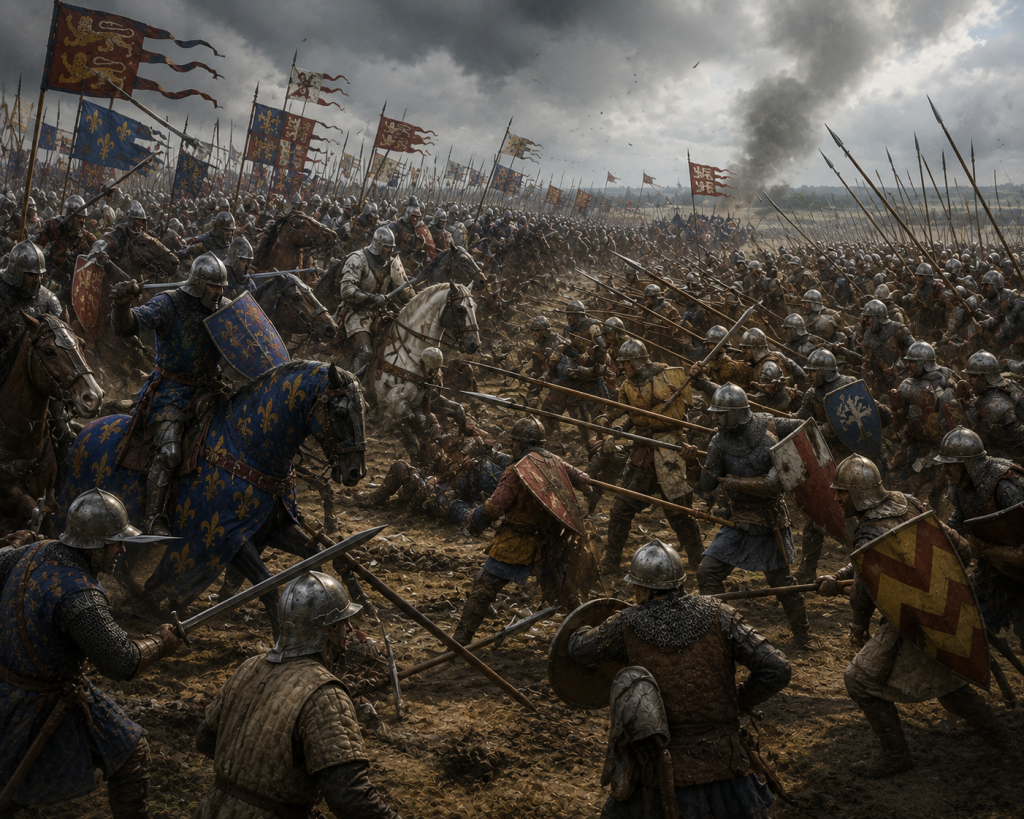
Artistic interpretation of a medieval battlefield, illustrating the formations, discipline, and tactics that defined warfare across Europe during the Middle Ages.
10 min read

“Ask most people to picture medieval warfare, and they will describe two great lines of armoured knights crashing together across an open field. Ask a medieval commander, and he would tell you that scene was precisely the outcome any sensible general spent most of his career trying to avoid.”
Popular imagination, shaped by film and by centuries of romanticised retelling, persists in picturing medieval warfare as an endless sequence of grand pitched battles, two armies drawn up in open country, banners raised, before crashing together in a single decisive clash of steel. The genuine historical record, considerably less cinematic and considerably more calculating, tells a different story entirely. Pitched battles, the very episodes popular memory treats as the defining feature of medieval conflict, were in fact comparatively rare events, sought only reluctantly by commanders who understood just how much a single afternoon’s bad luck could cost them. In contrast, the actual, grinding business of medieval warfare unfolded overwhelmingly through siege, raid, starvation, and patient attrition. Understanding this genuine texture of medieval conflict, rather than the more dramatic Hollywood substitute, offers essential groundwork for approaching the specific campaigns, from Vlad the Impaler’s own scorched-earth resistance against Mehmed II to the pitched battles that punctuated, but never fully defined, the Wars of the Roses.
Why Commanders Avoided Battle Whenever They Could
The reluctance medieval commanders showed toward open pitched battle reflected a coldly rational calculation considerably more sophisticated than popular imagination typically credits them with. A pitched battle concentrated an entire campaign’s fortunes into a single afternoon, exposing a commander’s army, his cause, and frequently his own life to the outcome of one relatively brief, chaotic engagement whose result depended on factors: weather, terrain, morale, and sheer chance that no amount of careful planning could fully control. The consequences of defeat could prove genuinely catastrophic and immediate in a way that a lost skirmish or an unsuccessful siege rarely matched: King John II of France was captured outright at the Battle of Poitiers in 1356, and Richard III’s own death at Bosworth Field in 1485 ended both his reign and his life within the span of a single engagement.
Given these stakes, a commander confident of ultimate victory through other means had genuine incentive to avoid battle altogether whenever his opponent proved willing to let him. Historians examining the broader pattern across medieval Western Europe have found pitched battles considerably rarer than popular memory assumes; one detailed study of medieval Flanders, a region subject to frequent invasion, identified only eleven battles of real note across more than two and a half centuries between 1071 and 1328. Richard I of England, a monarch whose own reputation rests substantially on his military reputation, fought in no more than two or three genuine pitched battles across his entire career, spending far more of his active campaigning life engaged in siege warfare instead, an activity that would, in 1199, ultimately claim his own life through an arrow wound received at the siege of Châlus.
A general who avoids battle is not, by medieval standards, a cautious or unimpressive commander. He is, more often than not, simply the more competent one — sensibly refusing to gamble an entire campaign’s fortunes on a single afternoon’s uncertain outcome.
The Chevauchée: Warfare Through Devastation
If pitched battle represented the exception medieval commanders generally sought to avoid, the chevauchée, a deliberate campaign of raiding, burning, and pillaging enemy territory, represented one of the genuine, dominant tools through which medieval warfare was actually conducted. Rather than seeking direct confrontation with an opposing army, forces conducting a chevauchée moved rapidly through enemy territory, destroying crops, burning villages, seizing livestock and hostages, and generally devastating the rural economic foundation upon which any medieval ruler’s own military and political power ultimately depended.
This strategy, refined to particularly devastating effect by English commanders during the Hundred Years’ War against France, served several genuine strategic purposes simultaneously. It deprived an enemy of the agricultural resources needed to sustain his own forces and population, it enriched the raiding army through plunder, and, perhaps most significantly, it demonstrated publicly and humiliatingly that a rival ruler could not adequately protect his own subjects, a failure that struck directly at the legitimacy any medieval lord depended upon to maintain his own authority. The chevauchée’s effectiveness rested precisely on its refusal to seek the kind of decisive battlefield confrontation an opposing commander might have been prepared to risk everything to avoid, achieving genuine strategic effect through sustained economic devastation rather than through any single dramatic military engagement.
A burned harvest and a slaughtered herd of cattle rarely appear in the same celebrated retellings that grand pitched battles receive. Yet, they achieved, time and again across medieval history, precisely the strategic effect a single risky confrontation might never have delivered as reliably.
Vlad the Impaler applied this same underlying logic in his own 1462 resistance against Sultan Mehmed II. Vlad’s own scorched-earth tactics, poisoning wells and emptying villages ahead of the advancing Ottoman army, drew on precisely this established medieval strategic tradition, achieving genuine strategic effect against a vastly superior invading force without ever needing to risk his own considerably smaller army in open pitched battle.
Sieges: The Genuine Centre of Medieval Campaigning
Beyond raiding, the single most common form of sustained medieval military activity was siege warfare, a genuinely dominant feature of medieval campaigning that modern popular memory consistently underweights relative to its actual historical significance. As castle architecture grew increasingly sophisticated across the medieval period, siege warfare correspondingly evolved into an increasingly central and increasingly technically demanding feature of medieval military campaigning, with historians generally agreeing that sieges considerably outnumbered pitched battles across virtually every region and period of medieval Western Europe examined in detail.
The basic logic underlying siege warfare proved considerably simpler, if considerably more prolonged, than the dramatic uncertainty of open battle: a besieging army sought to starve a fortified position’s defenders of the food, water, and morale needed to continue resistance, while defenders sought to hold out long enough for relief to arrive or for the besieging force’s own supply difficulties, always a genuine constraint on medieval armies operating away from home territory, to force a withdrawal. This pattern of patient attrition, considerably less dramatically satisfying than open battle but considerably more common in actual medieval practice, defined the experience of medieval warfare for a great many soldiers and commanders across the period considerably more accurately than any single celebrated pitched battle ever could.
Knights, Ransom, and the Uneven Cost of War
One of the more genuinely striking features of medieval warfare, particularly among the knightly and noble classes who dominated its formal command structures, concerns the specific economic logic surrounding capture and ransom, a system that shaped battlefield conduct in ways considerably removed from any simple narrative of straightforward lethal combat. A captured knight or nobleman represented, to his captor, a genuinely valuable financial asset rather than merely a defeated enemy, with ransom payments calculated at levels substantial enough to reward the captor generously without typically bankrupting the captured noble’s own family or estate entirely. This economic incentive meant that casualties among the knightly and noble classes remained, across a great many medieval engagements, genuinely lower than popular imagination typically assumes, with capture and ransom frequently preferred over outright killing whenever circumstances allowed.
This pattern stood in genuinely stark contrast to the considerably higher casualty rates typically suffered by ordinary infantry and common soldiers, who possessed no comparable ransom value and consequently faced considerably less restraint from opposing forces during the actual fighting itself. When the French nobleman the Comte de la Perche died during the Battle of Lincoln in 1217, contemporary accounts describe genuine, widespread grief expressed even among his opponents, a reaction reflecting the genuine rarity and significance of noble battlefield deaths within a system generally oriented toward capture and financial ransom rather than systematic slaughter among the knightly classes specifically.
War, among the medieval nobility at least, frequently operated as much through financial calculation as through genuine lethal intent — a captured lord was worth considerably more alive and ransomed than dead, an economic logic that shaped the actual conduct of battle in ways strikingly different from more modern conceptions of total, indiscriminate warfare.
The Limits of Feudal Military Obligation
Medieval warfare’s genuine character was further shaped by the practical, structural limitations of how medieval armies were actually raised and sustained, constraints considerably more restrictive than the modern concept of a standing professional army might suggest. Feudal military obligation, the system through which vassals owed military service to their lords in exchange for landholding, typically carried strict, formally limited terms of service, commonly capped at around forty days annually in the classic feudal formulation, a limitation that placed genuine, hard practical constraints on how long any single military campaign could realistically be sustained using feudal levies alone.
This structural limitation shaped medieval campaigning considerably more directly than popular imagination typically acknowledges, encouraging precisely the kind of short, sharp raiding campaigns the chevauchée represented, rather than the kind of sustained, extended campaigning modern warfare more readily assumes as standard, and driving the gradual, increasing medieval reliance on paid mercenary forces and professional retinues capable of extended service beyond what feudal obligation alone could reliably guarantee. Armies operating away from friendly territory faced further genuine logistical constraints regarding food, water, and equipment resupply, constraints that shaped the practical geography and duration of medieval campaigning considerably more decisively than tactical preference alone ever could.
Battle, When It Finally Came
None of this should suggest that pitched battle never occurred, or that it lacked genuine tactical sophistication when commanders did eventually commit to it. Battles such as Falkirk, Bannockburn, Towton and Bosworth Field demonstrate that medieval commanders, when circumstances genuinely demanded direct confrontation, whether through strategic necessity, mutual willingness, or simple inability to avoid engagement any longer, could deploy genuinely sophisticated combined-arms tactics, coordinating cavalry, infantry, and, in the increasingly significant case of English forces particularly, longbow archery to devastating tactical effect.
What distinguishes the genuine historical pattern from popular imagination is not that pitched battle never happened, but that it represented the deliberately rare exception within a considerably broader, considerably less dramatic pattern of raiding, sieging, and patient attrition that actually defined most medieval military campaigning across most regions and most periods. The Wars of the Roses itself stands out partly because it produced a genuinely unusual concentration of decisive pitched battles within a comparatively compressed period, a pattern considerably less typical of medieval warfare more broadly than the conflict’s own outsized popular memory might suggest.
The armoured knights crashing together in open country make for a considerably better single image than a starving garrison slowly running out of food behind a besieged wall, or a burned harvest smouldering across an empty valley — but it was the siege and the burned harvest, far more often than the battlefield charge, that actually decided medieval wars.
Timeline: Key Developments in Medieval Warfare
- Early 12th century — The chevauchée begins appearing as a documented raiding strategy across French and Iberian campaigns.
- 1199 — Richard I of England dies from an arrow wound sustained during the siege of Châlus, reflecting siege warfare’s genuine dominance over pitched battle across his own military career.
- 1217 — The Battle of Lincoln illustrates the ransom economy surrounding noble combat, with the death of the Comte de la Perche prompting genuine grief even among his opponents.
- 1356 — King John II of France is captured at the Battle of Poitiers, illustrating the catastrophic personal and political stakes a single pitched battle could carry.
- 14th century onward — English commanders refine the chevauchée to particularly devastating effect during the Hundred Years’ War against France.
- Late 14th century — The chevauchée’s prominence begins declining as siege warfare and, eventually, artillery increasingly dominate medieval military strategy.
- 1462 — Vlad the Impaler employs scorched-earth tactics against Mehmed II’s invasion, drawing on the same broader medieval raiding and attrition tradition.
- 1485 — The Battle of Bosworth Field illustrates the genuine, catastrophic stakes a single pitched battle could carry for a reigning monarch.
- 15th–16th centuries — The gradual advance of gunpowder artillery begins transforming both siege warfare and the broader strategic logic of medieval and early modern conflict.
author's note
I have been fascinated by medieval warfare since I was a child, long before I understood it as a genuine field of historical study rather than simply the backdrop to the more dramatic stories I was drawn to. Vlad the Impaler’s own scorched-earth resistance against Mehmed II was never a failure to fight properly; it was, by the genuine standards of medieval strategy, exactly the kind of intelligent, casualty-conscious campaigning a heavily outnumbered commander was supposed to pursue.
sources and further reading
- Verbruggen, J. F. The Art of Warfare in Western Europe during the Middle Ages. North-Holland, 1977 — the foundational revisionist study establishing battle avoidance as the dominant medieval strategic pattern.
- Contamine, Philippe. War in the Middle Ages. Basil Blackwell, 1984.
- Bradbury, Jim. The Medieval Siege. Boydell Press, 1992.
- France, John. Western Warfare in the Age of the Crusaders, 1000–1300. Cornell University Press, 1999.
- DeVries, Kelly. Medieval Military Technology. Broadview Press, 1992.
- Prestwich, Michael. Armies and Warfare in the Middle Ages: The English Experience. Yale University Press, 1996.
A note on sources: much of the revisionist scholarly understanding of medieval warfare, emphasising battle avoidance, raiding, and siege over pitched battle, traces back to Verbruggen’s and Smail’s mid-twentieth-century work correcting an earlier historiographical tradition that had overstated the centrality and tactical sophistication of set-piece knightly battle. This article has drawn on the broad scholarly consensus that has developed from that foundational revisionist scholarship.
related articles
- The Wars of the Roses: The Conflict That Created the Tudors
- The Night Attack of Târgoviște
- Vlad the Impaler and Mehmed II
- The Order of the Dragon: The Brotherhood Behind Dracula
- Vlad the Impaler: The Man Behind the Dracula Legend
- Wallachia: The Kingdom Between Two Empires
- Justice or Cruelty: Understanding Vlad the Impaler’s Rule
- Vlad the Impaler’s Three Reigns
continue your journey through history
Discover the novels inspired by the people, rivalries and legends of medieval Europe.

Historical Fiction Author
History has always fascinated me—not simply for the great battles or famous rulers, but for the people behind the legends. Through years of research into medieval Europe, the Ottoman Empire, Tudor England, and the lives of extraordinary historical figures, I’ve sought to uncover the stories that lie beneath popular myths. My novels blend documented history with compelling fiction, inviting readers to step into the past and experience it as those who lived it might have done.
Join the Related to Dracula Circle