
HISTORY · Henry VIII
Henry VIII: The King Who Changed England
A Portrait of the Monarch Who Rewrote His Kingdom to Suit His Own Will
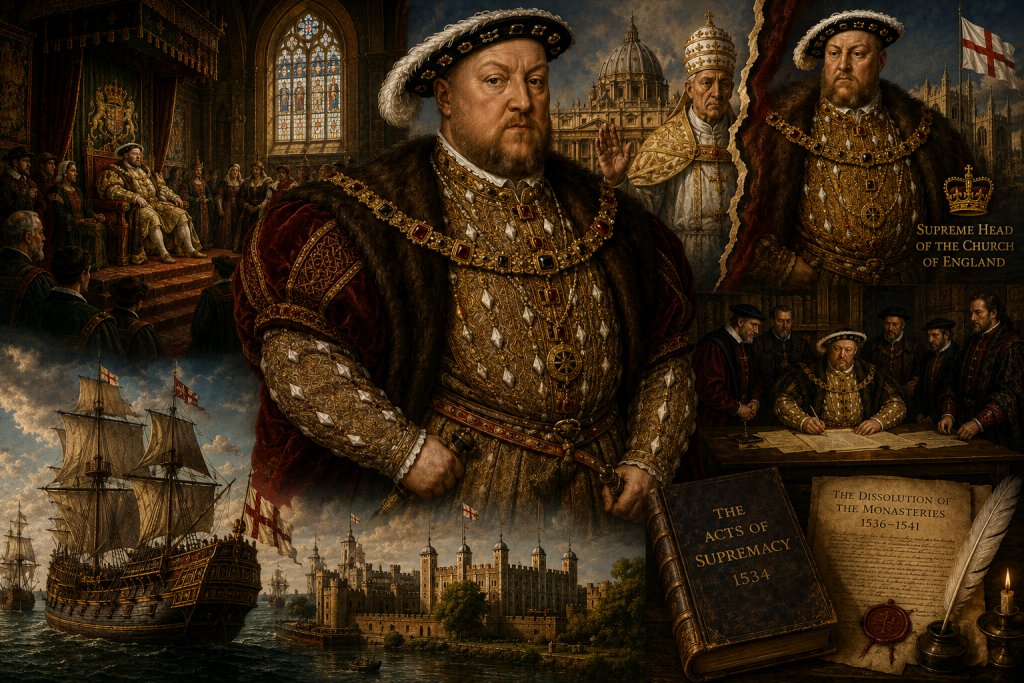
An artistic interpretation of Henry VIII, the Tudor king whose reign transformed England’s monarchy, religion and politics.
9 min read

“A king who inherits stability rarely feels compelled to burn it down. Henry inherited exactly that stability, and burned through it anyway — not out of any particular hatred for what he had been given, but out of a conviction, sustained across nearly four decades, that his own will mattered more than any institution built before him.”
Few English monarchs have left so large and so permanent a mark on their kingdom while, in the process, appearing to care so little about the long-term structural consequences of doing so. Henry VIII ascended the English throne in 1509 as a golden, celebrated young prince, widely regarded by contemporaries as the very picture of Renaissance kingship — athletic, intellectually curious, devoutly Catholic, and heir to a throne his own father had spent decades quietly stabilising after generations of dynastic civil war. By the time of his death in 1547, the same man had fractured England’s religious identity permanently, dismantled a monastic system that had stood for centuries, executed ministers and noblemen who had once been among his closest confidants, and reshaped the very structure of English kingship itself, establishing a model of royal supremacy that would echo through English political life for centuries afterwards. Understanding how this transformation occurred — how a young prince so thoroughly steeped in traditional Catholic piety became the monarch who broke permanently with Rome — requires looking closely at a reign defined less by any single coherent political philosophy than by one man’s escalating, largely unchecked conviction that his own personal will ought to reshape whatever institutional obstacle happened to stand in its way.
An Inheritance Built by a Careful, Watchful Father
Henry VIII inherited a throne considerably more secure than the one his own father, Henry VII, had first claimed through victory at the Battle of Bosworth Field in 1485, ending decades of dynastic conflict generally remembered as the Wars of the Roses. Henry VII had spent his own reign methodically consolidating royal authority, rebuilding the crown’s finances through careful, at times notoriously severe fiscal management, and establishing the Tudor dynasty’s legitimacy through a combination of strategic marriage alliances, judicious patronage, and the ruthless suppression of rival claimants who might otherwise have reignited the very civil conflict his own victory had only recently ended.
By the time of Henry VII’s death in 1509, this careful, deliberate work had produced a kingdom considerably more financially stable and politically secure than England had experienced in generations, providing the younger Henry with an inheritance that, by most contemporary assessments, represented an unusually favourable starting position for a new monarch. Henry VIII, still only seventeen at his accession, inherited not merely a crown but a genuinely functional, well-resourced administrative apparatus, along with a substantial royal treasury his father’s careful fiscal management had accumulated.
A cautious father builds a house designed to withstand storms. His son, inheriting that same sturdy house, does not always feel obligated to live within it quite so carefully.
The contrast between father and son proved immediate and striking. Where Henry VII had ruled with careful, often joyless pragmatism, prioritising financial security and political stability above almost every other consideration, the young Henry VIII embraced kingship with an entirely different temperament, delighting in tournament, music, scholarship, and the general performance of magnificent, chivalric Renaissance monarchy in a manner his own more austere father had rarely, if ever, indulged.
A Renaissance Prince, By Every Contemporary Account
The young Henry who ascended the throne in 1509 genuinely impressed contemporary observers across Europe, and not merely through the flattering court rhetoric that surrounded most reigning monarchs of the period. He stood unusually tall for the era, was reportedly strikingly athletic, excelling at jousting, hunting, and various other physically demanding courtly pursuits, and possessed genuine intellectual accomplishment, receiving an education that included proficiency in several languages, a serious engagement with theology, and sufficient musical training to compose his own original compositions, several of which survive to the present day.
This combination of physical vigour, intellectual curiosity, and evident personal charisma made Henry, in his early reign, a genuinely celebrated figure both within England and across the wider courts of Renaissance Europe, drawing favourable comparison from contemporary observers to other prominent Renaissance rulers of the period. His early religious devotion, too, appeared entirely conventional and sincere by the standards of his era, sufficiently committed to Catholic orthodoxy that he personally authored a theological treatise defending Catholic sacramental doctrine against the emerging challenge of Martin Luther’s reform movement, earning him, from a grateful Pope Leo X in 1521, the formal title Defender of the Faith. This title would carry a considerable, bitter irony once Henry’s own later religious policies unfolded.
It is worth sitting with this early portrait honestly, rather than reading it merely as prologue to everything that followed. The young Henry was not, by any credible contemporary account, a man already secretly planning to dismantle Catholic authority in England. He was, for a considerable stretch of his early reign, precisely the devout, celebrated Renaissance monarch he appeared to be.
Ambitions Beyond England’s Borders
Much of Henry’s early reign focused not on any domestic religious transformation, but on a considerably more conventional ambition for a Renaissance monarch of his era: military and diplomatic glory on the wider European continental stage, particularly through renewed English military engagement against France, echoing the earlier medieval English claims to French territory that had driven the Hundred Years’ War generations before Henry’s own birth. Henry pursued these continental military ambitions with genuine enthusiasm across the 1510s and into the 1520s, achieving mixed but occasionally genuinely notable results, including a celebrated victory at the Battle of the Spurs in 1513.
These continental military campaigns proved enormously expensive, steadily depleting the substantial treasury Henry VII’s careful fiscal management had accumulated, a pattern of costly military ambition that would recur throughout Henry’s reign and contribute significantly to the kingdom’s later financial pressures. Henry’s chief minister for much of this period, Cardinal Thomas Wolsey, managed both the practical administration of these continental ambitions and the broader machinery of English government with considerable skill, rising to become, for a substantial stretch of the 1510s and 1520s, arguably the single most powerful figure in English government beneath the king himself.
The Question of Succession
Beneath Henry’s early continental military ambitions and his genuine engagement with Renaissance courtly culture, a considerably more consequential concern gradually began to dominate his reign’s second decade: the pressing, deeply felt need to secure a legitimate male heir capable of succeeding him and thereby preserving the still relatively young Tudor dynasty’s hold on the English throne. This dynastic anxiety, rooted in genuine historical memory of the destructive civil conflict that had preceded his own father’s reign, would eventually drive Henry toward the religious and political transformations for which his reign remains most permanently remembered.
Henry’s growing conviction, across the late 1520s, that his existing marriage could not provide the legitimate male heir he considered dynastically essential, set in motion a sequence of political and religious developments that would ultimately transform not merely his own personal circumstances, but the entire structure of English religious and political life.
A king anxious about his own mortality and his kingdom’s future stability can, given sufficient conviction and sufficient authority, eventually persuade himself that almost any institutional obstacle standing between himself and a solution is an obstacle worth removing entirely.
The Break With Rome
Beginning in the early 1530s, Henry, working closely with ministers including Thomas Cromwell, engineered a sweeping series of parliamentary and legal measures that formally severed the Church of England from papal authority, establishing the English monarch, rather than the Pope in Rome, as the supreme head of the English church.
This transformation carried consequences extending far beyond the specific personal circumstances that had initially driven it. It represented a fundamental reordering of the relationship between English monarchy and religious authority, concentrating unprecedented spiritual and temporal power within the person of the reigning king. It also set in motion a subsequent, sweeping dissolution of England’s monasteries between 1536 and 1541, a process that transferred enormous monastic landholdings and wealth into royal and, subsequently, private secular hands. Together, these changes permanently transformed England’s religious landscape, its physical built environment, and its underlying economic and social structure, in ways that would persist for centuries beyond Henry’s own reign.
A king who redefines his own religious authority does not merely solve his own immediate personal problem. He rewrites, whether he fully intends to or not, the entire relationship between crown, church, and subject for every monarch who comes after him.
A Reign Defined by Escalating, Unchecked Will
What distinguishes Henry’s reign most sharply from that of his more cautious father is not merely the scale of transformation he ultimately achieved, but the underlying pattern of governance that produced it: a monarch whose personal will, once firmly settled on a particular course of action, proved increasingly difficult for any minister, institution, or established tradition to meaningfully restrain. Thomas Wolsey’s eventual fall from power in 1529, followed years later by Thomas Cromwell’s own execution in 1540, illustrates this pattern with particular starkness—both men had served Henry with considerable skill and evident personal loyalty. Both ultimately found themselves discarded, and in Cromwell’s case executed, once their continued usefulness to the king’s evolving personal and political priorities came into question.
This pattern extended well beyond Henry’s treatment of his own chief ministers, shaping virtually every dimension of his later reign, from his repeated matrimonial reorganisations to his periodic, often severe suppression of religious and political dissent, including the execution of prominent figures such as Thomas More, who had once served as Henry’s own trusted Lord Chancellor before his refusal to accept the king’s new religious supremacy cost him his life in 1535. Across nearly four decades of rule, Henry increasingly governed not through any consistent, coherent political or religious philosophy, but through the steadily escalating conviction that his own personal will, once settled, ought to override whatever institutional, legal, or personal loyalty previously stood in its way.
A Kingdom Permanently Reshaped
By the time of Henry’s death in January 1547, the England he left behind bore only partial resemblance to the kingdom he had inherited from his careful, watchful father nearly four decades earlier. Its religious identity had been permanently and irrevocably altered, its monastic institutions dismantled, its royal authority reshaped around an unprecedented concentration of religious and temporal power within the crown itself, and its succession, the very dynastic anxiety that had first set so much of this transformation in motion, left in the considerably more precarious hands of a nine-year-old son and two daughters whose own eventual, dramatic reigns would continue shaping English history for decades to come.
Henry VIII did not set out, in 1509, to become the king who broke England permanently from Rome, dismantled its monasteries, and executed ministers and wives with a regularity that would come to define his entire popular reputation. He arrived on the throne as a celebrated, devout Renaissance prince. He became, across nearly forty years of escalating personal will and diminishing institutional restraint, something considerably more consequential and permanently transformative than either he or his contemporaries could likely have predicted at the moment of his youthful, golden accession.
He inherited a stable house from a careful father. He left behind, instead, an entirely rebuilt kingdom — one whose new foundations, whatever their considerable cost, would outlast him by centuries.
Timeline: The Reign of Henry VIII
- 1491 — Henry is born, the second son of Henry VII, not initially expected to inherit the throne.
- 1502 — The death of Henry’s elder brother, Arthur, makes Henry the heir to the English throne.
- 1509 — Henry VII dies; Henry VIII ascends the throne at the age of seventeen.
- 1513 — English forces achieve a notable victory over France at the Battle of the Spurs.
- 1521 — Pope Leo X grants Henry the title Defender of the Faith in recognition of his theological treatise defending Catholic doctrine against Martin Luther.
- Late 1520s — Henry’s growing dynastic succession concerns begin driving significant political and religious developments.
- 1529 — Cardinal Thomas Wolsey falls from royal favour and loses his position as chief minister.
- Early 1530s — Henry, working with Thomas Cromwell, engineers England’s formal break from papal authority, establishing royal supremacy over the English church.
- 1535 — Sir Thomas More is executed following his refusal to accept Henry’s new religious supremacy.
- 1536–1541 — The dissolution of England’s monasteries transfers enormous monastic wealth and landholdings into royal and secular hands.
- 1540 — Thomas Cromwell, having served as Henry’s chief minister for much of the 1530s, is executed.
- 1547 — Henry VIII dies, succeeded by his young son, Edward VI.
author's note
I have been fascinated by English history, and by the Tudor period specifically, since I was a child, reading everything I could find on Henry’s reign long before I ever thought about writing fiction set within it. This article deliberately sets aside some of the most familiar, most frequently told elements of Henry’s story — the marriages, the wider Tudor court intrigue — in favour of a broader, more structural question that first caught my attention as a much younger reader and has never quite let go since: what did it actually mean for one man’s escalating personal will to reshape an entire kingdom’s religious and political foundations so thoroughly and so permanently? It’s a question I find myself circling in much the same way my novel Related to Dracula: At Tudor Court does, following Sebastian, the great-grandson of Vlad Dracula, as he flees Wallachia for Henry VIII’s London and finds himself drawn into the same court, the same dangerous currents of royal favour, and the same orbit of figures — Anne Boleyn, Cardinal Wolsey, Henry himself.
sources and further reading
- Scarisbrick, J. J. Henry VIII. Yale University Press, 1968 — the classic, comprehensive scholarly biography against which most subsequent studies are measured.
- MacCulloch, Diarmaid. Thomas Cromwell: A Life. Allen Lane, 2018 — essential for understanding the administrative machinery of Henry’s reign.
- Guy, John. Tudor England. Oxford University Press, 1988 — a broad, authoritative overview of the political and institutional structures Henry inherited and reshaped.
- Starkey, David. Henry: Virtuous Prince. HarperPress, 2008 — a detailed study of Henry’s early life and accession.
- Elton, G. R. Reform and Reformation: England, 1509–1558. Harvard University Press, 1977 — a foundational study of the institutional and religious transformations of Henry’s reign.
- Bernard, G. W. The King’s Reformation: Henry VIII and the Remaking of the English Church. Yale University Press, 2005.
A note on sources: Henry’s reign is among the most extensively documented in English history, though historians continue to debate the precise balance of personal conviction, political calculation, and institutional pressure behind his major decisions. This article has drawn on the broad scholarly consensus represented across the works listed above.
related articles
- The Spare Prince: Henry VIII’s Childhood Before He Was Ever Meant to Wear the Crown
- The King’s Choice: Henry VIII’s Accession and the Courtship of Catherine of Aragon
- Henry VIII’s First Queen: Catherine of Aragon, the Forgotten Queen
- The English Reformation: Henry VIII and the Break with Rome
- The Six Wives of Henry VIII: Marriage, Power and the Making of Tudor England
- Henry VIII: King, Reformer or Tyrant?
- Tudor England: The Dynasty That Transformed a Kingdom
- Henry VII: The King Who Founded the Tudor Dynasty
- The Wars of the Roses: The Conflict That Created the Tudors
- How Henry VIII Fell in Love With Anne Boleyn: The Courtship That Changed England
continue your journey through history
Discover the novels inspired by the people, rivalries and legends of medieval Europe.

Historical Fiction Author
History has always fascinated me—not simply for the great battles or famous rulers, but for the people behind the legends. Through years of research into medieval Europe, the Ottoman Empire, Tudor England, and the lives of extraordinary historical figures, I’ve sought to uncover the stories that lie beneath popular myths. My novels blend documented history with compelling fiction, inviting readers to step into the past and experience it as those who lived it might have done.
Join the Related to Dracula Circle