
HISTORY · Henry VIII
The Spare Prince: Henry VIII’s Childhood Before He Was Ever Meant to Wear the Crown
How a Second Son, Raised for a Life in the Shadows, Suddenly Found Himself Standing in the Light
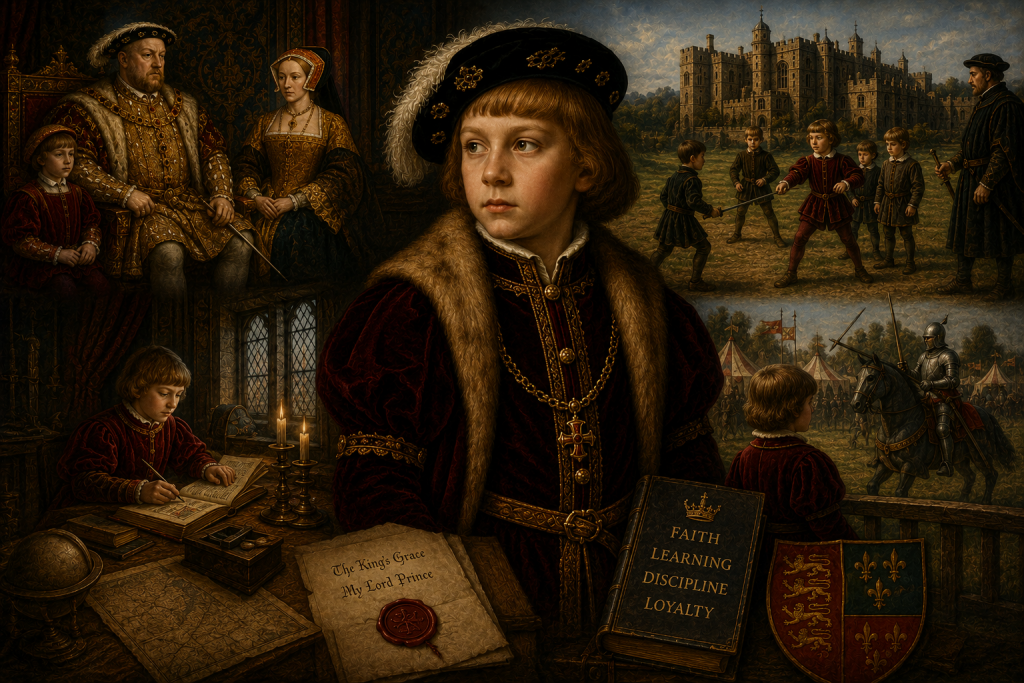
An artistic interpretation of the young Henry VIII before unexpectedly becoming heir to the English throne.
10 min read
“Every kingdom carefully prepares its heir and quietly overlooks its spare — until, without warning, the spare is all that remains, and an entire childhood built for a different purpose must be hurriedly, imperfectly repurposed for a crown.”
There is a particular kind of historical irony embedded in the fact that Henry VIII, a king who would go on to reshape the English monarchy so completely that his name remains, five centuries later, virtually synonymous with unchecked royal will, spent the first decade of his life being raised for an altogether more modest, more sheltered future. He was not, at birth, considered England’s coming king. That role, and the intensive, carefully structured education befitting it, belonged instead to his elder brother Arthur, whose own name had been chosen deliberately by their father to evoke the legendary British king of Camelot, a symbolic act announcing, from the very moment of his birth, precisely the destined, celebrated monarchy Henry VII intended his firstborn son to inherit. Henry, arriving second, grew up instead within the comparatively unstructured freedom of a childhood never seriously expected to lead toward the throne at all — a freedom that, however unintentionally, may have shaped the confident, self-assured, occasionally reckless temperament that would define his eventual, entirely unplanned reign.
Born Second, and Treated Accordingly
Henry was born on 28 June 1491 at Greenwich Palace, the third child and second surviving son of Henry VII and Elizabeth of York. This marriage had itself been carefully arranged to unite the rival houses of Lancaster and York, formally ending the destructive dynastic conflict of the Wars of the Roses that had consumed England for much of the preceding half-century. His elder brother Arthur, born in 1486, had already been invested as Prince of Wales and betrothed, through careful diplomatic negotiation, to the Spanish princess Catherine of Aragon, arrangements reflecting the considerable dynastic weight Henry VII placed on his firstborn son’s eventual succession.
Arthur’s own upbringing reflected this weighty expectation directly, structured deliberately around rigorous preparation for eventual kingship. He was raised, from a comparatively young age, largely separate from the rest of the royal family’s daily household, maintaining his own dedicated household at Ludlow Castle in the Welsh Marches, where he received an intensive education in statecraft, languages, and the practical administrative responsibilities expected of a future English monarch, all under close, deliberate supervision reflecting his father’s evident determination to prepare Arthur thoroughly for the throne he was destined to inherit.
One brother was raised, from his earliest years, as though every day mattered toward a specific, carefully planned destination. The other was allowed, for the most part, to grow up.
Henry, by contrast, remained largely within the more conventional royal nursery environment shared with his sisters, particularly Margaret and Mary, at residences including Eltham Palace, receiving an education that, while genuinely excellent by the standards of the period, lacked the specific, deliberate weight of dynastic preparation that shaped Arthur’s considerably more structured upbringing. This is not to suggest Henry’s own childhood education was neglected or unserious; quite the contrary, surviving evidence indicates a genuinely rigorous programme of instruction reflecting his father’s broader commitment to Renaissance humanist educational ideals. But it was an education oriented toward producing an accomplished, well-rounded royal prince suited to a supporting dynastic role, rather than one specifically and deliberately calibrated, as Arthur’s had been, toward eventual kingship itself.
An Exceptional Education, For a Role Not Yet His Own
Henry’s childhood tutors included several genuinely distinguished figures of the period, among them the poet and scholar John Skelton, who provided Henry with a thorough grounding in Latin, classical literature, and the broader humanist intellectual culture that had begun spreading through European royal courts during this period. Henry demonstrated genuine intellectual aptitude throughout his childhood education, developing fluency in several languages and a sustained interest in music and composition that would remain with him throughout his adult life, alongside the physical training in horsemanship, hunting, and increasingly serious jousting practice considered essential for any royal prince of the period, whether or not that prince was specifically destined to inherit the throne itself.
This combination of genuine intellectual accomplishment and vigorous physical training produced, by all surviving contemporary accounts, a strikingly capable and personable young prince, admired within the royal household for his energy, evident charm, and precocious accomplishment across a genuinely wide range of courtly pursuits. Yet this admiration existed, throughout Henry’s early childhood, within a context that never seriously anticipated he would eventually need to apply these considerable talents to the actual business of governing an entire kingdom. He was, in the framework of his own family’s dynastic planning, simply the accomplished second son, valuable to the Tudor dynasty’s broader diplomatic and marital strategy, but not, in any immediate practical sense, its intended future king.
A prince raised to be admired is not necessarily raised, in quite the same careful, deliberate way, to be obeyed — and the difference between those two forms of upbringing would eventually leave its mark on how Henry approached the throne once it unexpectedly became his own.
Some historians examining this period have suggested that Henry’s comparatively less structured, less intensively supervised childhood may have fostered a stronger, more independent sense of personal confidence and self-assurance than Arthur’s own more rigorously controlled upbringing allowed, a plausible if inherently speculative reading given how thoroughly Henry’s later adult reign would come to be defined by exactly this assertive, largely unchecked personal confidence in his own judgement and will.
Arthur’s Marriage and the Weight of Dynastic Expectation
The years leading up to 1502 brought the culmination of years of careful diplomatic planning surrounding Arthur’s own dynastic future, as his long-arranged marriage to Catherine of Aragon, the daughter of the powerful Spanish monarchs Ferdinand and Isabella, finally proceeded in November 1501, following Catherine’s arrival in England after a lengthy and difficult sea voyage. The marriage represented a genuinely significant diplomatic achievement for Henry VII, cementing an alliance with one of the era’s most powerful continental royal houses and providing further, tangible confirmation of the Tudor dynasty’s growing international standing and legitimacy following the earlier upheaval of the Wars of the Roses.
For the ten-year-old Henry, Arthur’s marriage represented a prominent royal ceremonial occasion in which he participated as a supporting figure within his brother’s celebration, a role entirely consistent with his own established position as the family’s accomplished but dynastically secondary son. There is no substantial evidence to suggest Henry, at this stage, harboured any particular expectation or ambition regarding the throne his brother had spent his entire childhood being prepared to inherit; the ten-year-old prince appears, by every reasonable historical reading, to have anticipated a rather different adult future, likely involving a prominent ecclesiastical or diplomatic role suited to a capable, well-educated younger son of the reigning monarch.
The Sudden Death of Arthur
Everything changed with shocking, unexpected suddenness in the early spring of 1502. Arthur, having settled with his new wife Catherine at Ludlow Castle to continue his preparation for eventual kingship, fell seriously ill, most likely, according to the balance of surviving evidence, from a virulent illness that swept through the Ludlow household during this period, quite possibly the mysterious ailment known to contemporaries as the sweating sickness, though the precise nature of Arthur’s fatal illness remains, even now, a matter of some historical uncertainty given the limitations of contemporary medical description. Arthur died on 2 April 1502, at just fifteen years old, a mere five months after his long-anticipated marriage had finally taken place.
The shock this sudden death produced within the royal family and the wider kingdom can scarcely be overstated. Arthur had been raised, from his earliest childhood, as the carefully cultivated centrepiece of the entire Tudor dynasty’s long-term legitimacy and stability, his eventual succession representing the culmination of everything his father had worked to secure since claiming the throne through military victory in 1485. His death threw the kingdom’s entire dynastic future into sudden, genuine uncertainty. It thrust upon the surviving ten-year-old Henry a role and a destiny for which his own considerably less structured, less deliberately calibrated childhood education had never specifically prepared him.
A kingdom’s entire carefully constructed succession plan can collapse within the space of a single unexpected illness — and whatever remains standing afterwards, however unprepared, must suddenly be treated as though it had been the intended plan all along.
An Immediate, Wrenching Reorientation
The months following Arthur’s death brought an urgent, wholesale reorientation of Henry’s own upbringing and treatment within the royal household, as his father moved swiftly to reposition his surviving son as the kingdom’s new heir apparent. Henry was formally invested as Prince of Wales in February 1504, nearly two years after Arthur’s death, a comparatively cautious delay that some historians have read as reflecting Henry VII’s own genuine grief and lingering uncertainty following the loss of his carefully prepared firstborn son, alongside broader diplomatic complications surrounding the kingdom’s future marital and succession strategy that Arthur’s unexpected death had suddenly thrown into disarray.
This reorientation extended beyond formal ceremonial investiture into the practical, daily structure of Henry’s own upbringing, which grew considerably more restricted and carefully supervised in the years immediately following his brother’s death, as his father, having lost one heir already, grew increasingly protective and cautious regarding the physical safety and personal conduct of the son who now represented the Tudor dynasty’s sole surviving male hope for continued succession. Whereas Arthur’s own preparation for kingship had unfolded gradually across the entirety of his short childhood, Henry’s preparation was compressed, urgently and somewhat unevenly, into the remaining years before his own eventual accession, a circumstance that several historians have suggested left him considerably less thoroughly grounded in the practical, day-to-day administrative training Arthur had received across his own more deliberately structured upbringing.
Arthur had an entire childhood to grow gradually into the weight of a crown. Henry, by contrast, had to grow into that same weight considerably faster, absorbing in a handful of urgent years what his brother had been given more than a decade to learn properly.
A Childhood That Ended Twice
Considered as a whole, Henry’s childhood might reasonably be understood as having ended not once, in the conventional sense of any single individual’s gradual transition into adulthood, but twice: first through the ordinary, unremarkable process by which any accomplished, admired second son of a reigning monarch eventually settles into whatever secondary adult role his family’s dynastic planning has assigned him, and then again, considerably more abruptly and consequentially, through the sudden death of a brother whose own entire childhood had been deliberately organised around a destiny that unexpectedly, irreversibly, became Henry’s own instead. The self-assured, physically vigorous, intellectually accomplished young man who would eventually ascend the throne in 1509 carried forward, into his own unexpected kingship, both the genuine talents his earlier, less rigidly structured childhood had allowed to flourish, and the considerable, unfamiliar weight of a role his own upbringing had never specifically, deliberately prepared him to bear.
Timeline: Henry’s Childhood Before the Throne
- 1486 — Arthur, Henry’s elder brother, is born and immediately invested with the full weight of Tudor dynastic expectation as heir to the throne.
- 1491 — Henry is born at Greenwich Palace on 28 June, the family’s second surviving son.
- Early 1490s — Arthur is raised largely separately, maintaining his own household at Ludlow Castle under intensive preparation for eventual kingship.
- 1490s — Henry is raised within the royal nursery alongside his sisters, receiving a broad, humanist-influenced education under tutors including John Skelton.
- November 1501 — Arthur marries Catherine of Aragon following years of careful diplomatic negotiation, with the ten-year-old Henry participating in the ceremonial celebrations.
- 2 April 1502 — Arthur dies suddenly at Ludlow Castle, likely from illness, just months after his marriage, throwing Tudor dynastic succession into unexpected crisis.
- 1502–1504 — Henry’s upbringing is urgently reoriented toward preparation for eventual kingship, with his daily life growing considerably more restricted and carefully supervised.
- February 1504 — Henry is formally invested as Prince of Wales, confirming his new position as heir to the English throne.
- 1509 — Henry VII dies; the seventeen-year-old Henry ascends the throne as Henry VIII.
author's note
Henry’s own overlooked, unstructured childhood is one of the corners of Tudor history I have found myself drawn back to again and again since I first read about the Tudors as a child. It has, in a roundabout way, shaped how I think about Sebastian, the hero of Related to Dracula, whose own ordinary upbringing in the Wallachian mountains, herding sheep and reading by the light of a cottage fire, never once prepared him for the destiny his great-grandmother Ana reveals to him at fifteen: that he is the great-grandson of Vlad Dracula himself. Arthur was raised deliberately for a crown. Sebastian, like Henry, was raised for an entirely different life, only to have history reach in and claim him anyway. That parallel, a boy shaped by an ordinary childhood before an extraordinary inheritance catches up with him, is something I find genuinely useful for understanding both stories side by side, and it is one of the reasons this particular period has held my attention for as long as it has.
sources and further reading
- Starkey, David. Henry: Virtuous Prince. HarperPress, 2008 — the most detailed available study of Henry’s childhood and early life prior to his accession.
- Scarisbrick, J. J. Henry VIII. Yale University Press, 1968.
- Gunn, Steven. Henry VII. Routledge, 2007 — essential background on Henry VII’s reign and the dynastic planning surrounding both his sons.
- Weir, Alison. Britain’s Royal Families: The Complete Genealogy. Vintage, 2008 — useful for tracing the broader Tudor family structure and succession context.
- Sicca, Cinzia, and Louis A. Waldman, eds. The Anglo-Florentine Renaissance: Art for the Early Tudors. Yale University Press, 2012 — includes relevant context on Arthur’s household and preparation at Ludlow.
- Penn, Thomas. Winter King: Henry VII and the Dawn of Tudor England. Allen Lane, 2011 — a detailed study of Henry VII’s reign, including the dynastic crisis following Arthur’s death.
A note on sources: the precise cause of Arthur’s fatal illness remains genuinely uncertain given the limitations of contemporary medical record-keeping, and historians continue to debate the exact nature and extent of Henry’s own childhood preparation prior to becoming heir apparent. This chapter has drawn on the broad consensus represented across the biographical scholarship listed above.
related articles
continue your journey through history
Discover the novels inspired by the people, rivalries and legends of medieval Europe.

Historical Fiction Author
History has always fascinated me—not simply for the great battles or famous rulers, but for the people behind the legends. Through years of research into medieval Europe, the Ottoman Empire, Tudor England, and the lives of extraordinary historical figures, I’ve sought to uncover the stories that lie beneath popular myths. My novels blend documented history with compelling fiction, inviting readers to step into the past and experience it as those who lived it might have done.
- Henry VIII: The King Who Changed England
- The King’s Choice: Henry VIII’s Accession and the Courtship of Catherine of Aragon
- Henry VIII’s First Queen: Catherine of Aragon, the Forgotten Queen
- The English Reformation: Henry VIII and the Break with Rome
- The Six Wives of Henry VIII: Marriage, Power and the Making of Tudor England
- Henry VIII: King, Reformer or Tyrant?
- Tudor England: The Dynasty That Transformed a Kingdom
- Henry VII: The King Who Founded the Tudor Dynasty
- The Wars of the Roses: The Conflict That Created the Tudors
- How Henry VIII Fell in Love With Anne Boleyn: The Courtship That Changed England
Join the Related to Dracula Circle