
HISTORY · ANNE BOLEYN
How Henry VIII Fell in Love With Anne Boleyn: The Courtship That Changed England
Seven Years of Letters, Refusals, and Mounting Royal Desperation
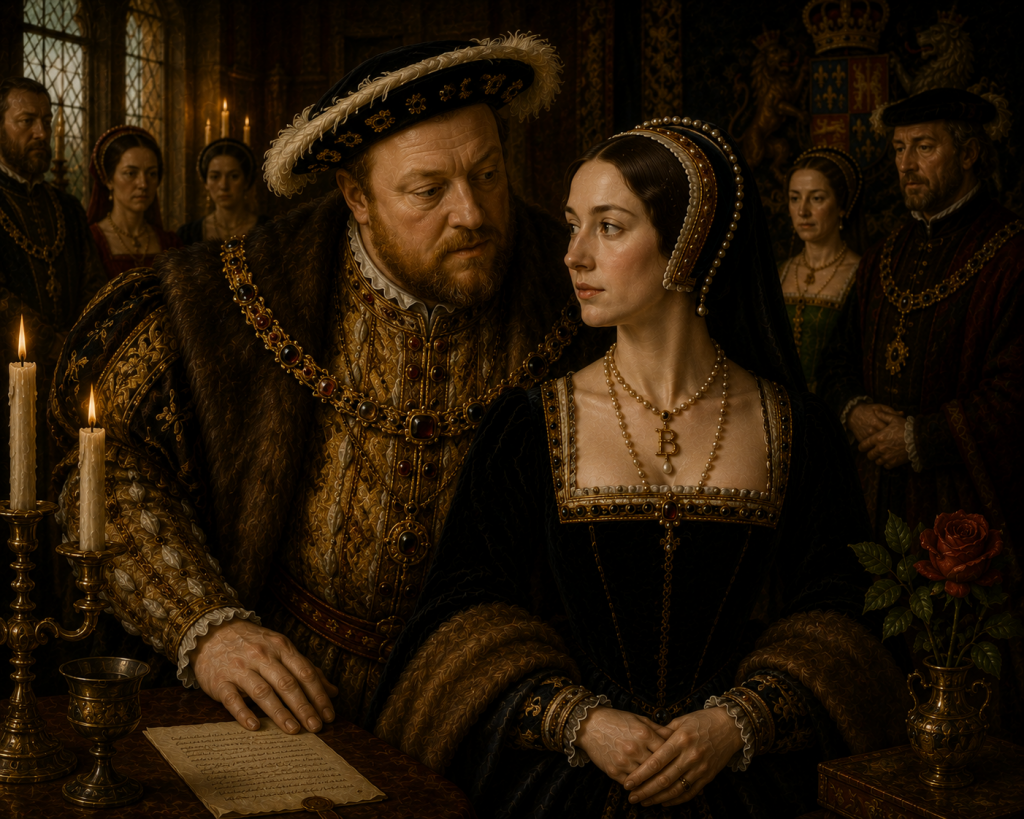
Artistic depiction of Henry VIII and Anne Boleyn during their courtship.
9 min read

“My own darling,” he wrote, in his own hand, to a woman who had not yet agreed to be his — seventeen surviving letters, written across years of frustrated waiting, from a king considerably more accustomed to simply taking what he wanted than to spending nearly a decade asking for it.
Most royal romances of the sixteenth century left behind little more than an official chronicled record; the private emotional texture of any given courtship is largely lost to history beneath layers of diplomatic formality and ceremonial description. Henry VIII‘s courtship of Anne Boleyn survives, remarkably, in a considerably more intimate form: seventeen letters written in Henry’s own hand, preserved today in the Vatican’s archives, apparently seized at some later point as potential evidence during the later annulment proceedings against Catherine of Aragon. These letters, spanning roughly the years between 1527 and 1528, offer a genuinely rare, direct window into the private emotional experience of a Renaissance monarch far more accustomed to commanding outcomes than to waiting, uncertain and increasingly desperate, for a woman’s own considered response. Understanding how this courtship actually unfolded, considered on its own terms rather than merely as prelude to the political and religious transformation it eventually helped precipitate, reveals a genuinely striking, sustained emotional drama that shaped English history every bit as significantly as the legal and theological manoeuvring that ran alongside it.
A Courtship That Began Where an Earlier One Had Failed
Henry’s romantic attention toward Anne began developing sometime during the mid-1520s, most likely around 1526, arriving within a court environment where Henry had already, across the preceding years, pursued a fairly conventional pattern of royal romantic attention toward various court women, including Anne’s own elder sister Mary Boleyn. What distinguished Henry’s pursuit of Anne so markedly from this earlier established pattern was Anne’s own immediate, sustained resistance to following the same familiar path. This resistance appears, from the very earliest surviving evidence, to have genuinely startled and increasingly consumed a king considerably unaccustomed to prolonged romantic refusal from anyone within his own court.
Anne’s resistance took a specific, carefully calculated form: rather than declining Henry’s attention altogether, a refusal that would have carried genuine political risk given the power differential involved, Anne instead made clear, across the earliest surviving exchanges between them, that she would not accept the role of royal mistress that had defined her sister’s own earlier relationship with the king, insisting instead on terms that implied nothing less than marriage as the only acceptable resolution to Henry’s evident interest. This position, genuinely audacious given Anne’s own comparatively modest gentry standing relative to the reigning monarch pursuing her, set the specific, unusual terms under which the following several years of courtship would unfold.
A king accustomed to romantic pursuit typically ending in his own favour, on his own terms, and within his own preferred timeframe, instead found himself facing a woman prepared to make him wait considerably longer, and want considerably more, than he had ever previously been required to.
The Surviving Letters: A King’s Own Private Voice
The seventeen letters Henry wrote to Anne across roughly 1527 and 1528, preserved today in the Vatican Apostolic Library, offer genuinely unusual direct access to Henry’s own private emotional register during this critical period, distinct from the more formal, ceremonially mediated public voice through which most surviving evidence of Henry’s reign otherwise reaches modern readers. These letters, written entirely in Henry’s own hand at a moment when royal correspondence was ordinarily dictated to secretaries, reveal a monarch genuinely, visibly preoccupied with securing Anne’s affection and, increasingly, her formal commitment to eventual marriage, expressing sentiments of romantic longing, physical desire, and mounting frustration at the prolonged uncertainty of their situation with a directness that several historians have found genuinely striking given Henry’s own otherwise carefully cultivated royal public image. The letters were seized as potential evidence during the later annulment proceedings, which is how they came to survive in the Vatican’s own archives at all.
Several of these letters describe Henry’s own physical and emotional distress at prolonged periods of separation from Anne, his evident jealousy regarding rumours of other potential suitors, and his repeated, increasingly urgent expressions of commitment to resolving his marital situation with Catherine of Aragon so that his relationship with Anne might proceed toward the marriage he had, by this point, become genuinely convinced represented the only acceptable outcome. Henry frequently signed these letters with a small drawn heart accompanying Anne’s initials, a distinctly personal, unofficial gesture entirely unlike the formal conventions typically governing royal correspondence of the period, and one that several historians read as genuine, if perhaps somewhat theatrical, evidence of authentic personal emotional investment rather than merely calculated political courtship alone.
A king does not typically draw hearts beside a woman’s initials in official correspondence unless something considerably more personal than mere political calculation is genuinely, actively at work.
Gifts, Absences, and the Texture of a Prolonged Courtship
Beyond the surviving letters themselves, various additional evidence illuminates the specific texture of this extended courtship: Henry’s documented gifts to Anne across this period, including jewellery and other valuable tokens of romantic favour, his repeated efforts to secure Anne’s presence at court despite periodic absences caused by outbreaks of illness, including a serious episode involving the sweating sickness in 1528 during which Anne herself fell ill, prompting genuine, well-documented royal anxiety and concern for her recovery. Henry’s own correspondence from this period repeatedly emphasises his eagerness for Anne’s return to court and his own considerable relief upon her eventual recovery, further texture suggesting a courtship considerably more emotionally invested, on Henry’s part at least, than a purely calculated political arrangement might otherwise have produced.
The courtship also unfolded within an increasingly public and increasingly awkward court environment, as Catherine of Aragon herself remained queen throughout this entire extended period, forced to navigate the genuinely painful reality of her husband’s open, sustained romantic pursuit of another woman. In contrast, the formal legal question of their own marriage’s validity remained unresolved for years on end. This uncomfortable, prolonged triangular court dynamic, playing out openly across several years rather than resolving with any particular speed, placed considerable strain on all parties involved, and contributed directly to the mounting political and diplomatic pressure surrounding the annulment proceedings.
Cardinal Wolsey’s Failure and the Courtship’s Mounting Stakes
As the years passed without the papal annulment Henry increasingly desperately sought, examined in fuller institutional detail elsewhere, the personal courtship between Henry and Anne grew increasingly entangled with the broader political and legal machinery Henry’s ministers were simultaneously attempting to construct on his behalf. Cardinal Wolsey’s own eventual failure to secure the annulment, and his corresponding fall from royal favour in 1529, carried genuine personal significance for Anne specifically, given her own well-documented earlier resentment toward Wolsey following his intervention in her prior relationship with Henry Percy. Anne appears, from surviving evidence, to have actively encouraged and welcomed Wolsey’s political downfall, viewing his removal as clearing a genuine personal and political obstacle standing between herself and the marriage she had spent years insisting upon as the only acceptable resolution to her relationship with Henry.
This mounting entanglement between personal courtship and high political consequence intensified considerably further across the early 1530s, as Thomas Cromwell’s own considerably more radical legislative strategy finally provided the practical legal mechanism through which Henry’s prolonged pursuit of both annulment and remarriage could actually be resolved. What had begun, roughly seven years earlier, as a comparatively private romantic pursuit had, by this point, grown into a matter of genuine constitutional and religious consequence for the entire kingdom, the personal and the political having become, across the intervening years, almost entirely inseparable from one another.
A courtship that began as one man’s private romantic pursuit had, by its conclusion, become inseparable from the complete legal reordering of an entire kingdom’s religious life — a transformation neither party could plausibly have anticipated when Henry first began writing those early, increasingly desperate letters.
A Secret Marriage, and a Courtship’s Resolution
The courtship’s actual resolution arrived with a genuine sense of urgency and, fittingly given its own unusually private, personal character throughout, considerable secrecy. Henry and Anne married in a private, deliberately unpublicised ceremony in January 1533, proceeding with the marriage before the formal legal resolution of Henry’s prior marriage to Catherine had been fully and publicly completed, a sequence of events that several historians suggest reflects genuine urgency stemming from Anne’s own pregnancy with the child who would, in September of that same year, become Princess Elizabeth. This secret marriage, followed within months by the formal legal annulment of Henry’s marriage to Catherine and Anne’s own public coronation as queen in June 1533, brought to conclusion a courtship that had, across nearly seven years of letters, gifts, prolonged separation, and mounting political entanglement, evolved from private royal romantic pursuit into one of the single most consequential relationships in the entire span of English history.
A Genuine Romance, Whatever Followed It
It would be a considerable distortion of the surviving evidence to read this extended courtship merely as calculated political manoeuvring dressed in the language of romantic sentiment, however thoroughly the relationship’s eventual, painful ending in 1536 has coloured much later popular retelling of its earlier, considerably more hopeful chapters. The surviving letters, gifts, and documented emotional texture of these years suggest, by the assessment of most careful modern historians, a courtship genuinely rooted in authentic mutual attraction and sustained emotional investment, at least across these particular early years, whatever combination of personal affection, political calculation, and mounting dynastic desperation ultimately, complicatedly, drove both parties toward the marriage they finally achieved in January 1533.
Before it became, within barely three years, the marriage history remembers primarily for its violent, dramatic ending, it was, for a genuinely sustained and well-documented period, something considerably simpler and considerably more human: a king who wrote love letters in his own hand, and a woman who made him wait years before finally, cautiously, allowing herself to be won.
Timeline: The Courtship
- c. 1526 — Henry VIII’s romantic attention toward Anne Boleyn begins developing.
- 1527 — Henry begins the extended correspondence that would eventually produce his seventeen surviving letters to Anne, now preserved in the Vatican Apostolic Library.
- 1527–1528 — Henry pursues formal annulment proceedings against Catherine of Aragon while the personal courtship with Anne continues to intensify.
- 1528 — Anne falls seriously ill during an outbreak of the sweating sickness, prompting well-documented royal anxiety and concern from Henry.
- 1529 — Cardinal Wolsey falls from power, having failed to secure the papal annulment; Anne reportedly welcomes his political downfall.
- Early 1530s — Thomas Cromwell’s legislative strategy provides the legal mechanism to finally resolve Henry’s marital situation.
- January 1533 — Henry and Anne marry in a private, secret ceremony, likely prompted by Anne’s pregnancy.
- 1 June 1533 — Anne is publicly crowned Queen of England.
- September 1533 — Anne gives birth to Princess Elizabeth.
author's note
Henry’s own surviving love letters are something I first read many years ago, long before I had any thought of writing Tudor fiction myself, and they genuinely shaped the emotional undercurrents of Related to Dracula, even though my books follow this courtship from Sebastian’s own outsider vantage point rather than Henry’s. Sebastian watches Anne navigate this pursuit at close range, aware of far more than he lets on. I wanted the reader to sense the same mounting, genuine urgency this article traces in Henry’s own private correspondence, without ever losing sight of how much personal risk Anne herself was taking by holding out for marriage rather than accepting the safer, more familiar role of royal mistress. That tension, between real affection and real danger, has fascinated me for as long as I have been reading about this period, and it sits at the heart of how I wanted their story to feel in my novels.
sources and further reading
- Ives, Eric. The Life and Death of Anne Boleyn. Blackwell Publishing, 2004.
- Warnicke, Retha M. The Rise and Fall of Anne Boleyn: Family Politics at the Court of Henry VIII. Cambridge University Press, 1989.
- Savage, Henry, ed. The Love Letters of Henry VIII. Allan Wingate, 1949 — a published edition of Henry’s surviving letters to Anne, with useful scholarly annotation.
- Bordo, Susan. The Creation of Anne Boleyn: A New Look at England’s Most Notorious Queen. Houghton Mifflin Harcourt, 2013.
- MacCulloch, Diarmaid. Thomas Cromwell: A Life. Allen Lane, 2018.
- Fraser, Antonia. The Wives of Henry VIII. Weidenfeld & Nicolson, 1992.
A note on sources: Henry’s seventeen surviving letters to Anne, held today in the Vatican Apostolic Library, represent one of the rare instances of directly personal, unmediated royal correspondence surviving from this period, though the circumstances of their eventual preservation there, likely seized as evidence during annulment proceedings, mean only Henry’s side of the correspondence survives, with Anne’s own responses lost to history. This article has drawn on the scholarly editions and biographical treatments listed above in reconstructing this courtship’s fuller context.
related articles
- Anne Boleyn: The Woman Who Changed the Fate of a Kingdom
- The Early Life of Anne Boleyn: The Making of England’s Most Controversial Queen
- The Real Anne Boleyn: Separating the Queen From the Myth
- The Case Against Anne Boleyn: Guilty, Innocent, or Simply Inconvenient?
- The English Reformation: Henry VIII and the Break with Rome
- The Six Wives of Henry VIII: Marriage, Power and the Making of Tudor England
- Henry VIII: King, Reformer or Tyrant?
- Tudor England: The Dynasty That Transformed a Kingdom
continue your journey through history
Discover the novels inspired by the people, rivalries and legends of medieval Europe.

Historical Fiction Author
History has always fascinated me—not simply for the great battles or famous rulers, but for the people behind the legends. Through years of research into medieval Europe, the Ottoman Empire, Tudor England, and the lives of extraordinary historical figures, I’ve sought to uncover the stories that lie beneath popular myths. My novels blend documented history with compelling fiction, inviting readers to step into the past and experience it as those who lived it might have done.
Join the Related to Dracula Circle