
HISTORY · Henry VIII
The King’s Choice: Henry VIII’s Accession and the Courtship of Catherine of Aragon
How a Young King’s First Royal Decision Became, However Briefly, an Act of Genuine Devotion
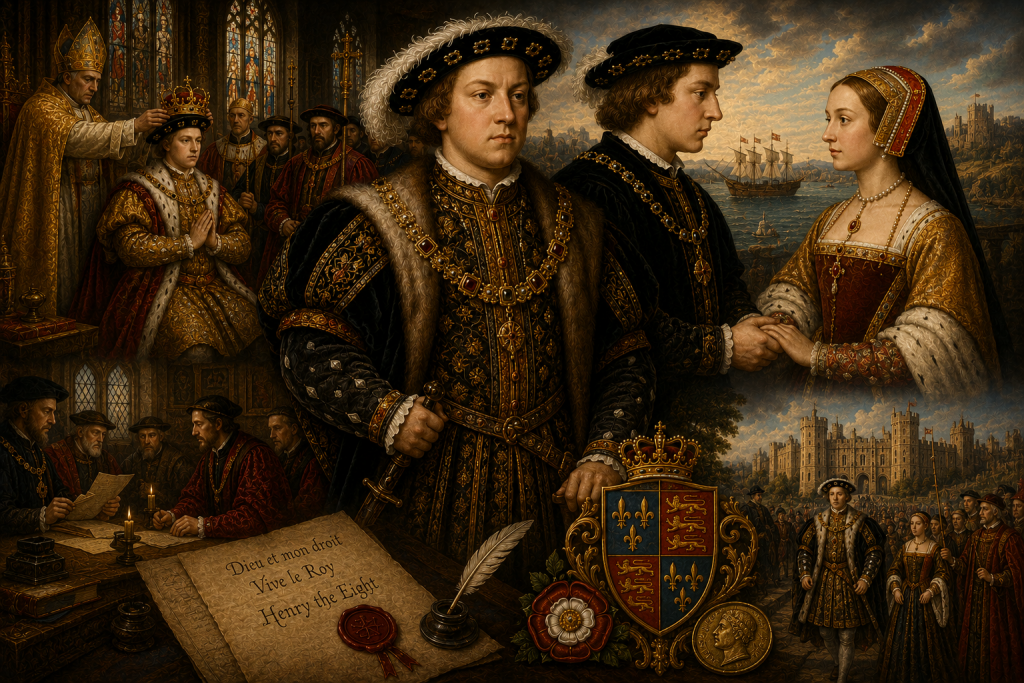
An artistic interpretation of Henry VIII’s accession to the English throne and his early courtship of Catherine of Aragon.
10 min read

“Every other decision of his reign would eventually be remembered as evidence of a will that answered to no one. But his very first decision as king, made within weeks of his father’s death, was to marry the widow he had waited seven uncertain years to claim — proof, whatever came later, that Henry’s will was not always something to be feared.”
Before Henry VIII became the monarch history remembers most readily for the dramatic unravelling of his marriages, he was, for a brief and genuinely striking interval at the very outset of his reign, a young king who appeared to choose love and personal loyalty over the more calculating diplomatic caution his own father had spent years exercising. The story of how Henry came to marry Catherine of Aragon, the widow of his elder brother Arthur, is not simply a footnote to the more famous marital drama that would eventually follow; it is, examined on its own terms, a genuinely unusual episode of prolonged diplomatic uncertainty, quiet personal conviction, and a young king’s first, decisive assertion of his own independent will — one that, unlike so much of what followed across the rest of his reign, appears to have been motivated by something closer to genuine affection and honourable duty than by calculation alone.
A Widow Left in Diplomatic Limbo
Catherine of Aragon’s position within the English court following Arthur’s sudden death in April 1502 proved considerably more precarious and uncertain than her earlier arrival as a celebrated royal bride might ever have suggested. She remained in England rather than returning immediately to Spain, caught within an increasingly awkward and prolonged diplomatic limbo as her father, King Ferdinand of Aragon, and her father-in-law, Henry VII, negotiated over her future status, her substantial dowry, and the considerable question of whether she might, despite her brief marriage to Arthur, eventually marry Henry VII’s surviving son and new heir instead.
This possibility, a marriage between Catherine and the young Henry, by then invested as Prince of Wales, offered genuine diplomatic advantages to both royal houses, preserving the valuable Anglo-Spanish alliance Arthur’s original marriage had been designed to secure, without requiring Henry VII to return the substantial portion of Catherine’s dowry that Ferdinand had already paid him, while still preserving his prospect of collecting the considerable remainder still owed. A formal betrothal between Catherine and the young Henry was accordingly arranged in 1503, when Henry was still only twelve years old, an arrangement that required, given Catherine’s previous marriage to Henry’s own brother, a special papal dispensation from Pope Julius II, addressing the canonical complications arising from her prior marital status within the same family.
A widow’s future, in the careful, calculating world of early Tudor diplomacy, was rarely her own to determine — it belonged, instead, to whichever combination of kings and popes could eventually agree on terms convenient enough to all parties involved.
Seven Years of Uncertainty
What followed the 1503 betrothal was not the straightforward path toward eventual marriage the arrangement might have suggested, but instead a genuinely prolonged, uncomfortable period of diplomatic uncertainty stretching across nearly the entirety of the remaining years of Henry VII’s reign. Henry VII, whatever his initial willingness to arrange the betrothal, grew increasingly cautious and non-committal regarding the marriage’s actual completion as the years passed, motivated by a combination of shifting European diplomatic priorities, ongoing disputes with Ferdinand over the remaining, unpaid portion of Catherine’s dowry, and, according to some historians, a degree of personal reluctance on Henry VII’s own part to fully commit his surviving heir to a marriage whose diplomatic value he had, by the later years of his reign, come to regard with somewhat less enthusiasm than he had shown immediately following Arthur’s death.
This prolonged uncertainty placed Catherine herself in an increasingly difficult and genuinely painful personal position, maintained within the English court for years on end in a state of unresolved limbo, her future entirely dependent on negotiations she had no direct control over, her household allowance frequently inadequate and irregularly provided, and her own correspondence from this period revealing genuine, sustained personal distress at the precariousness and indignity of her prolonged, unresolved situation. Far from the swift, celebratory resolution her earlier marriage to Arthur might have suggested awaited her, Catherine spent the better part of her early twenties navigating genuine financial hardship and profound personal uncertainty within a foreign court that seemed, for years at a stretch, unable or unwilling to resolve her future one way or the other.
A princess raised for a swift, celebrated royal marriage instead spent the better part of a decade waiting, in genuine uncertainty and real hardship, for a court seemingly content to leave her future permanently unresolved.
Adding further complication to this already difficult situation, Henry VII, following the death of his own wife Elizabeth of York in 1503, reportedly considered at various points the possibility of marrying Catherine himself, a proposal that, whatever its ultimate lack of serious pursuit, further illustrates just how thoroughly Catherine’s own personal future had become subordinated to the shifting calculations of Tudor dynastic strategy during this prolonged, uncertain period.
A Formal Repudiation, Under Pressure
The uncertainty surrounding Catherine’s eventual marriage to Henry reached a particularly stark and revealing point in 1505, when the young Henry, then thirteen years old and acting, by most historical assessments, under direct instruction from his own father rather than through any independent personal conviction, formally repudiated the earlier 1503 betrothal shortly before reaching the age at which the arrangement would otherwise have become legally binding without further royal intervention. This formal repudiation, executed through the appropriate legal and ecclesiastical channels of the period, technically left Henry free of any binding obligation to eventually marry Catherine at all, a diplomatic manoeuvre generally interpreted by historians as reflecting Henry VII’s own continued strategic hedging regarding the marriage’s ultimate value, rather than any genuine reflection of the young Henry’s own personal feelings toward Catherine herself.
This episode carries genuine significance for understanding what followed, precisely because it demonstrates so clearly that the eventual marriage was never, at any point during Henry VII’s own lifetime, a settled or guaranteed outcome. Catherine spent these same years increasingly isolated and financially strained within the English court, her position rendered considerably more precarious still by this formal repudiation, which left her future entirely dependent on whatever decision Henry VII’s own shifting diplomatic calculations, or his eventual death and the accession of a new, independently minded monarch, might ultimately produce.
Henry VII’s Death and an Immediate, Striking Decision
Henry VII died on 21 April 1509, and the accession of the seventeen-year-old Henry VIII brought with it, within a remarkably short span of time, a decision that stands in genuinely striking contrast to the prolonged, calculating hesitation that had characterised his father’s own handling of the Catherine question across the preceding seven years. Rather than continuing his father’s cautious diplomatic hedging, or pursuing any of the various alternative marital possibilities that might reasonably have been available to a newly crowned young king with the entire diplomatic landscape of Renaissance Europe theoretically open to him, Henry moved swiftly and decisively to marry Catherine, proceeding with the wedding on 11 June 1509, less than two months after his father’s death and his own accession to the throne.
This swift decision, taken so early and so decisively within Henry’s own reign, has long attracted genuine historical interest precisely because it appears to reflect something considerably closer to independent personal conviction than the more calculated political manoeuvring that would come to define so much of Henry’s later marital history. Contemporary accounts and later historical assessment alike have generally interpreted Henry’s decision as reflecting genuine personal affection for Catherine, who was nearly six years his senior and had endured years of visible hardship and uncertainty within the English court that the young Henry, even as a boy, had presumably observed directly.
His father spent seven years treating Catherine’s future as a calculation to be endlessly deferred. His son, given the chance to make his own first decision as king, settled the matter within weeks — and settled it, by every available indication, in her favour.
Henry reportedly stated, according to several surviving accounts from the period, that he considered himself bound by both personal inclination and a sense of honourable duty toward his father’s own earlier, if subsequently abandoned, intentions regarding the marriage, framing his decision explicitly as an act of personal conscience and genuine regard for Catherine herself, rather than as the product of any narrower diplomatic recalculation alone. Whether this framing reflects Henry’s own entirely sincere personal motivation, or a somewhat more curated public presentation of a decision that also carried genuine diplomatic advantage in preserving the valuable Anglo-Spanish alliance, remains a matter modern historians continue to weigh carefully rather than resolve with complete certainty.
A Coronation, Together
Henry and Catherine were married in a private ceremony on 11 June 1509. They crowned together at Westminster Abbey on 24 June 1509, a joint coronation that itself carried genuine symbolic significance, presenting the new king and his chosen queen to the wider kingdom as a unified royal partnership from the very outset of the reign, rather than the more staggered, sequential coronation arrangements that might otherwise have been employed. Contemporary accounts of the coronation and the accompanying celebrations describe genuine public enthusiasm and widespread approval for the match, reflecting both Catherine’s own well-established personal popularity within England, cultivated across her difficult years of prolonged residence at the English court, and the broader diplomatic satisfaction produced by the continued, now finally secured, Anglo-Spanish alliance.
For Catherine herself, the marriage brought a genuine, dramatic transformation in personal circumstances, resolving nearly seven years of financial hardship, diplomatic uncertainty, and profound personal precariousness with what appeared, at this particular moment in 1509, to be a comprehensive and thoroughly vindicating resolution: not merely marriage to an English king, but marriage to a young, evidently devoted husband who had chosen her decisively and publicly, against the more cautious alternative path his own father had spent years pursuing instead.
A Beginning Worth Remembering on Its Own Terms
It would be a mistake to read this early episode of Henry’s reign solely through the lens of what would eventually follow across the subsequent decades of his marital history, a later trajectory that belongs to its own separate telling. Considered on its own terms, within the specific context of 1509 alone, Henry’s decisive, swiftly executed choice to marry Catherine represents something genuinely distinct from the pattern of escalating, largely unchecked personal will that would come to define so much of his later reign: not merely a young king asserting his own independent authority for its own sake, but a young king appearing, by the clearest available contemporary evidence, to exercise that same independent will in service of personal loyalty, evident affection, and a sense of honourable duty toward a woman who had waited, through years of genuine hardship, for precisely this outcome.
Every marriage carries within it, at the very beginning, at least the appearance of genuine hope and mutual devotion. Henry and Catherine’s beginning, unlike so much of what history has chosen to remember about their eventual ending, appears to have earned that appearance honestly.
Timeline: Accession and Courtship
- 1502 — Following Arthur’s death, Catherine remains in England amid growing diplomatic uncertainty regarding her future.
- 1503 — A formal betrothal between Catherine and the young Henry, now Prince of Wales, is arranged, requiring a special papal dispensation.
- 1503 — Elizabeth of York, Henry VII’s wife, dies; Henry VII reportedly considers, without serious pursuit, the possibility of marrying Catherine himself.
- 1503–1509 — Catherine endures prolonged financial hardship and diplomatic uncertainty within the English court as Henry VII repeatedly delays confirming the marriage.
- 1505 — Henry, acting under his father’s direction, formally repudiates the 1503 betrothal, technically freeing him of any binding marital obligation to Catherine.
- 21 April 1509 — Henry VII dies; the seventeen-year-old Henry ascends the throne as Henry VIII.
- 11 June 1509 — Henry and Catherine are married, less than two months after Henry’s accession.
- 24 June 1509 — Henry and Catherine are jointly crowned at Westminster Abbey, presenting a unified royal partnership to the kingdom.
author's note
Henry’s own surprisingly devoted early courtship of Catherine is a part of the Tudor story that has stayed with me since I first came across it many years ago, long before I began writing Related to Dracula: At Tudor Court. My character Sebastian arrives in London as an outsider, a shepherd’s boy from Wallachia carrying a secret bloodline and an inherited gift he barely understands. The same court that could produce a young king willing to defy his own father’s caution for love is also the court that will soon test Sebastian’s loyalties in ways he cannot yet imagine. Understanding Henry’s own capacity for genuine devotion, before the reign that followed hardened him, is something I first found genuinely moving as a much younger reader, and it has shaped how I wanted this earlier Tudor world to feel on the page.
sources and further reading
- Starkey, David. Henry: Virtuous Prince. HarperPress, 2008.
- Fraser, Antonia. The Wives of Henry VIII. Weidenfeld & Nicolson, 1992 — includes detailed treatment of Catherine’s years of uncertainty before her marriage.
- Mattingly, Garrett. Catherine of Aragon. Little, Brown and Company, 1941 — the classic biographical study of Catherine, including her difficult years at the English court before 1509.
- Tremlett, Giles. Catherine of Aragon: Henry’s Spanish Queen. Faber & Faber, 2010 — a comprehensive modern biography covering the full period of Catherine’s betrothal and early marriage.
- Scarisbrick, J. J. Henry VIII. Yale University Press, 1968.
- Gunn, Steven. Henry VII. Routledge, 2007.
A note on sources: Catherine’s own surviving correspondence from her years of prolonged uncertainty provides some of the most direct and personally revealing evidence for this period, though historians continue to debate the precise balance of genuine affection and diplomatic calculation behind Henry’s own eventual, decisive choice to marry her in 1509. This article has drawn on the broad biographical consensus represented across the sources listed above.
related articles
- Henry VIII: The King Who Changed England
- The Spare Prince: Henry VIII’s Childhood Before He Was Ever Meant to Wear the Crown
- Henry VIII’s First Queen: Catherine of Aragon, the Forgotten Queen
- The English Reformation: Henry VIII and the Break with Rome
- The Six Wives of Henry VIII: Marriage, Power and the Making of Tudor England
- Henry VIII: King, Reformer or Tyrant?
- Tudor England: The Dynasty That Transformed a Kingdom
- Henry VII: The King Who Founded the Tudor Dynasty
- The Wars of the Roses: The Conflict That Created the Tudors
- How Henry VIII Fell in Love With Anne Boleyn: The Courtship That Changed England
continue your journey through history
Discover the novels inspired by the people, rivalries and legends of medieval Europe.

Historical Fiction Author
History has always fascinated me—not simply for the great battles or famous rulers, but for the people behind the legends. Through years of research into medieval Europe, the Ottoman Empire, Tudor England, and the lives of extraordinary historical figures, I’ve sought to uncover the stories that lie beneath popular myths. My novels blend documented history with compelling fiction, inviting readers to step into the past and experience it as those who lived it might have done.
Join the Related to Dracula Circle