
HISTORY · Henry VIII
Henry VIII: King, Reformer or Tyrant?
Weighing Nearly Four Decades of Rule Against Three Competing Verdicts
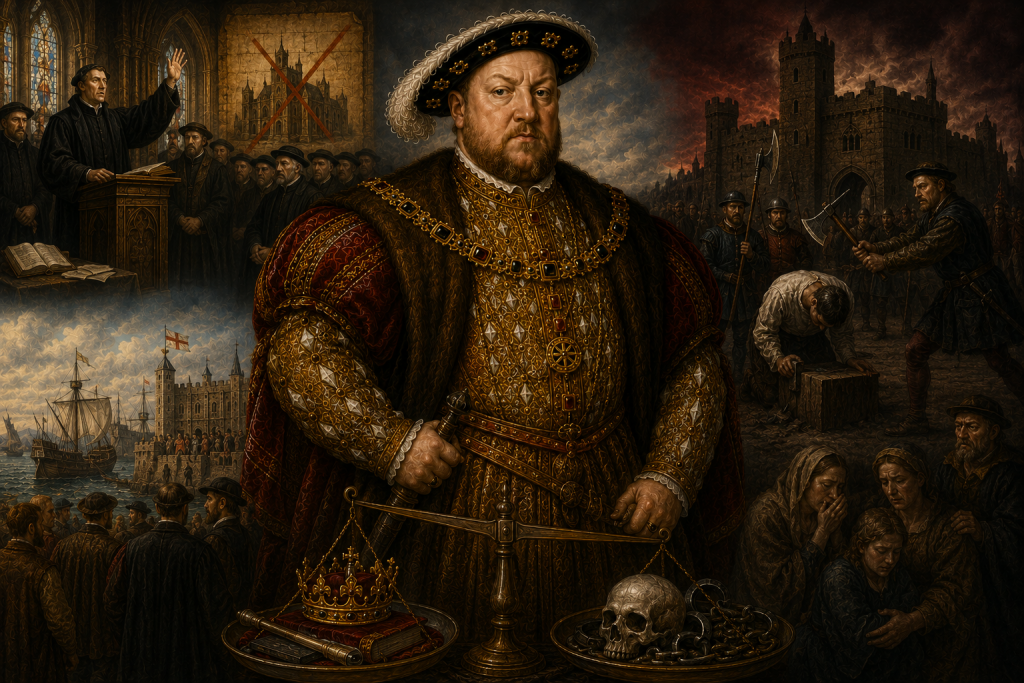
An artistic interpretation of Henry VIII, whose reign continues to divide historians between reformer, visionary, and tyrant.
9 min read

“Call him merely a king and you understate what he actually did. Call him only a reformer and you flatter motives that were rarely, if ever, primarily theological. Call him simply a tyrant and you risk missing the genuine, if deeply flawed, statecraft beneath the cruelty. The honest verdict, as usual, refuses to sit still inside any single word.”
Few English monarchs resist tidy categorisation quite as stubbornly as Henry VIII, a ruler whose nearly four-decade reign has been claimed, at various points across the centuries since his death, as evidence for three quite different and not entirely compatible historical verdicts. To some, he remains simply a king, a conventional if unusually consequential Renaissance monarch pursuing entirely ordinary dynastic and diplomatic priorities through the ordinary tools of early modern kingship. To others, he stands as a genuine reformer, the monarch whose break with Rome, whatever its immediate personal catalyst, permanently reshaped English religious life and set the kingdom on a distinctive Protestant trajectory of lasting historical consequence. And to still others, examining the same reign through the lens of its mounting executions, its dismantled institutions, and its increasingly unchecked exercise of royal will, Henry appears considerably more accurately described as a tyrant, a ruler whose personal authority grew so unrestrained across nearly four decades that no minister, wife, or institution could ultimately depend on its continued survival once it ceased serving his own immediate purposes. Each of these three framings captures something genuinely true about Henry’s reign. None of them, examined in isolation, captures the whole of it.
The Case for “King”: A Conventional Renaissance Monarch
The case for understanding Henry primarily as an entirely conventional, if unusually capable, Renaissance monarch rests on genuinely substantial evidence drawn from across his reign. He inherited a stable and well-resourced kingdom from his careful father, and pursued, across his early reign particularly, entirely ordinary priorities for a monarch of his era and station: continental military glory through renewed campaigns against France, the cultivation of an impressive, culturally accomplished royal court reflecting broader European Renaissance ideals, and the anxious, entirely dynastically conventional pursuit of a secure male succession that would preserve his own family’s continued hold on the throne.
Viewed through this lens, even Henry’s most dramatic and consequential decisions retain a recognisable logic considerably less exceptional than their eventual historical consequences might suggest. Dynastic anxiety over succession, after all, drove the marital and political calculations of virtually every hereditary European monarch of the period, and Henry’s own particular solution to that anxiety, however unusually sweeping in its ultimate execution, emerged from pressures that were, in their essential shape, entirely ordinary features of early modern hereditary kingship rather than any unusual personal pathology unique to Henry alone.
A king anxious about his succession is not, in itself, a remarkable historical figure. Nearly every hereditary monarch of the period shared precisely that same anxiety — what distinguished Henry was not the anxiety itself, but how far he was ultimately willing to go in resolving it.
The Case for “Reformer”: An Accidental but Genuine Transformation
The case for understanding Henry as a genuine religious and institutional reformer rests less on any argument regarding his own personal, sustained theological conviction, and considerably more on the sheer scale and permanence of the institutional transformation his reign actually produced. Whatever combination of personal, dynastic, and political motivation drove Henry’s initial break with Rome, the resulting transformation of English religious and political life proved genuinely, permanently significant, establishing a distinctive tradition of English royal supremacy over ecclesiastical affairs that would persist, in modified form, for centuries beyond Henry’s own death, and setting England on a broader religious trajectory that would eventually, across his children’s own subsequent reigns, produce a distinctly Protestant national religious identity.
This reformist legacy deserves genuine, serious historical weight, whatever reservations one might reasonably hold regarding Henry’s own personal motivations for setting it in motion. The dissolution of the monasteries permanently reshaped English religious, economic, and social life; the establishment of royal supremacy over the church fundamentally altered the structure of English political authority in ways that outlasted every subsequent Tudor and Stuart monarch’s own individual reign. Few monarchs, whatever their original motivation, can claim to have produced institutional transformation of comparably lasting historical consequence.
A reformation need not begin with pure theological conviction to end up producing genuine, lasting reform — intention and consequence are not, in Henry’s case, quite the same thing, and history has generally chosen to weigh the consequence rather more heavily than the intention.
Yet this reformist framing also carries genuine limitations worth acknowledging directly. Henry himself, across much of his reign, maintained theologically conservative positions considerably closer to traditional Catholic doctrine than to the more thoroughgoing continental Protestant reform then unfolding under figures such as Luther and Calvin, suggesting that “reformer,” if applied to Henry without careful qualification, risks implying a degree of sustained theological conviction and doctrinal innovation that the historical Henry did not, in fact, consistently hold or pursue.
The Case for “Tyrant”: An Escalating, Unchecked Will
The case for understanding Henry as a genuine tyrant rests on a substantial body of evidence, evidence that grows considerably more difficult to explain away as merely conventional early modern kingship the further one traces Henry’s reign toward its later years. The executions of Sir Thomas More and Bishop John Fisher for their principled religious dissent; the execution of Thomas Cromwell, Henry’s own once-indispensable chief minister, once his usefulness had similarly expired; the executions of two of Henry’s own wives, Anne Boleyn and Catherine Howard — together these episodes trace a genuinely consistent pattern of a ruler increasingly willing to remove, through the most severe means available, anyone, however previously loyal or personally close, whose continued position no longer served his immediate purposes.
This pattern extends well beyond Henry’s treatment of ministers and wives into the broader machinery of his later reign, including increasingly severe legal mechanisms such as bills of attainder, which allowed for execution through parliamentary legislative act rather than conventional judicial trial, a legal innovation that stripped away even the modest procedural protections ordinary judicial process might otherwise have provided to those accused of offences against the crown. The cumulative effect of these episodes, considered together across the full span of Henry’s reign, suggests a ruler whose exercise of personal authority grew steadily less restrained by law, institution, or personal loyalty as his reign progressed.
A single execution might reflect the ordinary, if severe, exercise of early modern royal justice. A sustained pattern of executions, extending across decades and touching ministers, clergy, and Henry’s own wives alike, becomes considerably harder to describe as anything other than tyranny, however conventional its individual legal mechanisms might have appeared at the time.
Holding the Three Verdicts Together
The genuine difficulty in reaching a single, settled verdict on Henry’s reign lies precisely in the fact that all three framings remain simultaneously true across different dimensions of the same nearly four-decade rule, rather than representing competing, mutually exclusive historical interpretations from which a single correct choice must ultimately be selected. Henry was, unmistakably, a conventional Renaissance king pursuing entirely ordinary dynastic priorities through recognisable early modern political tools. He was, equally unmistakably, a genuine reformer in terms of the permanent, civilisation-shaping institutional consequences his reign actually produced, whatever the limitations of his own personal theological conviction. And he was, by the later years of his reign particularly, a ruler whose exercise of personal will had grown sufficiently unrestrained, sufficiently willing to discard institutional loyalty, personal relationship, and even basic judicial protection whenever doing so served his immediate purposes, that “tyrant” describes his conduct with considerably more historical accuracy than mere severity or ordinary early modern royal authority could reasonably account for on its own.
Perhaps the fairest single verdict is simply this: Henry began his reign as recognisably one thing, and ended it as something considerably more complicated and considerably more dangerous — a king who discovered, across nearly four decades of largely unchecked authority, just how far a sufficiently determined monarch’s will could actually reach once every institutional and personal restraint capable of containing it had, one by one, been removed.
What the Question Itself Reveals
There is, finally, something genuinely instructive in the very persistence of this unresolved historical debate across the centuries since Henry’s death, a debate this article has traced without attempting to resolve it definitively in favour of any single verdict. Few English monarchs generate comparably sustained disagreement regarding the most basic question of how their reign ought fundamentally to be characterised, and this persistent uncertainty itself testifies to the genuine complexity of a ruler whose actions simultaneously produced conventional dynastic outcomes, permanent institutional transformation, and an escalating record of severity toward anyone, however previously trusted, who came to stand between Henry and his own immediate priorities. The question posed by this article’s title may not, in the end, admit of any single, fully satisfying answer — and that irresolution, rather than representing any failure of historical analysis, may simply reflect the genuine, deeply layered complexity of the reign itself.
Timeline: Key Moments Across the Three Framings
- 1509 — Henry ascends the throne as a conventionally celebrated Renaissance prince, embodying the “king” framing at its most straightforward.
- 1513 — Continental military campaigns against France reflect entirely ordinary early modern dynastic and diplomatic priorities.
- 1533–1534 — The break with Rome and the Act of Supremacy establish the institutional foundation for Henry’s later “reformer” legacy.
- 1535 — The executions of Thomas More and John Fisher mark an early, stark demonstration of the pattern later associated with the “tyrant” framing.
- 1536–1541 — The dissolution of the monasteries extends Henry’s reformist institutional legacy across the English religious and economic landscape.
- 1536 and 1542 — The executions of Anne Boleyn and Catherine Howard further deepen the pattern of severity associated with Henry’s later reign.
- 1540 — The execution of Thomas Cromwell demonstrates that even Henry’s own most indispensable ministers remained vulnerable once their usefulness had expired.
- 1547 — Henry dies, leaving behind a reign whose fundamental character historians continue to debate across all three competing framings.
author's note
Trying to hold all three of these framings together without collapsing into a single verdict is a genuine, long-running preoccupation of mine, one that predates Related to Dracula by many years. My Sebastian encounters Henry directly at court, and I never wanted to write him as a simple monster or a simple romantic hero, but as a genuinely capable, genuinely dangerous man whose favour could elevate an outsider like Sebastian in an instant, and whose displeasure could end him just as quickly. This article’s refusal to settle on one tidy answer mirrors, I think, exactly the uncertainty I have always felt reading about Henry myself, and exactly the uncertainty I wanted a reader to feel every time Sebastian finds himself in the same room as the king.
sources and further reading
- Scarisbrick, J. J. Henry VIII. Yale University Press, 1968.
- Elton, G. R. Reform and Reformation: England, 1509–1558. Harvard University Press, 1977.
- Bernard, G. W. The King’s Reformation: Henry VIII and the Remaking of the English Church. Yale University Press, 2005.
- MacCulloch, Diarmaid. Thomas Cromwell: A Life. Allen Lane, 2018.
- Ives, Eric. The Life and Death of Anne Boleyn. Blackwell Publishing, 2004 — useful for understanding the legal mechanisms, including attainder, used against several of Henry’s ministers and wives.
- Guy, John. Tudor England. Oxford University Press, 1988.
A note on sources: historians remain genuinely divided regarding the appropriate overall characterisation of Henry’s reign, and this article has deliberately drawn on scholarship representing each of the three framings discussed, rather than favouring any single interpretive tradition as definitively correct.
related articles
- Henry VIII: The King Who Changed England
- The Spare Prince: Henry VIII’s Childhood Before He Was Ever Meant to Wear the Crown
- The King’s Choice: Henry VIII’s Accession and the Courtship of Catherine of Aragon
- Henry VIII’s First Queen: Catherine of Aragon, the Forgotten Queen
- The English Reformation: Henry VIII and the Break with Rome
- The Six Wives of Henry VIII: Marriage, Power and the Making of Tudor England
- Tudor England: The Dynasty That Transformed a Kingdom
- Henry VII: The King Who Founded the Tudor Dynasty
- The Wars of the Roses: The Conflict That Created the Tudors
- How Henry VIII Fell in Love With Anne Boleyn: The Courtship That Changed England
continue your journey through history
Discover the novels inspired by the people, rivalries and legends of medieval Europe.

Historical Fiction Author
History has always fascinated me—not simply for the great battles or famous rulers, but for the people behind the legends. Through years of research into medieval Europe, the Ottoman Empire, Tudor England, and the lives of extraordinary historical figures, I’ve sought to uncover the stories that lie beneath popular myths. My novels blend documented history with compelling fiction, inviting readers to step into the past and experience it as those who lived it might have done.
Join the Related to Dracula Circle