
HISTORY · wallachia
The Fall of Medieval Wallachia
How a Principality Built on Defiance Slowly Learned to Stop Resisting Altogether
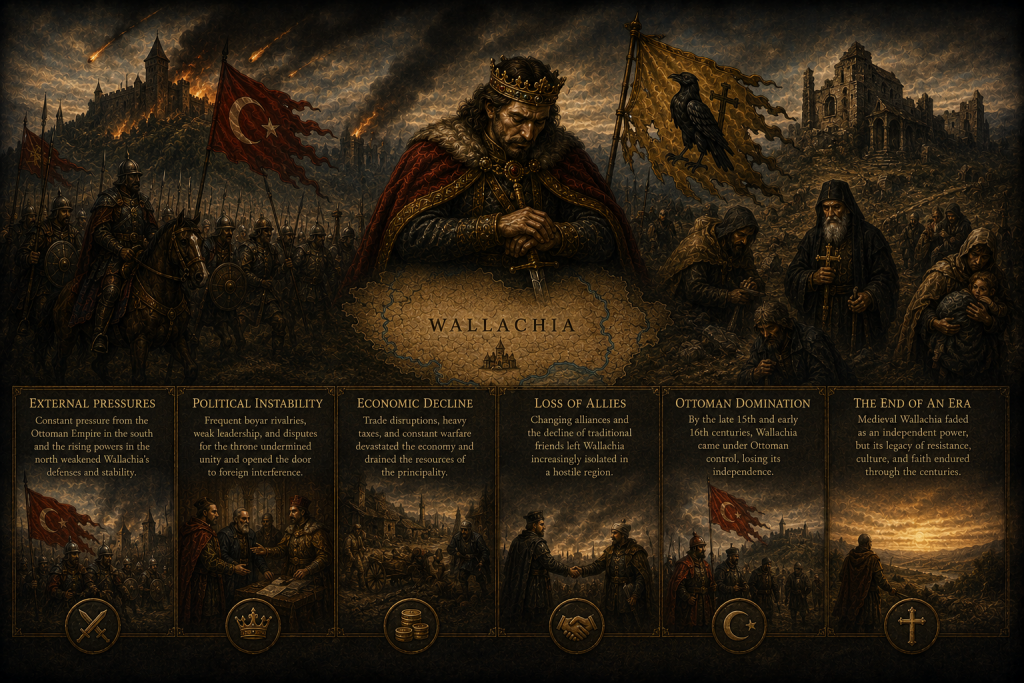
An artistic interpretation of the decline of medieval Wallachia and the end of an independent frontier state.
8 min read

“Empires rarely conquer a determined buffer state through a single decisive battle. More often, they simply outlast it, waiting patiently as decade after decade of tribute and compromise wears down the will to resist until submission no longer feels like defeat at all — merely the ordinary shape of things.”
Medieval Wallachia did not fall the way great capitals sometimes fall, in a single catastrophic siege remembered forever afterwards as the day everything changed. Its ending arrived instead in the far quieter, far less dramatic register in which most genuine historical transformations actually occur: gradually, unevenly, through several generations of steadily tightening Ottoman oversight, an increasingly hollowed-out native nobility, and a slow but unmistakable erosion of the very qualities — an assertive, occasionally defiant voivodeship, a genuinely contested succession, a native ruling class still capable of producing figures like Vlad the Impaler — that had defined Wallachia as a distinct medieval principality in the first place. By the time the process had run its course, the Wallachia that emerged bore Ottoman-approved rulers rather than locally contested ones, foreign-born administrators rather than boyar-descended voivodes, and a political culture in which the very idea of a prince riding out to defy the Sultan directly, as Vlad had once done, had become almost unthinkable.
The Century After Vlad: A Gradual Tightening
Vlad’s death in 1476 did not mark any sudden, decisive turning point in Wallachia’s relationship with Ottoman power, but the decades that followed his reign do reveal a steadily hardening pattern of Ottoman oversight considerably less flexible than the looser tributary arrangements that had characterised much of the earlier fifteenth century. Successive Wallachian voivodes throughout the late fifteenth and sixteenth centuries continued to be drawn from the broader Basarab dynastic pool of eligible claimants, and continued, in principle, to be selected with meaningful input from the Wallachian boyar nobility, but Ottoman approval and, increasingly, direct Ottoman preference came to weigh far more heavily in determining who actually secured and retained the throne than had generally been the case during Vlad’s own more turbulent, more genuinely contested era.
This shift reflected broader changes in the regional balance of power rather than any single Wallachian ruler’s individual failing. As Ottoman military and administrative capacity continued expanding throughout the sixteenth century, the empire found itself increasingly able to enforce compliance through sustained diplomatic and economic pressure rather than relying, as it more frequently had during Vlad’s own lifetime, on the comparatively blunter instrument of direct military invasion whenever a Wallachian ruler proved troublesome. Tribute demands grew steadily heavier, Ottoman garrisons and administrative oversight grew steadily more entrenched along the Danube frontier, and Wallachian voivodes found themselves operating within an ever-narrowing range of genuinely independent action.
A door does not need to be slammed shut all at once. It can simply be pushed a little further closed, year after year, until nobody quite remembers when it was last left properly open.
Michael the Brave: A Final, Brief Reassertion
Wallachia did produce one further, genuinely remarkable moment of assertive independence before the medieval pattern finally gave way entirely, in the person of Michael the Brave, who ruled at the very end of the sixteenth century and briefly achieved something no Wallachian voivode, Vlad included, had ever managed: the temporary unification, under his own personal rule, of Wallachia, Moldavia, and Transylvania, the three principal Romanian-speaking principalities of the region, into a single, if short-lived, political entity. Michael’s remarkable military campaigns against Ottoman authority in the 1590s, achieved amid a broader, temporarily favourable shift in regional power dynamics, offered a final, striking demonstration that the older medieval pattern of genuine Wallachian defiance had not been entirely extinguished, even after more than a century of steadily tightening Ottoman oversight.
This unification, however, proved every bit as precarious as the achievements of earlier Wallachian rulers, collapsing within a matter of years following Michael’s assassination in 1601, undone by precisely the combination of foreign intervention and domestic noble rivalry that had destabilised so many Wallachian rulers before him. Michael’s brief triumph and rapid downfall function, in retrospect, less as evidence that medieval Wallachian assertiveness could still succeed on its own historical terms, and more as a final, dramatic coda to that older pattern before the region settled decisively into the more thoroughly subordinated arrangement that would characterise the following two centuries.
A single bright flame, burning briefly and impressively, does not disprove that the surrounding fire had already, in every meaningful sense, gone out.
The Phanariot Era: A Different Kind of Rule Entirely
The most significant and lasting transformation in Wallachia’s political character arrived during the early eighteenth century, with the establishment of what historians generally term the Phanariot system, named after the Phanar district of Constantinople from which the Ottoman authorities increasingly drew candidates for the Wallachian and Moldavian thrones. Rather than continuing to select voivodes from the native Wallachian boyar nobility, even under close Ottoman oversight, the Ottoman administration began appointing Greek-speaking administrators drawn from prominent Constantinopolitan families, individuals who owed their position entirely to direct Ottoman favour rather than to any independent claim of Wallachian dynastic descent, boyar backing, or local military support.
This represented a fundamental break from the medieval voivodal system that had defined Wallachian rule for centuries. The eligibility-based succession, the genuine, if often violent, contestation between rival Basarab-descended claimants, the meaningful, if imperfect, influence exercised by the native boyar council — all of these characteristic medieval features gave way to a system in which Wallachian rulers were, in effect, salaried Ottoman administrators, frequently rotated between Wallachia, Moldavia, and various other Ottoman administrative postings according to Constantinopolitan political calculation, possessing little genuine independent authority and, crucially, little of the native dynastic legitimacy that had defined figures like Vlad the Impaler.
A voivode who fought, however brutally, to hold a throne he considered genuinely his own belonged to one political world entirely. An administrator rotated between postings by distant Constantinopolitan patronage belonged, unmistakably, to a very different one.
The Phanariot period, lasting roughly from the early eighteenth century until the 1820s, brought genuine administrative and cultural changes to Wallachia, including notable developments in education, printing, and broader engagement with wider European intellectual currents, even as it definitively ended the older medieval pattern of contested, locally rooted Wallachian rule that had run from Basarab’s founding victory at Posada through to Vlad’s own turbulent three reigns.
The Nineteenth Century: From Ottoman Vassal to Modern State
The Phanariot system itself came to an end amid the broader upheavals of the early nineteenth century, as a combination of Ottoman weakness, rising Romanian national sentiment, and shifting great-power interests across the wider Balkan region created space for a partial restoration of native rule, with locally born rulers once again assuming the Wallachian throne from the 1820s onward, albeit within a regional political landscape now shaped as much by Russian and broader European great-power diplomacy as by direct Ottoman authority alone.
This restoration of native rule proved to be, in retrospect, merely a transitional stage rather than any genuine return to the older medieval pattern. Wallachia’s ultimate political trajectory led not backwards toward the contested, boyar-influenced voivodeship of Vlad’s era, but forward toward an entirely new form of statehood altogether, culminating in 1859 with the union of Wallachia and neighbouring Moldavia under a single elected ruler, Alexandru Ioan Cuza, an event generally regarded as the foundational moment of the modern Romanian state. Medieval Wallachia, in the specific institutional and political sense this chapter has explored, effectively ceased to exist at this point, absorbed into a new national project that would, within a matter of decades, formally sever even the last vestiges of Ottoman suzerainty entirely.
The principality that Basarab had first carved out through a narrow mountain-pass victory did not disappear through conquest or catastrophe in the end. It simply grew, over centuries, into something considerably larger than itself, and in doing so, quietly stopped being medieval Wallachia altogether.
What Actually Fell
It is worth being precise about what exactly “fell” across this long, gradual process, since no single Ottoman conquest, no catastrophic military defeat, and no dramatic final battle marks the transformation this chapter has traced. What fell, across roughly three centuries following Vlad’s own turbulent reign, was a particular political culture — the genuinely contested, boyar-influenced, dynastically eligible voivodeship, a system that had, whatever its considerable internal instability and brutality, produced rulers capable of genuine, if precarious, independent action against vastly more powerful neighbours. In its place emerged, gradually and through several distinct stages, first tighter Ottoman tributary oversight, then outright Phanariot administration stripped of native dynastic legitimacy entirely, and finally, through the nineteenth-century national project, an entirely new form of modern statehood that owed comparatively little to the specific medieval institutions Basarab, Vlad, and their contemporaries had built and fought so persistently to preserve.
Timeline: The Fall of Medieval Wallachia
- 1476 — Vlad III’s death marks the end of the reign most closely associated with assertive medieval Wallachian defiance of Ottoman authority.
- Late 15th–16th centuries — Ottoman tributary oversight steadily tightens, gradually narrowing the genuine independence available to subsequent Wallachian voivodes.
- 1590s — Michael the Brave briefly unites Wallachia, Moldavia, and Transylvania, offering a final dramatic reassertion of the older medieval pattern of defiance.
- 1601 — Michael the Brave is assassinated, and his brief unification collapses amid renewed foreign intervention and domestic instability.
- Early 18th century — The Ottoman administration establishes the Phanariot system, appointing Constantinopolitan Greek administrators to the Wallachian throne in place of native boyar-backed voivodes.
- Early 18th century–1820s — Wallachia is governed under the Phanariot system, formally ending the medieval pattern of contested native dynastic rule.
- 1820s — Native Wallachian rule is partially restored amid Ottoman decline and rising Romanian national sentiment, though within a landscape increasingly shaped by wider European great-power diplomacy.
- 1859 — Wallachia unites with Moldavia under Alexandru Ioan Cuza, generally regarded as the foundational moment of the modern Romanian state.
author's note
There is something quietly melancholy about this particular article. Vlad’s own reign, for all its brutality, at least represented a version of Wallachia still capable of genuine, if desperate, defiance — and watching that capacity slowly drain out of the principality across the following centuries, replaced first by tighter tribute and finally by administrators who were never truly Wallachian at all, gives a considerably more complicated appreciation for exactly what Vlad and his contemporaries were actually fighting to preserve. Medieval Wallachia deserves to be remembered not simply as the backdrop against which one dramatic prince happened to rule, but as a genuinely distinct political culture whose slow, undramatic ending deserves rather more attention than it usually receives.
sources and further reading
- Treptow, Kurt W., ed. A History of Romania. Centre for Romanian Studies, 1996.
- Djuvara, Neagu. A Brief Illustrated History of Romanians. Humanitas, 2014.
- Hitchins, Keith. The Romanians, 1774–1866. Oxford University Press, 1996 — an authoritative study of the Phanariot period and the nineteenth-century national restoration.
- Giurescu, Constantin C. Istoria Românilor (History of the Romanians). Editura Științifică, 1975.
- Panaite, Viorel. The Ottoman Law of War and Peace: The Ottoman Empire and Tribute Payers. Columbia University Press, 2000 — useful for understanding the formalisation of Ottoman tributary oversight over Wallachia and Moldavia.
- Florescu, Radu R., and Raymond T. McNally. Dracula, Prince of Many Faces: His Life and His Times. Little, Brown and Company, 1989.
A note on sources: the transition this chapter describes unfolded gradually across several centuries and multiple distinct administrative phases, meaning historians continue to debate the precise weighting of causes — Ottoman policy, internal Wallachian boyar politics, and wider regional power shifts — behind any given stage of the process. This chapter has followed the broad institutional narrative on which the sources listed above largely converge.
related articles
- Vlad the Impaler: The man behind the Dracula legend
- The Childhood of Vlad the Impaler
- Vlad the Impaler and Mehmed II
- The Night Attack of Târgoviște
- Vlad the Impaler’s three reigns
- Wallachia: The Kingdom between Two Empires
- The Rise of the Basarab Dynasty
- The Wallachian Voivodes Explained
- Why Wallachia Was Important to Europe
- Wallachia’s Legacy in Modern Romania
continue your journey through history
Discover the novels inspired by the people, rivalries and legends of medieval Europe.

Historical Fiction Author
History has always fascinated me—not simply for the great battles or famous rulers, but for the people behind the legends. Through years of research into medieval Europe, the Ottoman Empire, Tudor England, and the lives of extraordinary historical figures, I’ve sought to uncover the stories that lie beneath popular myths. My novels blend documented history with compelling fiction, inviting readers to step into the past and experience it as those who lived it might have done.
Join the Related to Dracula Circle