
HISTORY · Henry VIII
The English Reformation: Henry VIII and the Break with Rome
How a King’s Search for a Solution Became the Permanent Reordering of a Nation’s Faith
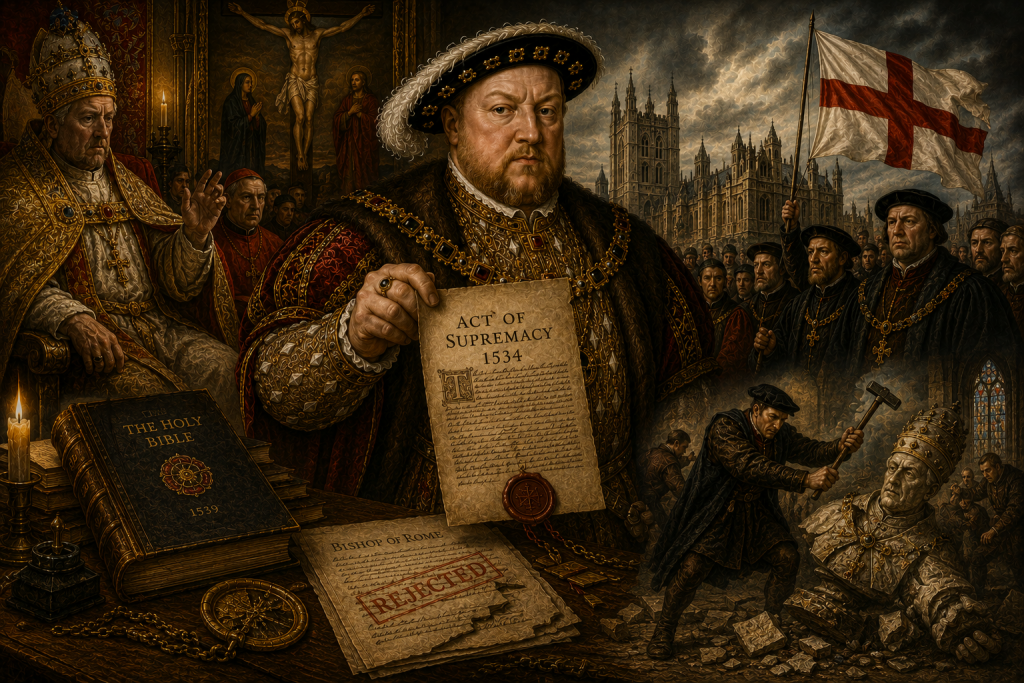
An artistic interpretation of Henry VIII and the English Reformation, depicting the break with Rome that transformed England’s religious and political landscape.
9 min read

“He did not set out, in any coherent theological sense, to become a reformer. He set out to solve a single, pressing problem — and solved it so thoroughly that he ended up rewriting the entire relationship between his kingdom and its God.”
Few events in English history carry consequences as sweeping, as permanent, and as thoroughly disproportionate to their immediate original cause as the English Reformation, the sequence of legal, political, and religious transformations through which Henry VIII severed the Church of England from nearly a millennium of papal authority. What began, in the late 1520s, as a comparatively narrow legal and theological question concerning the validity of Henry’s marriage to Catherine of Aragon expanded, across half a decade, into a wholesale reordering of English religious and political life, establishing the English monarch as supreme head of the church, dismantling centuries of institutional Catholic authority, and setting England permanently on a distinct religious trajectory from the wider Catholic Europe it had, until this point, remained thoroughly and unremarkably part of.
A Problem That Began as Purely Legal
The specific dynastic and personal circumstances driving Henry’s initial pursuit of an annulment belong to their own separate telling. What matters for understanding the Reformation’s broader institutional origins is the shape the resulting legal and diplomatic problem actually took once Henry determined, by the late 1520s, that his marriage required formal ecclesiastical dissolution. Henry pursued this objective initially through entirely conventional Catholic legal channels, seeking a formal annulment from Pope Clement VII on the grounds that his marriage had violated canon law from its very outset, a claim resting on biblical scriptural interpretation regarding marriage to a brother‘s widow that Henry and his advisers pressed with genuine theological seriousness rather than treating as a mere convenient pretext alone.
This pursuit, however, ran directly into a diplomatic obstacle considerably beyond Henry’s own control: Pope Clement VII found himself, throughout the critical years of this dispute, under the direct military and political influence of Holy Roman Emperor Charles V, who was, as it happened, Catherine of Aragon’s own nephew, giving the Emperor genuine personal and dynastic incentive to prevent any papal ruling that might publicly humiliate his aunt through formal annulment. Clement, caught between Henry’s persistent pressure and Charles’s own considerably more immediate and militarily consequential influence over papal affairs, spent years delaying, deferring, and ultimately declining to grant the annulment Henry sought, a diplomatic impasse that would prove, in retrospect, the single most consequential failure of papal diplomacy in the entire history of English Christianity.
A pope caught between an English king’s request and an emperor’s displeasure faced, in practical terms, no genuine choice at all — and that structural, entirely predictable diplomatic bind would eventually cost Rome an entire kingdom’s continued allegiance.
Cardinal Wolsey’s Failure and Fall
Cardinal Thomas Wolsey, Henry’s long-serving chief minister and the most powerful figure in English government beneath the king himself throughout the 1510s and much of the 1520s, bore primary responsibility for securing the papal annulment Henry demanded, a task for which Wolsey’s own considerable ecclesiastical standing and diplomatic experience made him the natural, obvious choice. Wolsey pursued this objective with genuine effort across several years, exploring various legal and diplomatic avenues in an attempt to navigate the impossible bind Clement’s own political circumstances had created, but ultimately proved unable to deliver the resolution Henry increasingly impatiently demanded.
This failure, however, was genuinely beyond Wolsey’s realistic capacity to overcome given the underlying diplomatic circumstances and ultimately proved fatal to his extraordinary career. Wolsey fell from royal favour in 1529, stripped of his most significant offices and political authority, and died in 1530 while travelling to face formal charges of treason, having failed, across years of genuine effort, to deliver the single outcome his king had come to regard as absolutely essential. Wolsey’s fall marked a genuinely significant turning point, removing from Henry’s service the one minister whose entire career and worldview remained fundamentally rooted within the existing structure of Catholic ecclesiastical authority, and opening space for considerably more radical advisers prepared to pursue solutions Wolsey himself, as a Cardinal of the Roman church, could likely never have countenanced.
Thomas Cromwell and the Machinery of Legal Revolution
Thomas Cromwell’s rise to become Henry’s principal minister across the early 1530s brought to royal service a figure whose approach to the annulment impasse proved considerably more radical, and ultimately considerably more consequential, than Wolsey’s own more conventionally ecclesiastical strategy had ever attempted. Rather than continuing to seek papal cooperation through existing Catholic legal and diplomatic channels, Cromwell pursued an entirely different solution: securing, through a systematic and remarkably rapid programme of parliamentary legislation, England’s complete legal and institutional independence from papal authority altogether, thereby removing the Pope from the equation of Henry’s marital dispute entirely, by removing the Pope from any meaningful authority over English religious affairs whatsoever.
This legislative programme, executed with striking speed and coherence across the early 1530s, produced a sequence of parliamentary acts that together constituted nothing less than a wholesale legal revolution in the relationship between English crown and church. The Act in Restraint of Appeals, passed in 1533, formally prohibited English subjects from appealing ecclesiastical legal matters to Rome, establishing instead that such matters would be resolved entirely within England’s own domestic ecclesiastical courts — a provision that, not coincidentally, allowed Thomas Cranmer, newly appointed as Archbishop of Canterbury, to formally rule on and grant Henry’s annulment through purely domestic English ecclesiastical authority, without any further need for papal involvement or approval whatsoever.
Where Wolsey had spent years trying to persuade Rome to grant what Henry wanted, Cromwell simply removed Rome from the process altogether — a considerably more radical solution, but one that proved, in practical terms, entirely and swiftly effective.
The Act of Supremacy: A New Head of the Church
The legislative culmination of this systematic transformation arrived with the Act of Supremacy in 1534, which formally declared Henry VIII to be the Supreme Head of the Church of England, establishing in explicit legal terms the complete severance of English ecclesiastical authority from papal jurisdiction that Cromwell’s earlier legislative programme had already substantially achieved in practice. This single piece of legislation represented a transformation of genuinely staggering institutional consequence, concentrating within the person of the reigning English monarch a combination of spiritual and temporal authority without meaningful precedent in English history, and severing, in formal legal terms, nearly a millennium of continuous English participation within the broader institutional structure of Western Catholic Christianity.
The Act of Supremacy did not, in its own immediate legal text, represent a wholesale doctrinal reformation in the manner of the more thoroughgoing theological transformations then unfolding across parts of continental Europe under figures such as Martin Luther and, somewhat later, John Calvin. Henry himself, throughout this period and for much of the remainder of his reign, maintained a genuinely complex and, by the standards of continental Protestant reformers, considerably conservative theological position, retaining a great many elements of traditional Catholic doctrine and liturgical practice even as he formally rejected papal authority altogether. The English Reformation, in its earliest Henrician phase, was thus more accurately understood as a jurisdictional and institutional revolution — a fundamental reordering of who held ultimate religious authority within England — than as an immediate, comprehensive doctrinal transformation of English religious belief and practice itself.
Resistance, and Its Costs
This sweeping transformation did not proceed entirely without resistance, and the specific individuals who refused to accept Henry’s new religious supremacy paid, in several cases, the most severe possible price for their principled refusal. Sir Thomas More, who had earlier served as Henry’s own Lord Chancellor with genuine distinction, refused to formally swear the required oath acknowledging Henry’s supremacy over the English church, a refusal rooted in More’s own deep and genuinely sincere Catholic conviction regarding the Pope’s rightful spiritual authority. More’s continued refusal, sustained despite considerable pressure and the clear, mounting danger it represented, ultimately resulted in his execution for treason in 1535, a death that shocked contemporary observers across Europe given More’s own considerable prior distinction and his personal closeness to Henry across many earlier years of loyal royal service.
John Fisher, Bishop of Rochester, met a strikingly similar fate in the same year, executed for his own comparable refusal to accept Henry’s religious supremacy, a further demonstration that the new order Henry and Cromwell had constructed would tolerate no meaningful principled dissent from figures whose continued public resistance might otherwise encourage broader institutional or popular opposition to the newly established royal supremacy.
A revolution conducted primarily through parliamentary statute rather than open warfare can still, when it encounters genuine principled resistance, prove every bit as lethal to those who refuse to bend before it.
The Dissolution of the Monasteries
The institutional transformation set in motion by the break with Rome extended, across the remaining years of the 1530s, into a further, enormously consequential development: the systematic dissolution of England’s monasteries between 1536 and 1541, a process through which the crown, working through Cromwell’s own remarkably efficient administrative machinery, dismantled centuries of English monastic institutional life, transferring the very considerable landholdings and accumulated wealth these institutions had gathered over centuries into royal hands, and subsequently, in large measure, into the hands of secular purchasers and grantees across the English nobility and emerging gentry classes.
This process represented both a genuinely significant additional source of royal revenue during a period of considerable ongoing crown financial pressure, and a further, physically visible transformation of the English landscape and religious life, as monastic buildings across the kingdom were dismantled, repurposed, or abandoned entirely, permanently altering both the physical built environment and the underlying social and charitable infrastructure that these institutions had, for centuries, provided to English communities.
A Transformation That Outlasted Its Original Cause
What makes the English Reformation such a genuinely striking historical episode, considered as a whole, is the sheer disproportion between its immediate originating cause — a single king’s pursuit of marital annulment, a question of dynastic and personal urgency rather than any deeply considered theological programme — and the permanent, civilisation-shaping consequences that pursuit ultimately produced. Henry VIII did not begin the 1520s as any kind of religious reformer; he began that decade as a genuinely conventional, theologically conservative Catholic monarch, formally honoured by the Pope himself as Defender of the Faith for his own earlier defence of Catholic orthodoxy against Luther’s continental challenge. And yet the specific, narrow legal impasse he encountered in pursuing his own personal and dynastic objectives ultimately drove him, working through ministers considerably more radical in their institutional thinking than Henry’s own initial instincts might have independently produced, toward a transformation that permanently and irreversibly altered England’s religious identity, its political structure, and its relationship to the wider institutional framework of Western Christianity.
He wanted, at the outset, a single specific legal outcome. What he built instead, almost as an unintended by-product of pursuing it, was an entirely new religious and political order for the whole of his kingdom — one that would outlast him, reshape his own children’s turbulent successive reigns, and define English religious identity for centuries to come.
Timeline: The Break with Rome
- Late 1520s — Henry begins formally pursuing a papal annulment of his marriage, encountering sustained diplomatic obstruction rooted in Emperor Charles V’s influence over Pope Clement VII.
- 1529 — Cardinal Thomas Wolsey falls from power, having failed to secure the annulment Henry demanded.
- Early 1530s — Thomas Cromwell rises to become Henry’s principal minister, pursuing a considerably more radical legislative strategy.
- 1533 — The Act in Restraint of Appeals ends English ecclesiastical appeals to Rome, allowing Thomas Cranmer to resolve Henry’s annulment through domestic English authority alone.
- 1534 — The Act of Supremacy formally establishes Henry VIII as Supreme Head of the Church of England.
- 1535 — Sir Thomas More and Bishop John Fisher are executed for refusing to accept Henry’s new religious supremacy.
- 1536–1541 — The systematic dissolution of England’s monasteries transfers vast monastic wealth and landholdings into royal and subsequently private secular hands.
- 1547 — Henry VIII dies, leaving behind a permanently transformed English religious and political order for his successors to navigate.
author's note
The machinery of the break with Rome, Wolsey’s failure, Cromwell’s rise, is a piece of English history I have returned to many times over the years, and it forms the genuine historical backdrop against which my character Sebastian is drawn into increasingly dangerous court politics in Related to Dracula. Sebastian is appointed by Cardinal Wolsey himself to investigate a series of mysterious murders in London, work that places him directly inside the same corridors where England’s religious future was being quietly, urgently decided. Writing Wolsey as a character required understanding him as considerably more than the failed minister history remembers, an understanding built on a great deal of reading long before I ever attempted to write him as fiction, and it shaped how I wanted his final years of influence to feel on the page: weighted, watchful, and running out of time.
sources and further reading
- MacCulloch, Diarmaid. Thomas Cromwell: A Life. Allen Lane, 2018 — the definitive modern account of Cromwell’s role in engineering the break with Rome.
- Elton, G. R. Reform and Reformation: England, 1509–1558. Harvard University Press, 1977 — the foundational scholarly study of the institutional and legal mechanics of the Reformation.
- Bernard, G. W. The King’s Reformation: Henry VIII and the Remaking of the English Church. Yale University Press, 2005.
- Marius, Richard. Thomas More: A Biography. Alfred A. Knopf, 1984 — detailed treatment of More’s resistance and execution.
- MacCulloch, Diarmaid. Thomas Cranmer: A Life. Yale University Press, 1996.
- Duffy, Eamon. The Stripping of the Altars: Traditional Religion in England, 1400–1580. Yale University Press, 1992 — essential for understanding the wider religious and cultural impact of the break with Rome on ordinary English life.
A note on sources: historians continue to debate the precise weighting of personal, political, and genuinely theological motivation behind Henry’s break with Rome, and the sources listed above represent differing, though broadly complementary, scholarly perspectives on this question. This article has focused specifically on the institutional and legislative mechanics of the break, reserving the fuller personal and dynastic context for its own separate telling.
related articles
- Henry VIII: The King Who Changed England
- The Spare Prince: Henry VIII’s Childhood Before He Was Ever Meant to Wear the Crown
- The King’s Choice: Henry VIII’s Accession and the Courtship of Catherine of Aragon
- Henry VIII’s First Queen: Catherine of Aragon, the Forgotten Queen
- The Six Wives of Henry VIII: Marriage, Power and the Making of Tudor England
- Henry VIII: King, Reformer or Tyrant?
- Tudor England: The Dynasty That Transformed a Kingdom
- Henry VII: The King Who Founded the Tudor Dynasty
- The Wars of the Roses: The Conflict That Created the Tudors
- How Henry VIII Fell in Love With Anne Boleyn: The Courtship That Changed England
continue your journey through history
Discover the novels inspired by the people, rivalries and legends of medieval Europe.

Historical Fiction Author
History has always fascinated me—not simply for the great battles or famous rulers, but for the people behind the legends. Through years of research into medieval Europe, the Ottoman Empire, Tudor England, and the lives of extraordinary historical figures, I’ve sought to uncover the stories that lie beneath popular myths. My novels blend documented history with compelling fiction, inviting readers to step into the past and experience it as those who lived it might have done.
Join the Related to Dracula Circle