
HISTORY · ANNE BOLEYN
The Early Life of Anne Boleyn: The Making of England’s Most Controversial Queen
Before the Crown, Before the King — a Kentish Childhood and a Continental Education
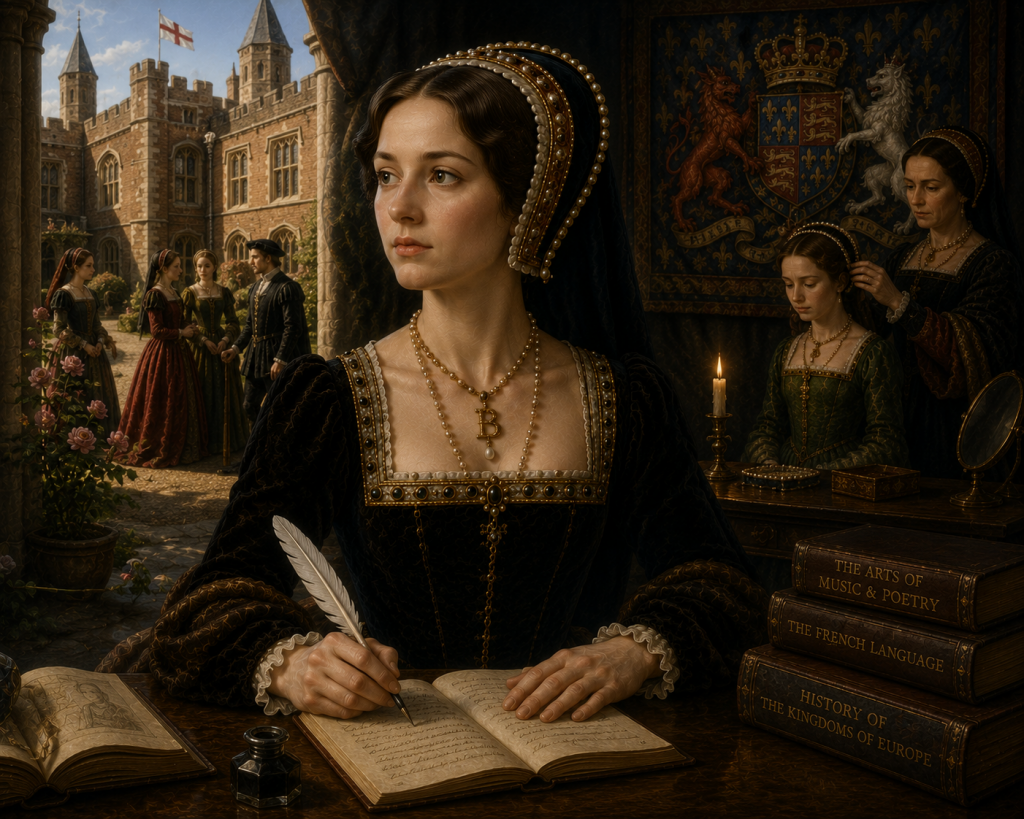
Artistic depiction of Anne Boleyn during her early life.
8 min read

“No child raised at Hever Castle could have imagined the shape her adult life would eventually take. What that Kentish upbringing did provide, quietly and unglamorously, were the specific ingredients — ambition, education, and a family fluent in the mechanics of court advancement — from which everything that followed would eventually be built.”
Long before Anne Boleyn became the queen whose fate reshaped English religious history, she was simply a daughter of the English gentry, raised within a family whose own ambitions and connections would, across the following two decades, prove considerably more consequential to her eventual path than anything resembling ordinary childhood destiny might have suggested. Understanding Anne’s own formation, the specific family environment, education, and continental experience that shaped her before Henry VIII ever entered her story, offers something the more familiar, dramatic narrative of her queenship and downfall often leaves comparatively unexamined: a clear-eyed account of exactly how a comparatively modest English gentry family produced a daughter equipped, by the time of her return to England in her early twenties, with the intellectual sophistication, court fluency, and personal confidence that would eventually place her at the very centre of English history.
A Family Already Skilled at Court Advancement
Anne was born into the Boleyn family between 1501 and 1507, most likely at the family’s principal seat, Hever Castle, in Kent, though even this basic biographical detail remains subject to ongoing scholarly uncertainty given the comparatively modest documentary attention paid to gentry daughters of the period. Her father, Sir Thomas Boleyn, represented a family already engaged in a genuinely sustained, multi-generational project of court advancement, having inherited both Hever Castle and a considerable fortune through his own father’s earlier successful mercantile and civic career in London, wealth that Thomas himself worked steadily to convert into genuine court influence and royal service across his own adult career.
Thomas Boleyn’s own advancement rested substantially on his considerable linguistic ability, diplomatic skill, and evident personal charm, qualities that secured him a series of increasingly significant diplomatic postings and court appointments under Henry VII and, subsequently, the young Henry VIII, including extended diplomatic service in France that would prove directly, practically relevant to his own daughter’s later continental education. Anne’s mother, Elizabeth Howard, connected the family further still to genuinely significant aristocratic standing, being herself the daughter of Thomas Howard, second Duke of Norfolk, one of the most powerful noble titles in the entire English peerage, providing Anne, through her mother’s line, with genuine aristocratic connection considerably beyond what her father’s own more recently established gentry standing alone might have provided.
A family that had already learned, across two generations, precisely how court advancement actually worked was unusually well positioned to prepare a daughter for exactly the kind of sophisticated court environment she would eventually be sent to inhabit.
Siblings, and a Household Built Around Advancement
Anne grew up alongside two siblings who survived into adulthood, her elder sister Mary and her brother George, both of whom would themselves go on to play genuinely significant roles within the broader Boleyn family’s court advancement, and both of whom remained closely, consequentially connected to Anne’s own later fortunes at court. Mary Boleyn’s own earlier romantic involvement with Henry VIII, preceding Anne’s own relationship with the king by several years, meant that Anne’s eventual rise unfolded within a family already directly, personally familiar with the specific dynamics of royal romantic attention, an experience that likely shaped, in ways difficult to document precisely but reasonable to infer, Anne’s own later, markedly more cautious and strategically deliberate approach to managing Henry’s own subsequent interest in her.
George Boleyn, meanwhile, pursued his own successful court career across the 1520s and early 1530s, rising to genuine prominence and diplomatic significance in parallel with his sister’s own ascending fortunes, a family pattern of coordinated advancement that would, within less than a decade, prove every bit as consequential to George’s own eventual fate as it had been to his earlier successes. However, the specific circumstances of that later shared downfall belong to their own separate telling.
The Boleyn household was never simply a family in the ordinary domestic sense alone. It functioned, across an entire generation, as a coordinated project of mutual advancement — and Anne, from her earliest years, grew up understanding precisely how that project actually worked.
Sent Abroad: The Court of Margaret of Austria
Anne’s own distinctive formation began in earnest around 1513, when her father’s diplomatic connections secured her a genuinely prestigious position within the household of Margaret of Austria, the Habsburg regent of the Netherlands, whose own court in Mechelen represented one of the more sophisticated and intellectually engaged princely courts then operating anywhere in Northern Europe. This placement, achieved through Thomas Boleyn’s own direct diplomatic relationship with Margaret, offered the young Anne, likely still no older than twelve at the time, an extraordinary early education in courtly manner, continental language, and the broader intellectual and cultural currents then circulating through one of Europe’s genuinely most refined princely households.
Margaret of Austria’s own court placed considerable emphasis on genuine education for the young women within her care, extending well beyond the more superficial ornamental accomplishments often considered sufficient for gentry and noble daughters elsewhere in Europe during this period. Anne’s own surviving early correspondence from this period, however limited, suggests a young girl genuinely engaged with and appreciative of the intellectual opportunities this placement provided, offering an early, formative demonstration of the genuine intellectual seriousness that would characterise her adult character considerably more consistently than mere conventional courtly accomplishment alone.
The French Court: Formation Under Queen Claude
Anne’s continental education deepened considerably further when she moved, around 1514, into French royal service, initially accompanying Henry VIII’s own sister, Mary Tudor, to France following Mary’s marriage to the ageing French King Louis XII, before remaining in France following Louis’s own death shortly afterwards and Mary’s subsequent return to England. Rather than returning to England alongside Mary, Anne remained at the French court, entering the household of Queen Claude, wife of the new French king Francis I, a position she would hold for a genuinely extended period stretching across roughly the following seven years, providing her with an unusually prolonged and thorough immersion in French language, culture, and court life considerably beyond what most of her English gentry contemporaries would ever experience firsthand.
This extended French residence exposed Anne directly to the sophisticated cultural and intellectual environment of the French Renaissance court, including early exposure to the reformist religious and humanist intellectual currents then circulating through French court circles, exposure that several historians credit as genuinely formative in shaping the sustained religious seriousness that would characterise Anne’s own later adult engagement with reformist ideas. Anne’s fluency in French, her evident comfort with sophisticated court conversation and intellectual discussion, and her generally cosmopolitan sensibility, all qualities contemporary English observers would later remark upon so consistently following her eventual return to England, trace directly back to these formative years spent within one of Renaissance Europe’s genuinely most cultured royal households.
Seven years is a considerable stretch of any young life to spend immersed within a single foreign court’s language, manner, and intellectual culture — and the young woman who eventually returned to England bore the unmistakable, lasting marks of exactly that prolonged immersion.
A Return to a Considerably Less Sophisticated English Court
Anne’s return to England around 1521 arrived amid rising diplomatic tension between England and France, circumstances that made her continued French court service increasingly impractical regardless of her own personal preference. It brought her back into an English court environment that, however genuinely accomplished and cosmopolitan by contemporary English standards, offered considerably less sustained intellectual and cultural sophistication than the French royal household she had spent the better part of a decade inhabiting. Contemporary accounts consistently describe the returning Anne as possessing a distinctly French polish, sophistication, and confident conversational manner that set her immediately, visibly apart from many of her English court contemporaries. Several historians suggest this impression reflects genuine cultural distinction rather than mere flattering later retrospective embellishment alone.
This immediate, visible distinctiveness proved, across the following several years, genuinely significant to Anne’s own developing court reputation and eventual prominence, establishing her, well before Henry VIII’s own romantic attention began developing, as a genuinely notable and distinctive figure within English court circles, admired for qualities of wit, intellectual engagement, and cosmopolitan sophistication that her prolonged continental formation had specifically, deliberately cultivated.
A Formation Built for Consequence, Long Before Anyone Could Have Predicted It
Considered as a whole, Anne’s early life reveals a formation genuinely unusual among her English gentry contemporaries, shaped by a family already well practised in the mechanics of court advancement, an extraordinarily prolonged and sophisticated continental education spanning nearly a decade across two of Renaissance Europe’s genuinely most accomplished princely courts, and a resulting personal confidence, intellectual seriousness, and cosmopolitan sensibility that distinguished her immediately upon her return to an English court considerably less prepared, in comparative cultural terms, for a young woman of her particular formation. None of this, considered on its own terms during Anne’s own childhood and adolescence, could reasonably have predicted the specific, extraordinary trajectory her adult life would eventually take. But it produced, by the time of her return to England in her early twenties, precisely the combination of qualities, education, family ambition, and personal confidence that would, within less than a decade, place her at the very centre of one of the most consequential transformations in the whole of English history.
She was not born to become a queen. She was, however, raised with unusual care into precisely the kind of formidable, sophisticated young woman capable of eventually becoming one — a distinction worth holding onto carefully, given how thoroughly later legend has tended to collapse the two into a single, inevitable destiny.
Timeline: Anne Boleyn’s Early Life
- c. 1501–1507 — Anne Boleyn is born, most likely at Hever Castle in Kent, to Sir Thomas Boleyn and Elizabeth Howard.
- Early 1500s–1510s — Anne grows up alongside her siblings Mary and George within a family actively engaged in coordinated court advancement.
- c. 1513 — Anne is sent to the court of Margaret of Austria in the Netherlands, securing an early, prestigious continental education.
- 1514 — Anne accompanies Mary Tudor to France following Mary’s marriage to King Louis XII.
- 1514–1521 — Following Louis XII’s death, Anne remains in France, entering the household of Queen Claude, wife of King Francis I, for an extended period of continental formation.
- c. 1521 — Anne returns to England amid rising Anglo-French diplomatic tension, bringing distinctive continental sophistication to the English court.
- Early–mid 1520s — Anne establishes herself as a genuinely notable figure within English court circles, well before Henry VIII’s own romantic attention begins developing.
author's note
I have been fascinated by Anne Boleyn since I was a child, long before I ever imagined writing a novel that would put her on the page myself, and researching her early life properly felt like returning to a story I have been quietly carrying for years. That childhood fascination is exactly what I drew on when I finally came to write her introduction in Related to Dracula: At Tudor Court. When Sebastian first meets her, he notices her strong French accent, her sophistication, the particular grace that sets her apart from other women at court, all details rooted in this same continental formation, at the courts of Margaret of Austria and then Queen Claude of France, that I had been fascinated by long before I ever wrote a word of fiction. Knowing the fuller, considerably deeper history behind that polish, the deliberate family strategy of advancement, the years spent absorbing an entirely different court’s language and manner, gave me far more confidence writing Anne as a fully formed person rather than simply the king’s eventual love interest.
sources and further reading
- Ives, Eric. The Life and Death of Anne Boleyn. Blackwell Publishing, 2004 — includes the most detailed available scholarly reconstruction of Anne’s continental education.
- Warnicke, Retha M. The Rise and Fall of Anne Boleyn: Family Politics at the Court of Henry VIII. Cambridge University Press, 1989 — particularly valuable for its detailed treatment of Boleyn family strategy and advancement.
- Bordo, Susan. The Creation of Anne Boleyn: A New Look at England’s Most Notorious Queen. Houghton Mifflin Harcourt, 2013.
- Weir, Alison. Mary Boleyn: The Mistress of Kings. Jonathan Cape, 2011 — useful for understanding the broader Boleyn family context, including Mary’s own earlier court experience.
- Fraser, Antonia. The Wives of Henry VIII. Weidenfeld & Nicolson, 1992.
- Knecht, R. J. Renaissance Warrior and Patron: The Reign of Francis I. Cambridge University Press, 1994 — useful background on the French court environment in which Anne spent her formative years.
A note on sources: the precise year of Anne’s birth and several specific details of her earliest childhood remain subject to genuine scholarly debate, given the limited documentary attention typically afforded to gentry daughters of the period before their later prominence. This article has followed the dating and interpretation most widely supported across the modern biographical scholarship listed above.
related articles
- Anne Boleyn: The Woman Who Changed the Fate of a Kingdom
- How Henry VIII Fell in Love With Anne Boleyn: The Courtship That Changed England
- The Real Anne Boleyn: Separating the Queen From the Myth
- The Case Against Anne Boleyn: Guilty, Innocent, or Simply Inconvenient?
- The English Reformation: Henry VIII and the Break with Rome
- The Six Wives of Henry VIII: Marriage, Power and the Making of Tudor England
- Henry VIII: King, Reformer or Tyrant?
- Tudor England: The Dynasty That Transformed a Kingdom
continue your journey through history
Discover the novels inspired by the people, rivalries and legends of medieval Europe.

Historical Fiction Author
History has always fascinated me—not simply for the great battles or famous rulers, but for the people behind the legends. Through years of research into medieval Europe, the Ottoman Empire, Tudor England, and the lives of extraordinary historical figures, I’ve sought to uncover the stories that lie beneath popular myths. My novels blend documented history with compelling fiction, inviting readers to step into the past and experience it as those who lived it might have done.
Join the Related to Dracula Circle