
HISTORY · ANNE BOLEYN
The Case Against Anne Boleyn: Guilty, Innocent, or Simply Inconvenient?
Weighing the Evidence Behind One of the Most Consequential Trials in English History
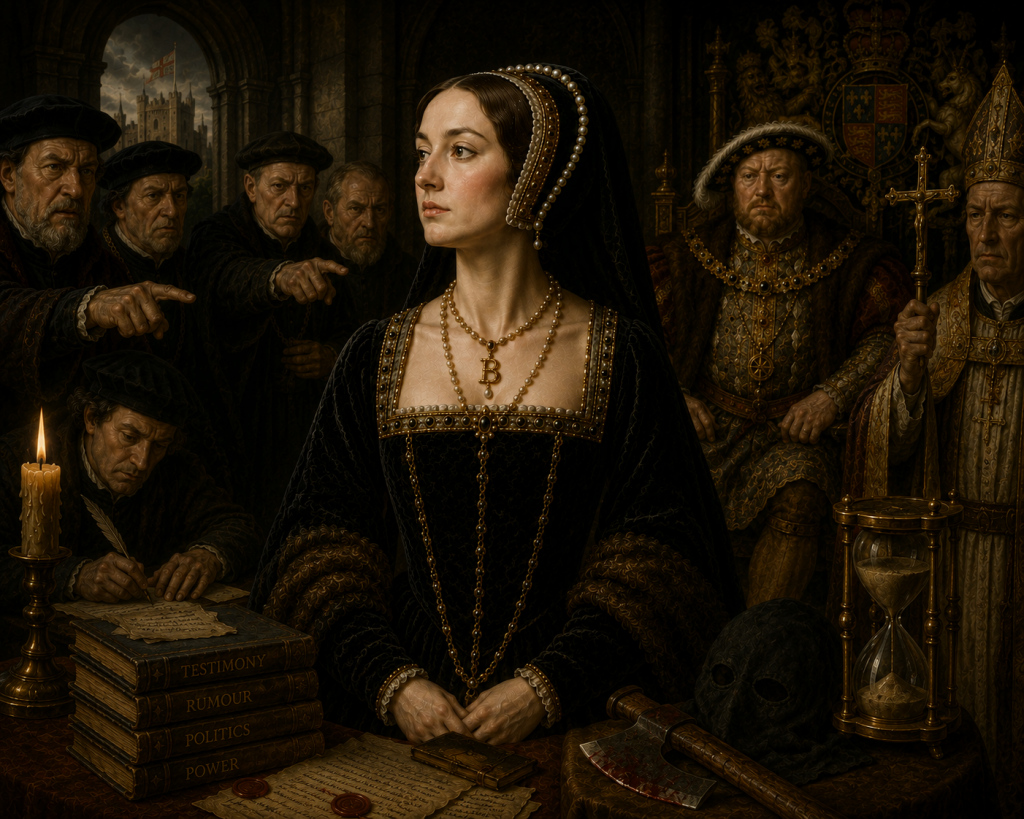
Artistic depiction of Anne Boleyn during the final days of her trial.
9 min read

“A queen was tried, convicted, and beheaded within the space of roughly three weeks, on charges spanning adultery with five separate men, incest with her own brother, and treasonous conspiracy against the king’s own life. The evidence supporting these charges has not grown any more convincing with five centuries of hindsight — if anything, it has grown considerably less so.”
Few trials in English history reveal, upon careful examination, quite so stark a gap between the severity of the verdict rendered and the genuine thinness of the evidence actually presented as the trial that ended Anne Boleyn‘s life in May 1536. Anne stood accused of adultery with five separate men, including a charge of incestuous relations with her own brother George, alongside charges of treasonous conspiracy against Henry VIII‘s own life, accusations of such sweeping severity that, if genuinely true, would represent behaviour of quite extraordinary and sustained recklessness for a reigning queen fully aware of the mortal danger any single such transgression alone would represent. Weighing this case fairly, on the evidence actually presented at the time and the considerably fuller documentary and contextual record modern historians have since assembled, requires setting aside both the reflexive assumption of guilt that Anne’s own execution might seem, on its face, to imply, and the equally reflexive assumption that any queen tried under an increasingly tyrannical husband must therefore automatically have been entirely innocent. The genuine historical record, examined carefully, points considerably more decisively toward one of these conclusions than the other — but arriving at that conclusion responsibly requires examining the actual charges, the actual evidence, and the actual political context in which the entire proceeding unfolded.
The Charges, Considered Individually
The formal charges brought against Anne in the spring of 1536 accused her of adultery with five specific men: court musician Mark Smeaton, courtiers Henry Norris, William Brereton, and Francis Weston, and, most severely, her own brother George Boleyn, alongside a further charge alleging that Anne had conspired with several of these same men to bring about Henry’s own death, a charge of treason carrying, if proven, an unambiguous sentence of execution. The specific alleged incidents named dates and locations across a period spanning several years, details that, examined closely by later historians with access to court itineraries and additional supporting documentation unavailable to the original trial’s own hurried proceedings, have in several instances been demonstrated to be genuinely impossible, with Anne documented as having been in an entirely different location, often with Henry himself, on several of the specific dates named in the formal charges.
This kind of demonstrable factual error within the charges themselves represents considerably more than a minor procedural inconsistency; it suggests, at minimum, a prosecution constructed with genuine carelessness regarding basic factual verification, and, considered alongside the broader pattern of evidence examined below, points toward a prosecution assembled primarily to secure a predetermined outcome rather than one built through careful, methodical investigation of genuine underlying wrongdoing.
A prosecution that cannot even reliably place the accused in the correct location on the dates of her alleged crimes has, at minimum, failed to meet even the most basic standard of careful factual construction — whatever verdict such a prosecution ultimately produces.
The Quality of the Evidence Actually Presented
The evidence supporting these charges, examined by modern historians with access to considerably fuller surviving documentation than was available at the time, proves genuinely thin across virtually every specific accusation. The most direct evidence came from Mark Smeaton, the court musician, who confessed to a sexual relationship with Anne following interrogation that several historians strongly suspect involved torture or, at minimum, considerable coercive pressure, given that Smeaton’s confession stands as the only direct admission of guilt among all five men accused, with Henry Norris, William Brereton, Francis Weston, and George Boleyn all maintaining their innocence throughout the proceedings against them, even facing their own executions.
No other substantive direct evidence beyond Smeaton’s own contested confession was presented supporting the specific adultery charges, with the prosecution relying instead considerably more heavily on circumstantial court gossip, politically motivated testimony from individuals with their own documented grievances against Anne, and inference drawn from ordinary, entirely conventional courtly behaviour, including customary flirtatious conversation and physical proximity considered entirely unremarkable within the established conventions of Renaissance court culture, but which the prosecution chose to characterise, in this particular instance, as evidence of genuine sexual impropriety.
A single contested confession, obtained under circumstances several historians regard as coercive, standing largely alone against the sustained denials of four other men facing their own executions, represents a genuinely fragile foundation on which to convict a reigning queen of treason.
Who Benefited From Anne’s Downfall
Understanding why such a thinly evidenced prosecution nonetheless proceeded to rapid conviction and execution requires examining the broader political context surrounding Anne’s fall, particularly the considerable interests several powerful figures held in securing precisely this outcome. By early 1536, Henry’s own attention had already begun shifting toward Jane Seymour. This shift created genuine royal motivation for resolving the increasingly strained marriage to Anne through whatever legal mechanism might prove available, particularly given that Anne, like Catherine of Aragon before her, had not yet produced the surviving male heir Henry’s own dynastic anxiety continued to demand.
Thomas Cromwell held his own genuine, well-documented political motivation for orchestrating Anne’s downfall, having developed significant policy disagreements with Anne regarding the disposition of revenue generated through the ongoing dissolution of the monasteries, disagreements that placed Cromwell’s own considerable political position at genuine risk should Anne’s own influence over Henry continue growing rather than diminishing. Several historians, examining Cromwell’s own later private statements regarding his role in the affair, have concluded that Cromwell actively and deliberately constructed the case against Anne, recognising in Henry’s own shifting personal interest an opportunity to eliminate a genuine political rival through legal mechanisms he himself was uniquely positioned to orchestrate.
A prosecution assembled by a minister with his own documented political grievance against the accused, presented before a king already personally motivated to secure precisely the guilty verdict ultimately delivered, does not, on its own, prove the charges false — but it provides considerable reason for genuine historical scepticism regarding how fairly those charges were actually weighed.
The Speed of the Proceedings
The trial itself proceeded with a speed genuinely difficult to reconcile with the gravity and complexity of the charges involved. Anne was arrested on 2 May 1536, tried on 15 May, convicted the same day, and executed on 19 May, a total span of barely seventeen days from arrest to death, encompassing not merely Anne’s own trial but the separate trials and executions of the four men convicted alongside her. This extraordinary speed, considered against the sheer number and severity of the specific charges involved, several spanning alleged incidents across multiple years and requiring, in principle, careful investigation and evidence-gathering, suggests strongly that the proceedings functioned considerably more as formal ratification of an already predetermined outcome than as genuine, open judicial investigation into contested factual questions.
Anne herself, according to surviving accounts of her own conduct throughout the trial, maintained her innocence with evident composure and dignity. She offered a defence that several observers present at the proceedings, even those without particular personal sympathy for Anne, reportedly found considerably more persuasive and coherent than the prosecution’s own case against her. This observation, whatever its own inherent limitations as evidence, further supports the broader pattern of a prosecution considerably weaker in genuine substance than its ultimate severe outcome might otherwise suggest.
The Modern Historical Consensus
Weighing this accumulated evidence, modern historians examining Anne’s trial overwhelmingly conclude that the charges against her were substantially, if not entirely, fabricated, constructed to serve the combined political interests of a king eager to remarry and a minister eager to eliminate a genuine rival, rather than reflecting credible evidence of the extensive, reckless misconduct the formal charges alleged. This does not necessarily require concluding that every single element of the prosecution’s case was consciously invented from nothing; some historians have suggested that ordinary courtly flirtation and conventional Renaissance court behaviour, genuinely misinterpreted or deliberately recast through hostile political framing, may have provided at least some superficial factual basis for a prosecution otherwise constructed considerably more through political motivation than genuine underlying evidence of the specific crimes formally charged.
The most historically responsible conclusion is not that Anne was proven guilty, nor even that she was proven innocent in the strict legal sense a modern court might require, but that the prosecution brought against her fails, by any reasonable historical standard of evidentiary scrutiny, to substantiate the severe charges on which she was ultimately convicted and executed.
A Verdict Weighed, Rather Than Simply Accepted
Considering the demonstrable factual errors within the specific charges, the genuine thinness and likely coercive origin of the primary supporting evidence, the clear and well-documented political motivations held by both Henry and Cromwell in securing precisely this outcome, and the extraordinary speed with which the entire proceeding unfolded from arrest to execution, the historically responsible verdict on Anne Boleyn’s guilt points considerably more decisively towards innocence. Or at minimum, towards a prosecution too fundamentally compromised by political motivation and evidentiary weakness to be treated as any reliable indicator of genuine underlying guilt, than toward straightforward acceptance of the charges as originally presented. Anne Boleyn was, by the most careful modern historical assessment available, very likely the victim of a prosecution constructed to serve purposes considerably removed from genuine justice, rather than a queen whose own documented conduct actually justified the severe fate ultimately imposed upon her.
Timeline: The Trial and Its Context
- Late 1535–early 1536 — Henry’s romantic attention begins shifting toward Jane Seymour, while Anne’s political relationship with Thomas Cromwell deteriorates over policy disagreements.
- 29 January 1536 — Anne suffers a miscarriage, further straining her marriage and her position at court.
- 24 April 1536 — A commission of inquiry is established to investigate alleged treason, providing the formal legal mechanism for the proceedings that follow.
- 30 April 1536 — Mark Smeaton is arrested and subsequently confesses to a sexual relationship with Anne.
- 2 May 1536 — Anne is arrested and taken to the Tower of London.
- 12 May 1536 — Henry Norris, William Brereton, Francis Weston, and Mark Smeaton are tried and convicted.
- 15 May 1536 — Anne and George Boleyn are tried and convicted.
- 17 May 1536 — George Boleyn and the other convicted men are executed.
- 19 May 1536 — Anne Boleyn is executed at the Tower of London.
author's note
Weighing the evidence against Anne this carefully is something I have done, in one form or another, ever since I first read about her trial as a much younger reader, and it has been essential background for Related to Dracula, even though my own novels close before her downfall unfolds in full. Knowing just how thin and politically motivated the actual prosecution against her was, rather than accepting the popular assumption of guilt, shaped how I wanted Sebastian’s own loyalty to her to feel throughout the story: genuine, clear-sighted, and never naive about the danger surrounding her. I found myself wanting this piece to exist as a kind of historical record standing behind my books, for any reader who finishes Sebastian’s story and wants to understand exactly how precarious Anne’s position at court genuinely was, even in these earlier, more hopeful years.
sources and further reading
- Ives, Eric. The Life and Death of Anne Boleyn. Blackwell Publishing, 2004 — includes the most detailed available scholarly analysis of the trial’s evidentiary weaknesses.
- Weir, Alison. The Lady in the Tower: The Fall of Anne Boleyn. Jonathan Cape, 2009 — a dedicated, detailed study of the final months and the trial itself.
- Warnicke, Retha M. The Rise and Fall of Anne Boleyn: Family Politics at the Court of Henry VIII. Cambridge University Press, 1989.
- Bernard, G. W. Anne Boleyn: Fatal Attractions. Yale University Press, 2010 — offers a notably more dissenting scholarly perspective, worth reading alongside the more common consensus view.
- MacCulloch, Diarmaid. Thomas Cromwell: A Life. Allen Lane, 2018 — essential for understanding Cromwell’s own documented role and motivations.
- Bordo, Susan. The Creation of Anne Boleyn: A New Look at England’s Most Notorious Queen. Houghton Mifflin Harcourt, 2013.
A note on sources: while the overwhelming modern scholarly consensus, reflected in Ives, Weir, and Warnicke, concludes that the charges against Anne were substantially fabricated, G. W. Bernard’s own scholarship offers a genuinely more sympathetic reading of the prosecution’s underlying case, and deserves acknowledgement as a dissenting perspective rather than being dismissed. This article has weighed the broader consensus most heavily, while noting that even sceptical readings of Bernard’s argument stop well short of establishing Anne’s guilt with any real historical confidence.
related articles
- Anne Boleyn: The Woman Who Changed the Fate of a Kingdom
- The Early Life of Anne Boleyn: The Making of England’s Most Controversial Queen
- How Henry VIII Fell in Love With Anne Boleyn: The Courtship That Changed England
- The Real Anne Boleyn: Separating the Queen From the Myth
- The English Reformation: Henry VIII and the Break with Rome
- The Six Wives of Henry VIII: Marriage, Power and the Making of Tudor England
- Henry VIII: King, Reformer or Tyrant?
- Tudor England: The Dynasty That Transformed a Kingdom
continue your journey through history
Discover the novels inspired by the people, rivalries and legends of medieval Europe.

Historical Fiction Author
History has always fascinated me—not simply for the great battles or famous rulers, but for the people behind the legends. Through years of research into medieval Europe, the Ottoman Empire, Tudor England, and the lives of extraordinary historical figures, I’ve sought to uncover the stories that lie beneath popular myths. My novels blend documented history with compelling fiction, inviting readers to step into the past and experience it as those who lived it might have done.
Join the Related to Dracula Circle