
HISTORY · ANNE BOLEYN
Anne Boleyn: The Woman Who Changed the Fate of a Kingdom
How a Courtier’s Daughter Became the Catalyst for England’s Break With Rome
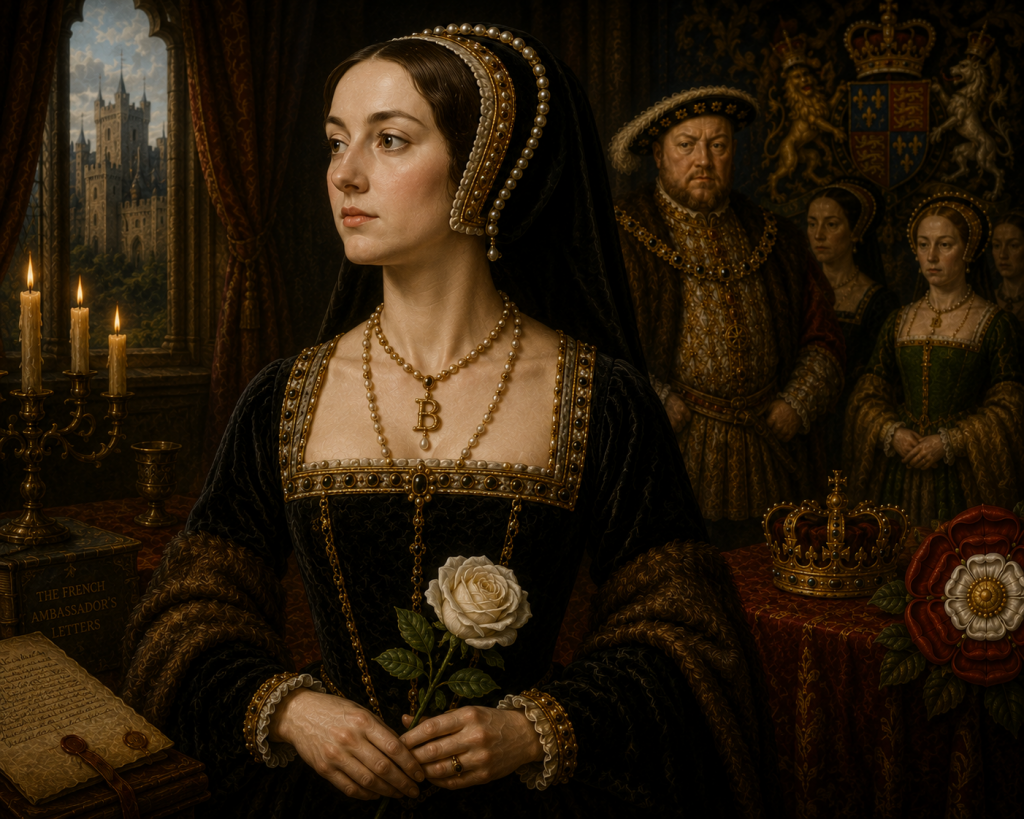
An artistic interpretation of Anne Boleyn, the second wife of Henry VIII
9 min read

“History rarely allows a single woman to be remembered simply as herself. Anne Boleyn has been remembered, across five centuries, as a seductress, a schemer, a martyr, and a victim — everything, it seems, except the genuinely capable, intelligent, and consequential figure the surviving evidence actually describes.”
Few women in English history have been so thoroughly claimed by legend, so persistently reduced to a single dramatic function within someone else’s story, as Anne Boleyn. She appears, in much popular memory, primarily as an instrument: the woman who supposedly “stole” a king from his rightful queen, the ambitious upstart whose rise precipitated England’s break with Rome, the doomed second wife whose swift fall from favour ended in execution on charges whose truth remains, even now, genuinely contested among historians. Each of these framings contains a fragment of something real. Each of them, examined in isolation, badly distorts the fuller, considerably more interesting woman the surviving historical record actually reveals: a genuinely educated, intellectually formidable, politically engaged figure whose brief tenure as Henry VIII’s second queen coincided with, and helped precipitate, one of the single most consequential religious and institutional transformations in the whole of English history. Understanding Anne on her own terms, rather than merely as a supporting figure within Henry’s own dramatic story, requires beginning where any fair biographical account must begin: with the woman herself, her formation, and the genuine qualities that first drew Henry’s attention and, eventually, his conviction that she alone could resolve the dynastic crisis that had come to dominate his reign.
A Daughter Shaped by Continental Sophistication
Anne Boleyn was born into a family of genuine, if not the very highest, English gentry standing, the daughter of Sir Thomas Boleyn, an ambitious and diplomatically accomplished courtier whose own considerable talents secured him a series of increasingly prominent positions within Henry VIII‘s early court. The precise year of Anne’s birth remains, even now, a matter of some scholarly uncertainty, with historians generally placing it somewhere between 1501 and 1507, a genuine gap in the documentary record that itself illustrates how comparatively modest Anne’s own family standing was at the time of her birth, well before her own later prominence made such basic biographical details a matter of more careful contemporary record-keeping.
What distinguished Anne’s own upbringing most significantly from that of many of her English gentry contemporaries was the genuinely unusual continental education she received during her adolescent years, spent first at the court of the Habsburg regent Margaret of Austria in the Low Countries, and subsequently, for a considerably longer and more formative period, at the French royal court, where she served within the household of Queen Claude, wife of King Francis I. This extended continental education exposed Anne, across several formative years, to French language, culture, and the sophisticated intellectual and religious currents then circulating through the French court, including early exposure to the reformist religious thinking that would, in later years, shape her own genuine, sustained interest in religious reform considerably more substantively than mere court fashion alone might otherwise explain.
A gentry daughter sent abroad for polish returned instead considerably more than merely polished — she returned fluent, cosmopolitan, and equipped with an intellectual formation that set her apart from a great many of her English contemporaries at court.
Anne returned to England around 1521, bringing with her a distinctly French sophistication in dress, manner, and conversation that contemporary accounts consistently describe as setting her apart within the English court, an impression reinforced by her own genuine wit, evident intelligence, and confident, engaged conversational manner, qualities that several contemporary observers explicitly distinguished from more conventional standards of feminine courtly accomplishment during this period.
A Court Debut and an Earlier Courtship
Following her return to England, Anne entered royal service within Catherine of Aragon‘s own household, a position of genuine prestige for a young woman of her family’s standing, placing her directly within the highest circles of English court life from her earliest years back in England. It was during this period that Anne became romantically involved with Henry Percy, heir to the powerful Earl of Northumberland. This attachment appears, from the surviving evidence, to have reflected genuine mutual affection between the two young courtiers before Cardinal Wolsey, acting on behalf of the crown’s own broader dynastic and political considerations regarding Percy’s own more strategically valuable intended marriage, intervened to end the relationship, a decisive intervention that left Anne, by several contemporary accounts, both genuinely disappointed and, in later years, harbouring a lasting personal resentment toward Wolsey. That resentment would carry real political consequence once her own standing at court had risen considerably further.
This early episode, whatever its own comparatively modest historical significance in isolation, offers a useful early glimpse of patterns that would recur throughout Anne’s later, considerably more consequential court career: a genuine capacity to attract serious romantic and political attention, a willingness to hold and act upon her own personal convictions and resentments rather than simply accepting whatever outcome the crown’s broader political calculations dictated, and an early, formative demonstration of just how directly personal relationships and high political calculation had already become intertwined within her own particular court experience.
Henry’s Attention, and Anne’s Own Resistance
Henry VIII’s own romantic attention toward Anne began developing sometime during the mid-1520s, a period during which Henry’s marriage to Catherine of Aragon had already begun showing the strains of the couple’s failure to produce a surviving male heir. What distinguishes Anne’s own conduct during this period most significantly from the more conventional pattern of royal courtly romance is her own well-documented, sustained resistance to becoming merely another of Henry’s romantic diversions, a pattern of behaviour Henry had, by this point in his reign, already established through prior relationships with other court women, including, notably, Anne’s own elder sister Mary Boleyn.
Anne, by contrast, appears to have insisted, across a genuinely prolonged courtship stretching across several years, on marriage rather than mere royal mistress status as the only acceptable resolution to Henry’s evident and increasingly serious romantic interest. This position carried genuine personal risk given the considerable power differential involved. But it also reflected, by most historians’ assessment, Anne’s own clear-eyed understanding of her actual strategic position and her evident determination not to accept a diminished status she considered incompatible with her own sense of personal dignity and worth.
Where many court women in Anne’s position might reasonably have calculated that accepting royal favour on whatever terms it was offered represented the wiser, safer course, Anne instead held out for considerably more — a calculation that would eventually prove both extraordinarily successful and, within less than a decade, catastrophically costly.
This sustained resistance proved, in combination with Henry’s own mounting dynastic desperation regarding the succession question, genuinely decisive in shaping the specific direction Henry’s pursuit of marital resolution eventually took. Rather than simply adding Anne to the established pattern of prior royal mistresses, Henry found himself increasingly convinced that marriage to Anne represented the necessary path forward, a conviction that, combined with his own separately developing legal and theological arguments regarding the invalidity of his existing marriage to Catherine, set in motion the sequence of events that would culminate in the English Reformation.
A Genuine Intellectual and Religious Partner
It would be a significant misreading of the surviving evidence to characterise Anne’s role in the events of the late 1520s and early 1530s as merely passive, the beautiful prize around which Henry’s own political and legal manoeuvring unfolded independently of her own genuine engagement or influence. Anne brought to her relationship with Henry a genuine, substantive intellectual and religious seriousness, reflecting the reformist currents she had first encountered during her earlier years at the French court. Contemporary and near-contemporary accounts consistently describe her as actively promoting and discussing religious reform ideas with Henry directly, providing him with reformist religious texts and engaging in genuine theological conversation that several historians credit with meaningfully shaping the direction of Henry’s evolving religious thinking during this critical period.
This genuine intellectual partnership distinguishes Anne considerably from the more passive romantic role popular memory often assigns her, suggesting instead a woman who engaged directly and substantively with the theological and political questions of her own historical moment, rather than merely benefiting, in a purely personal and romantic sense, from decisions and transformations that Henry and his ministers alone were independently pursuing.
She was not simply the reason a king sought a new religious settlement. By the consistent testimony of those who observed the relationship directly, she was, at least in part, an active participant in shaping what that new settlement would actually look like.
Queen, at Last
Anne and Henry married in a secret ceremony in January 1533, shortly before the legal mechanisms that would formally resolve the question of Henry’s prior marriage to Catherine, most significantly the Act in Restraint of Appeals, allowing Thomas Cranmer to declare that earlier marriage void and Anne’s own marriage to Henry legitimate. Anne was crowned Queen of England on 1 June 1533, in a coronation ceremony conducted with considerable public magnificence, even as it proceeded amid genuine, ongoing public controversy and, in some quarters, open hostility toward a queen whose rise to the throne remained closely, inescapably associated with the recently deposed and still genuinely popular Catherine of Aragon.
Anne gave birth in September 1533 to Princess Elizabeth, a daughter rather than the son Henry had spent years pursuing this entire transformation to secure, a genuine disappointment that, whatever its immediate impact, did not yet in itself threaten the marriage’s continued stability. The daughter born in this moment of considerable dynastic tension would, within a matter of decades, become one of the most consequential monarchs in the whole of English history. This historical irony deserves its own separate, fuller treatment rather than compressed mention here.
A Reign Whose Ending Deserves Its Own Telling
Anne’s tenure as queen, and the specific, genuinely contested circumstances surrounding its swift and violent conclusion in 1536, deserve a considerably fuller, dedicated telling of their own rather than compressed summary. What deserves emphasis here is simply the scale of what Anne’s brief but genuinely consequential tenure actually achieved, whatever judgement history ultimately renders regarding her own personal character or the fairness of her eventual fate. She was a courtier’s daughter whose own sustained personal conviction, genuine intellectual engagement, and clear-eyed strategic patience helped precipitate the complete legal and religious severance of England from a thousand years of papal authority. And she gave birth to a daughter whose own eventual reign would shape English history for decades to come.
Whatever else may be said of her, fairly or unfairly, across the five centuries since her death, Anne Boleyn was never merely a passive figure standing at the edge of someone else’s historical transformation. She stood, for a genuinely consequential handful of years, near the very centre of one of the most significant transformations in the whole of English history — and helped, through her own sustained conviction and genuine engagement, to shape what that transformation actually became.
Timeline: Anne Boleyn’s Rise
- c. 1501–1507 — Anne Boleyn is born into the family of Sir Thomas Boleyn, the precise year remaining a matter of scholarly uncertainty.
- Early 1510s — Anne is sent abroad for her education, first to the court of Margaret of Austria and subsequently to the French royal court.
- c. 1521 — Anne returns to England, bringing considerable continental sophistication and education to the English court.
- Early–mid 1520s — Anne enters Catherine of Aragon’s household and becomes romantically involved with Henry Percy, an attachment ended through Cardinal Wolsey’s intervention.
- Mid-1520s — Henry VIII’s romantic attention toward Anne begins developing, met with sustained resistance from Anne regarding mere mistress status.
- Late 1520s–early 1530s — Anne engages substantively in promoting religious reform ideas, meaningfully shaping Henry’s own evolving religious thinking.
- January 1533 — Anne and Henry marry in a secret ceremony, shortly before the legal resolution of Henry’s prior marriage to Catherine of Aragon.
- 1 June 1533 — Anne is crowned Queen of England.
- September 1533 — Anne gives birth to Princess Elizabeth, the future Elizabeth I.
- 1536 — Anne’s tenure as queen ends in circumstances that remain genuinely contested among historians.
author's note
Anne is a figure I have been fascinated by since I was a child, long before Related to Dracula even existed as an idea, and she is, in many ways, the character I have most enjoyed developing across the series. In my novel, Sebastian first encounters her not as a queen but as Lady Anne, newly returned from the French court, fluent, sophisticated, and fiercely determined to secure her own future on her own terms, right down to asking Sebastian for help he insists he cannot give. Recovering the real Anne’s genuine intellectual seriousness and clear-eyed strategic patience, rather than the flattened popular caricature I first encountered as a much younger reader and instinctively distrusted even then, mattered enormously to me in writing her, and this article is the closest thing to a factual companion piece I could offer alongside her story in the novel.
sources and further reading
- Ives, Eric. The Life and Death of Anne Boleyn. Blackwell Publishing, 2004 — widely regarded as the definitive modern scholarly biography.
- Bordo, Susan. The Creation of Anne Boleyn: A New Look at England’s Most Notorious Queen. Houghton Mifflin Harcourt, 2013 — examines how Anne’s historical reputation has been shaped and reshaped across the centuries.
- Warnicke, Retha M. The Rise and Fall of Anne Boleyn: Family Politics at the Court of Henry VIII. Cambridge University Press, 1989.
- Fraser, Antonia. The Wives of Henry VIII. Weidenfeld & Nicolson, 1992.
- Weir, Alison. The Lady in the Tower: The Fall of Anne Boleyn. Jonathan Cape, 2009.
- MacCulloch, Diarmaid. Thomas Cranmer: A Life. Yale University Press, 1996 — useful for understanding Anne’s genuine engagement with reformist religious currents.
A note on sources: much of what survives regarding Anne’s early life and formation derives from later, sometimes politically motivated accounts, meaning historians continue to exercise genuine caution when reconstructing the precise details of her upbringing and early court career. This article has drawn on Ives’s biography in particular as the most carefully sourced and widely respected modern scholarly treatment available.
related articles
- The Early Life of Anne Boleyn: The Making of England’s Most Controversial Queen
- How Henry VIII Fell in Love With Anne Boleyn: The Courtship That Changed England
- The Real Anne Boleyn: Separating the Queen From the Myth
- The Case Against Anne Boleyn: Guilty, Innocent, or Simply Inconvenient?
- The English Reformation: Henry VIII and the Break with Rome
- The Six Wives of Henry VIII: Marriage, Power and the Making of Tudor England
- Henry VIII: King, Reformer or Tyrant?
- Tudor England: The Dynasty That Transformed a Kingdom
continue your journey through history
Discover the novels inspired by the people, rivalries and legends of medieval Europe.

Historical Fiction Author
History has always fascinated me—not simply for the great battles or famous rulers, but for the people behind the legends. Through years of research into medieval Europe, the Ottoman Empire, Tudor England, and the lives of extraordinary historical figures, I’ve sought to uncover the stories that lie beneath popular myths. My novels blend documented history with compelling fiction, inviting readers to step into the past and experience it as those who lived it might have done.
Join the Related to Dracula Circle